The Jewish community in Kyrgyzstan
There has been a certain amount of controversy about the state of journalism in Kyrgyzstan in recent weeks. Part of this may well have been associated with the World Press Freedom Day, which was commemorated earlier in May. In fact, however, there has been much discussion about the state of journalism in the republic for some time … covering issues such as: control over the state TV, ownership and control of different “private” TV channels; threats and attacks on journalists … and so on.
One of the current issues of concern was sparked by a report published in a local Kyrgyz language newspaper, but which then gained wider notoriety because it was translated into Russian and posted on the internet by a Russian news agency. It has been cited as an example of Kyrgyz-language news outlets exploring “the limits of editorial freedom, publishing articles expressing chauvinistic and xenophobic views”.
In what was fairly emotive language, (for example, using a pejorative term zhidy instead of the more generally acceptable, neutral term yevrei to refer to the Jews; stating that Jews have, “over a number of years, and in many different countries, developed anti-state policies” and even making reference to a rumour that Maxim Bakiev, son of former President Kurmanbek Bakiyev, was Jewish), it blamed Jews for most of the country’s current problems.
In the light of this, I thought it might be a good idea to write a postcard about the history of the Jewish community here in Kyrgyzstan especially on the eve of Shavuot – the Jewish festival commemorating when the occasion Moses received the Torah from God on the slopes of Mount Sinai.
So, For the record:
In fact, the Jewish community in Kyrgyzstan is very small and, in fact, always has been. According to historical census data, for example, Jews used to make up about 2% of the population of the region in the days of the Russian empire and some scholars think that the proportion has never been higher than this. The number grew dramatically, however, during the Second World War, with an influx of refugees (some 20,000), but since then the community has been declining. Nowadays, there are estimated to be only about 3000 Jews living in Kyrgyzstan. Most are located in Bishkek and equally divided between Bukhara Jews and Ashkenazi.
There is a tradition that the Bukharan Jews trace their decadency from the lost tribes of Israel – the Issachar, Naphtali, and Ephraim Israelite tribes that never returned to the Holy Land following the period of captivity in Babylon in the sixth century BC. In the days of the Silk Road there were a number of Jewish communities that emigrated to Central Asia, often in the face of religious persecution. Marco Polo mentions communities of Jews along the Silk Road and in China that he encountered on his journey to court of the great Kublai Khan. There is archaeological evidence of Jewish traders, (Aramaic speakers), from Khazaria present in the area during the sixth century, when a number of such migrations took place, which resulted at some point in the 740s in the conversion of the then Kazakh kingdom to Judaism.
In Medieval times, the cities of Khorezm, Osh, Kokand and Samarkand hosted famous communities of Jewish scholars who called themselves khabr, (an Uzbek word derived from the Hebrew haver – friend or colleague). The Arab geographer Al-Maqdisi mentioned the cities of Osh, Balasagun, Uzgen, Taraz (in Kazakhstan) and others as having communities of Jewish traders. The atlas compiled by Abraham Crescas in Palma de Majorca, Catalonia in 1375-77 contains a map showing Kyrgyzstan with Lake Issyk-Kul and cites Talas as a holy city for Jews.
It is also worth noting that there are several mentions of Jews in the Manas epic and the star of David appears as decoration in Kyrgyz architecture and crafts from about the 8th Century onwards.
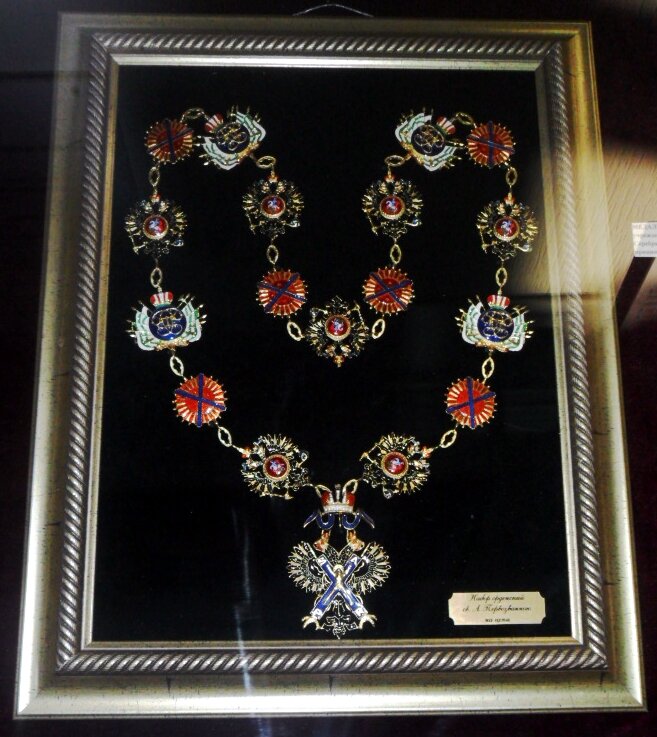
The Ashkenazi Jews are more recent settlers. They trace their ancestry back to Jewish communities in medieval Europe, particularly the Rhineland. In the mid-19th century, Russia absorbed Central Asia into its vast empire. As part of the process of colonization, affluent Central Asian traders were allowed to participate in trade corporation and a number were to perform special diplomatic and espionage missions, in addition to their commercial activity. One of these, Moses Raphailov, was a Jewish merchant from the Kashghar region (at the time Kyrgyzstan was a part of Kashgharia), who collected important strategic information for the Russian government and was subsequently awarded, in 1811, a gold medal for his “special contribution to the prosperity of the Russian Government”.
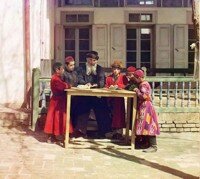
Amongst the groups that moved in the region were a number of Ashkenazi Jews who settled in the provincial cities of Karakol, Pishpek (now Bishkek), and Osh especially after the Russian Empire instituted a policy forbidding Jews to settle in villages. The Karakol community was small. In 1885 there was only one Jew recorded as living in the city, by 1900 there were fifteen and by 1910 the community had grown to thirty-one. The community in Pishpek was larger: in 1885 there were eight Jewish residents and in 1900 some 250 Jews lived in the city, although another source suggests that in 1913 there were only forty two. The largest Jewish community in the country was in Osh with, according to the 1900 census, a community of 800 Jews. The city had a Jewish Cotton factory, a Jewish bank and the Singer sewing machine The communities of Bukhanian and Ahkenazi Jews tended to live separately with the Bukharian Jews living in the old city and the Ashkenazi in the newer, European, section along with Russians and Tatars. Despite their historical associations with the region, the Bukharian Jews were seen as foreigners and were not as accepted by Kyrgyz society as the Ashkenazi Jews were.
A report by the Governor General of Turkistan in 1910 classified the Jews of Kyrgyzstan in seven categories:
- local Jews;
- Bukharan Jews who became Russian citizens;
- Jewish migrants from various parts of the Russian Empire;
- Jews who arrived in the frames of educational census;
- Bukharan and other Central Asian Jews who were not Russian citizens and had a status of temporary residents;
- Jews willing to get the status of local Jew and had asked for permission from the Tsarist authorities;
- other Jews who had temporary ‘business’ status.
The community had few institutional facilities. There were no synagogues in the country until 1915 and people would congregate in the homes of local rabbis for services. The only Jewish cemetery was in Osh although there was a Jewish section in the local Muslim cemetery in Pishpek and representatives of the hevra kadisha, (funeral association), from Kazakhstan and Uzbekistan would officiate at funerals. There were no Jewish schools, and so some Bukharian families sent their children to heder in Samarkand, whilst Ashkenazi children went to Russian schools with Jewish traditions being maintained in the family home.
There was, however, a publishing house established by a former book trader who had settled in Pishpek, Pinkas Lipshits. As well as religious literature, (mainly in Hebrew with commentaries in Yiddish or Russian), he also published works by Tolstoy, Goethe, and Shakespeare in Yiddish. There was also a newspaper, Rahamim, in Fergana and Kokand. The “Tarbut” cultural-educational association was established in Kokand, with branches all over Central Asia which ran a Yiddish theatre company. There were some gramophone recordings in existence of Sephardi Jews made in 1910.
The start of the first World War saw an influx of Ashkenazi Jews from Europe. Many of them had been exiled to the region as a result of their membership in various opposition political parties: Socialist Revolutionaries, Social Democrats, the Bund, and the Peasants Group. Also, in 1916, groups of Jewish refugees, (along with prisoners of war from the German and Austro-Hungarian armies), were sent to Kyrgyzstan to work in coalmines, irrigation projects, factories, and railroad construction. In general these new arrivals received a warm reception. The Bukharian Jews, however, were subject to the severe regulations that affected all native “non-Slavic local population”, requiring them to serve the army through manual and technical labour – which led to the popular uprising of 1916.
During the Soviet period, despite the militant atheism and anti-religious policy of the regime, Jews continued to practice their religion in secret and were able to establish a Jewish institute which founded a number of primary schools and technical colleges for the preservation of Bukharian culture, as well as several clubs. Between 1920 and 1940 the Soviets published some 750 books in Jewish languages, (which included Hebrew, Yiddish and dialects of Persian and Uzbek), and a Jewish newspaper. The community in Osh was led by Alexander Volodarsky, who had been exiled from his native Belorussia for his religious beliefs, who served as shochet and kashrut expert and managed to secure a separate Jewish section of the cemetery in Osh to replace the Jewish Cemetery that they had lost and which they were able to retain until the beginning of the Second World War.
A number of Russian Jews moved to Kyrgyzstan during the Stalinist purges of the 1930’s in order to escape persecution.
There was another large influx of refugees during the Second World War, when a wave of more than 20,000 Jewish refugees fled to the country from the Nazi-occupied western regions of the Soviet Union, (including a theatre company from Warsaw – who returned to Poland after the war ended). The majority of these immigrants were Ashkenazi Jews from Russia, Ukraine, and Poland. Those who settled in the cities and villages fared better than those who settled farming communities who were often unable to keep up with the local production quotas. Unlike their predecessors, they also faced antagonism form the locals who were suspicious of their “western capitalist background”. Several Jews were imprisoned for alleged “counter revolutionary activity” and the “spreading of lies about the bourgeois way of life.”
The war, however, resulted in a change in official Soviet policy concerning the relationship between state and religion. Religion was seen as having an important role in uniting the population against the common enemy, the Germans. In 1941, the authorities allowed the establishment of a synagogue in Frunze, (as Pishkek had been renamed in 1926), in the city centre, to be followed by synagogues in Osh and Kant. In 1945, 70 members attended daily services in the synagogue daily, 200 attended weekly services, and more than 2500 on the high holy days. The community was allowed to celebrate holidays and continue their activities until the 1950s, when another change in official policy prohibited all religious activities, apart from services on the High Holidays. Despite the new restrictions, the communities in Bishkek, Osh and Djalal Abad continued to operate.
The Jewish population in Kyrgyzstan has declined steadily since the Second World War, largely as a result of emigration to Israel – in 1990, just prior to independence, apparently more than 1000 emigrated to Israel.
The Jewish community in Bishkek continues to thrive and maintain a synagogue, a daily minyan (a congregation of 10 which is the minimum required for services), and operate a cultural/educational center, called “Menorah”, a school with approximately 70 students, and a number of social groups.
Anti Semitism is rare, although incidents sometimes occur, for example, following the revolution in April, 2011, anti Semitic placards appeared, and a home made Molotov cocktail, or pipe bomb, was thrown over the wall of the Bishkek Synagogue. One member of the community commented to a reporter from the New York based Jewish Daily Forward that “the Kyrgyz people are really warm people. What happened last year is really the first story of anti-Semitism.”
There have, however, also been some comments appearing in the press which could be said to be anti-Semitic, such as the one referred to in the introduction to this postcard.
.






 Bishkek