Naryn
Naryn, where we have a small guesthouse, is a long, thin town in the center of the country that straddles the fast flowing Naryn River and is set between high, steep cliffs.
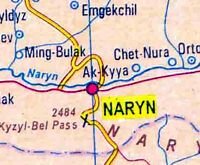 The modern town was founded in 1868 as a Russian garrison town, and much of the current town is post-war. It still houses an army base and headquarters for the customs at Torugart, one of the two border posts on the border Kyrgyzstan shares with China. In fact, Naryn is known mainly as a stopping point for travellers on the way to/from Kashgar and, unfortunately, many guidebooks published in the West are not very complimentary about the town.
Early settlements have been found in caves near the town and there are stories that suggest that the name is quite old. One picturesque Kyrgyz story tells of a herder who had sold his cattle in the Andijan region (now in Uzbekistan) and on his return, exhausted, he settled down for the night at a place called Jailoo (or “pasture”) and turned his horse free. The horse wandered and fed at a place called Arpa (which means “barley”). When the man tried to coral the horse the next day it ran away. He chased it and when he caught it he killed it and cooked its meat. He left the head behind and called the place At-Bashi (which means “Horses head”). He ate the meat along his journey and called the place where he had his last meal from the carcass Naryn – which was the name of the dish he had cooked – a sort of soup with finely cut meat. If you find these places on the map you will see that they are quite far apart – the man went a long way to sell his cattle and chased the horse for quite a distance!
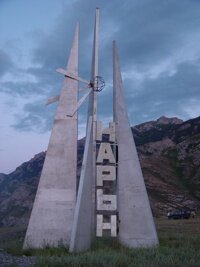
One of the City Gates, displaying the name in Cyrillic
Another source suggests that the name comes from the Mongolian word for “sunny”, and another from the Chinese for “narrow”.
Situated about 350 km from Bishkek and 200 km from the Chinese border at a height off 2800 m. a.s.l. Naryn can be very cold, especially at nights. In fact it is known as the coldest town in Kyrgyzstan and temperatures in winter have been known to fall to -40°C. The average annual temperature is -6°C. In summertime, however, the days can be very hot and dusty.
The population of the town of Naryn is about 45000, (and there about 260000 inhabitants in the whole of the Naryn oblast, or region) – most of them (99.9%) are Kyrgyz. Kyrgyz is the first language of the population and it is not unusual to find people who cannot speak Russian.
The River Naryn is the longest river in Kyrgyzstan, (535 km in length) and is in fact a river famous from antiquity. Its ancient name is the Syr-Darya and like its northern twin, the Amu-Darya, it flowed into the Aral Sea. Nowadays, extensive cotton farming in Uzbekistan absorbs most of its waters, so that the Aral Sea is drying up. It is possible to travel from the town to the source of this once famous river. Downstream, in Kyrgyzstan, the river is used extensively for hydroelectric power generation and it flows into the giant Toktogul Reservoir that you would see if you used the main Bishkek-Osh road. The river is a potential source of friction with Uzbekistan, since Kyrgyzstan wants to retain more of the water for its own uses.
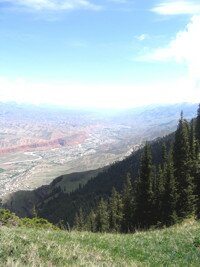
Panorama from the mountains overlooking the city
There are three main approaches to Naryn:
- From Bishkek, 10 km from the centre of town the road forks and there is a confusing road sign which has arrows indicating Naryn both to the left and to the right. The left hand fork leads to the top end of town, (Moskovskaya/Razzakova) and the right hand fork takes you the bottom end of town – dropping steeply through a chasm, which cut through the cliffs.
- The road from Torugart (At-Bashi and Tash-Rabat) descends steeply from the mountains and also brings you to the top of town.
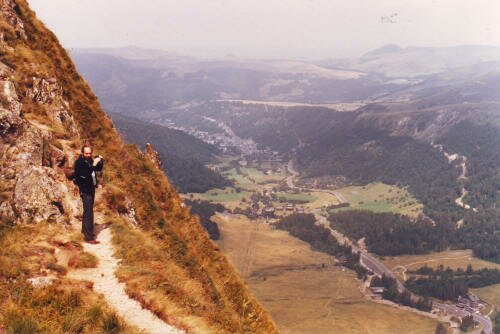
- The raod from Djalal Abad and Osh. There is a very good view of the river valley with the town in the distance a few km from the town centre.
There are also minor roads into mountain valleys and one of the most interesting takes you to Ece Naryn and the valley of the Little Naryn River, and it is possible to reach Lake Issyk Kul by this road (… but needs a 4WD vehicle – it is not a good road, and is not always open).
There is a small Museum in the town with exhibits about the history of the town; paintings of places and famous people from the Naryn region; a room containing the personal effects of Jakeev Tabaldi, a famous revolutionary who helped to build railways in Central Asia, joined the Red Army and worked for the Bolsheviks in Naryn and Issyk-Kul regions; and a room containing a number of stuffed examples of wildlife found in the Naryn region. The largest room is dedicated to examples of local Kyrgyz handicrafts – Shyrdaks, Ala-kiyis, Tush-kiyis etc. Naryn is renowned as a centre of excellence for the manufacture of Shyrdaks.
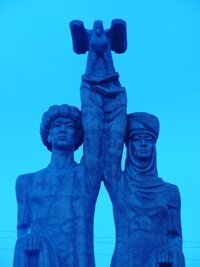
Monument in the main Square
The long main street running the length of the town is still called Ulitsa Lenina (Lenin Street) and the town’s 3 trolley buses regularly ply their way along it from one end of the town to the other. The strret passes through the main square which is still watched over by a statue of Lenin. The square was redesigned in 1999 and in the center, facing Lenin, is another statue of two young Kyrgyz, a man and a woman holding aloft an eagle.
A couple of kilometers to the West of the main square is the new mosque (finished in 1993), which was financed by Saudi Arabian money and has a distinctly Arabian design. A little further on is the town banya (sauna) – now privatized. Several houses near the riverbank also advertise saunas – utilizing naturally hot water. In the hills overlooking the Western end of the town are several ski fields that in winter are used by the locals.


 Bishkek