Statisticians’ Day
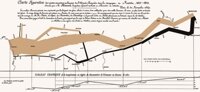
Perhaps the best Statistical graphic ever produced: Minard's map showing the progress of Napolean's Grande Armee in the advance on, and retreat from Moscow.
The last Sunday in April is Statisticians Day.
It’s another one of those “professional holidays” that seem to be so common here in Kyrgyzstan. This one seems to be particularly appropriate because it often seems that here in Kyrgyzstan, statistics are given the sort of reverence normally reserved for holy writ.
The word itself comes from the Latin, “statis“, which means the “political state” and one of the main tasks it is used for is the analysis of facts and figures for and about governments, resources and populations. Hence the official fascination with statistical results, even though many people may not be fully conversant with the underlying principles that produce them. Although Statistics provide a valuable tool, they are also open to abuse and misunderstandings, both intentional and unintentional.
One definition of Statistics is: “the science of the collection, organization, and interpretation of data”. Another states that it is the study of “ways that lots of data can be represented using a few numbers and the study of how such numbers can be chosen and used to draw reasonable conclusions about the data.” Those definitions raise a number of important issues, which I have mentioned before in other postcards. For example, taking the first definition I would add the “presentation” of data, and to the second I have concerns over what is meant by “reasonable”.
Liker most people, my involvement with, and exposure to, Statistics began at school. Of course we learned standard techniques for finding an average and graphing data, but it was only as I started to undertake my A-Levels, (University entrance level examinations, taken at 18+ in the UK), that I really began to understand what a fascinating topic it was.
My Maths teacher looked at me and said: “So, you are not taking Physics.” ”No, Sir,” I replied. ”Well, in that case we had better not enter you for the Mechanics paper … there’s an overlap between the two and studying the one would help your understanding of the other. More to the point, the other candidates would have an advantage over you, because they will almost certainly be studying Physics, so they will find the questions easier. ” At the time I didn’t understand the significance of that comment, but having worked as an examiner and attending grading meetings, I now see the wisdom it encomposed. Then he said, “You don’t want to do just Pure Maths, because that means you’ll have to delve deeper into the subject in more detail and will have no idea of the practical applications of what you are studying, so it will have to be the Statistics option. It will also fit in better with your other subjects,” (Geography and Religious Knowledge … OK, I’m not sure that it added much to my understanding of the Bible, but it did prove useful in some of the Geographical topics that we studied, and was immensely useful later when it came to studying Psychology and Sociology, not to mention my current work in trying to run a business.)
Despite the fact that Statistics was my Applied Maths Option, Statistics is considered by many to be a distinct mathematical science rather than a branch of mathematics because of its empirical roots and its focus on applications. It can be subdivided into a number of different fields such as Descriptive Statistics and Inferential Statistics, or Parametric as opposed to Non-Parametric Statistics.
It’s a fairly new branch of mathematics and is usually thought to have it’s origins in the 17th Century, with crucial concepts later being developed later by Blaise Pascal and Pierre de Fermat. In the nineteenth century it came into its own as a serious subject and the advent of computers to aid in the essential “number crunching” involved and the vast number of applications where its results can be applied have meant that it has become a ever increasingly important influence in our lives.
My study of Statistics, however, has led me two conclusions that I constantly refer to: that “I am not afraid of numbers, but I am afraid of the way that they are used” and “Statistics raise more questions than they answer“.
Disraeli is reputed to have said when describing the ever escalating costs of producing Babbage’s Analytical Engine, (a sort of prototype calculating device that is hailed as a forerunner of the computer – which, incidentally, could have been steam driven), that “there are lies, damn lies and statistics.” Most mathematicians, and in this I would include myself, feel that he may have been going a bit far when he said that, but would have a lot more sympathy with Andrew Lang, when he said, “He uses statistics as a drunken man uses a lamppost – for support rather than illumination.”
With proper and sensible use, however, Statistics can be a vital tool in raising issues, focusing attention and helping the decision making process. Without them, we would be reliant upon instinct and emotion and much more likely to find ourselves “lead up the garden path”.
Those working in the field of collection, organization, analysis and representing of data do a valuable service as “back room” boys, and deserve the recognition given to them by this “professional holiday”.
.







 Bishkek