Vladimir Ilyich Lenin … in Kyrgyzstan
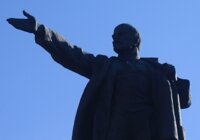
April 22nd marks the birthday of one of the major historical figures of the Twentieth Century … and one that had a considerable influence on Kyrgyzstan, even though he never set foot in the country: Vladimir Ilyich Lenin.
Lenin was born in Simbirsk (now called Ulyanovsk) in the Russian Empire in 1870 – the son of Ilya Nikolaevich and Marai Alexandovna Ulyanov. The family was of mixed ethnicity – Russian, Kalmyk (the descendants of the Oirats – a Western Mongolian people that have lived in the Eurpoean part of Russia for over 400 years), German, Jewish, Swedish and (according to at least one of his biographers) “possibly others”.
In 2007, and interesting suggestion that one of those possible “others” might well have been Kyrgyz. Apparently the claim is based upon a pencil sketch by a 19th Century Russian artists, Vasily Perova, of a Kyrgyz shepherd, Ulan, which bears an uncanny likeness to pictures of the young Vladimir Ilyich. Lenin’s family name was Ulyanov – Ulan.
Ulan, apparently drove flocks of sheep on the Volga steppes and there he met and married a young Tatar girl. They had a son, Ilya, who - according to the story – became the father of the revolutionary leader.
Even if this account is true … neither Lenin, nor the authors of the Communist Manifesto, Marx and Engels, ever visited Kyrgyzstan … however, they can still be encountered here … if only in statues and monuments.
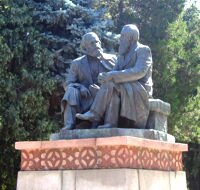
Portraits of the three of them together occur in several places – for example, they feature in a relief on one of the buildings of the Kyrgyz National University in Bishkek. Opposite the American University in Bishkek there is a statue of Marx and Engels sitting on a park bench, discussing some finer points of economics or philosophy?
During the Soviet period, the main street in every town of any size was called Lenin Street – and many towns have retained the name – although in Bishkek itself, Prospect Lenin has become Prospect Chui. Both, Karl Marx Avenue and Frederick Engels Street in Bishkek have been renamed after Kyrgyz personalities.
The Kyrgyz seem to respect Lenin to a greater extent than their CIS neighbours. His statue was still standing in the main Ala Too square in Bishkek until 2003 – when it was removed to the other side of the historical Museum – (whereas his statues were removed from the central squares of other Central Asian capitals much earlier). The majority of the other monuments to him are still preserved in the cities and towns of the Tien-Shan; many streets are still bear his name (at one time the main street in every town and village was called Leninskaya) and one of the capital’s districts is still named Leninisky.
Other effigies of Lenin can be found around the country … some in unlikely places – for example:
- In Bishkek:
- In the Historical Museum
- Outside the Polytechnic on Prospect Mir
- On the road to Almaty outside a factory
- Watching over the swimming pool behind the main Sports Palace
- In the main square or in parks in many towns and villages such as Naryn, Kochkor, Osh and Djalal Abad.
- In Djalal Abad there is a statue of Lenin sitting – like Rodin’s “The Thinker”


 Bishkek