Dehn Durakov – April Fools’ Day
When is a joke not a joke?
April Fools’ Day, (or All Fools’ Day), is not a holiday but as in many other countries around the world is celebrated on April 1st by people playing hoaxes or practical jokes on one another. Most of them are small scale, private jokes, played on immediate family, friends or work colleagues, but not all of them. There have been several famous, or infamous, examples of elaborate hoaxes played on the public which were staged by supposedly serious media outlets. I’ll mention just two early ones that I particularly remember.
Back in 1957, the flagship current affairs programme on the BBC was called Panorama and it was presented by Richard Dimbleby, a portly character whose rich deep voice was usually tuned to tacking important topics of the day or delivering the commentary on some momentous or royal event. His presence carried a particular gravitas, so when he presented an April Fool’s report which included a film clip showing agricultural workers climbing ladders to “harvest” the limp spaghetti from off the branches of the “spaghetti trees”. Dimbleby’s commentary which accompanied the film told about the “spaghetti harvest” in Switzerland and the eradication of a dreaded pest, the “spaghetti weevil”. It was taken as a serious item by many viewers, so much so, that the BBC received calls asking how to cultivate their own Spaghetti trees. (For the record, spaghetti doesn’t grow on trees but is a form of pasta made from flour and water sometimes mixed with other ingredients such as eggs and vegetable oils and extracts. The report was filmed far from Switzerland, just outside London, in St. Albans.)
Twenty years later, in 1977, the British newspaper, The Guardian, printed a seven page special supplement about a tiny Island nation called San Serrife, in the Indian Ocean, supposedly commemorating the tenth anniversary of its independence. It contained an elaborate description of the country, (location and description of the landscape, government, population, transport, culture and sport), interviews and even advertisements from major companies. The supplement was littered with puns and in-jokes, many of which played to the “intelligentsia” which goes to make up much of the newspapers readership. Even so, supplement was taken seriously with a surprising number of people later admitting how they went scurrying to their atlases to see if they could find the islands that made up the tiny state.
Although I said that I remember these two, at the time of the Panorama programme, I would have been just four years old, so I suspect that my memory dates back to watching a later discussion on the ethics of journalists presenting such joke items. How could we take them seriously and believe what they told us when they played such practical jokes on us?
A good question.
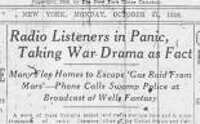
There is some doubt about whether the Mercury Theater’s notorious production of a play directed by Orson Welles based on The War of the Worlds by H. G. Wells, in October 1938, was a deliberate hoax intended to create an impression of alien invasion, or if it was legitimate drama. There is no doubt, however, that it was taken seriously by many of the listeners who heard it, (just as many seriously accepted the veracity of the April Fool’s hoaxes staged by Panorama and The Guardian).
We have a temptation to accept anything we see in the media as fact, and to treat it as “gospel”, rather than question it.
A news report often contains comment, and we should remember this. Even where it purports to be simply a factual account of events, it is will simply recount events as seen and experienced by the reporter at a given time and place. Another reporter, in a different place and at another time, might well see things differently.
For example, the first reports of the Markale mortar bombardment in 1994, (during the siege of Sarajevo in the Bosnian War), claimed that the mortar shell that landed in the market place killing 68 people and wounding 144 others, was fired from Bosnian government positions. Later analysis, however, suggested that it wasn’t possible to determine where it had come from, and later the International Criminal Tribunal for the former Yugoslavia concluded that the offending shell had, in fact, been fired by Serb forces.
Recent reports that the Pentagon has acquired software allowing it to create “phoney accounts” on social media sites and post tweets and status updates that appear to come from eye witnesses to events half way across the world in order to help shape opinion and even manipulate reaction and shape future events, has made our reliance on the media for accurate and reliable information even more tenuous. We shouldn’t surrender ourselves, our powers of logic and reasoning, our judgment, to the person making the first report on something that we happen to come across.
A healthy dose of skepticism is called for when scanning the media, whether it is: a story about spaghetti trees, strange places we have never heard of, alien invasions, luxury ocean going yachts being built in Kyrgyzstan’s Shipyards (more about that, perhaps, another time), outrages in far away places, results of supposedly scientific research (such as Blue Monday – the unhappiest day of the year), the best location for Santa to start his annual journey bearing gifts to the children of the world, hotel reviews on social media, tweets posted online purporting to report events in trouble hotspots, statistics and survey results … in short, we should question everything we see in the press, the media, or on line … even on a personal blog like this
… and especially on April 1st.
.
For the record:
It is not certain where, when or how “April Fools’ Day” originated. Amongst the various theories are:
- it referred to someone who planted their crops too early … In many pre-Christian cultures May Day, (May 1st), was celebrated as the first day of summer, and the start of the spring planting season. The term “April Fool” may well have been used to refer to someone who their crops before this date.
- it referred to someone who refused to accept the new calendar and insisted on using the old one – for example:
- someone who refused to accept the Gregorian Calendar and continued using the Julian calendar, or
- someone who refused to accept the decision of King Charles IX of France who changed the first day of the year from April 1st to January 1st,
- it was related to the story of the biblical flood and Noah’s Ark – in the account in the book of Genesis, Noah sent a raven and two doves from the Ark to find evidence that the waters had receded. The first, the raven never returned and the first dove, released a week later, returned exhausted as the waters had not yet receded. Tradition has it that it was released on the first day of the Hebrew month that corresponds with April.
- there is a possible reference to April Fools’ Day in Chaucer’s Canterbury Tales, in the Nun’s Priest’s tale, which tells a tale of two fools, (Chanticleer and the fox), which took place on March 32nd.
My favourite April Fools’ hoax is the annual washing of the lions ceremony which takes place in the Tower of London every year.
In some countries, (such as: the UK, Australia, New Zealand, Canada and South Africa), the jokes are only allowed until noon and someone who plays a trick after then is considered the “April Fool”, but elsewhere, (such as in Ireland, France, and America), the jokes can be played any time of the day.
In Kyrgyzstan:
There is no long tradition of playing jokes on April Fools’ Day, but as with so many other aspect of the modern “global village”, an idea based in one culture is often adopted by another – and it is common to find people, (especially amongst the younger generation) playing “April Fool” jokes on one another.
Some discotheques and restaurants organize special evenings to mark the date.






 Bishkek