Beware the Ides of March
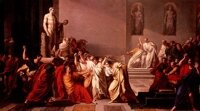
Tuesday was the “Ides of March”.
The Romans had a very strange calendar until Caesar decided to reform it in 46BC, (adding 46 extra days in order to bring it back into line with the seasons on which it was supposed to be based, and causing chaos and disruption throughout the Roman world). His reforms, however, didn’t stretch to the ancient division of the 30-day month by the kalends, nones and ides.
The kalends was the first day of the month, (probably, originally denoting the day of the new moon), and the ides were 13, (or 15 days in the case of March, May, July, and October), were probably originally associated with the full moon. The nones were probably associated with the half moon phase in the lunar cycle and occurred nine days before the ides. The other days in between had no special names and were designated by how many days it was to the next kalend, nones or ides. For example, my birthday, March 8th, would have been called “VIII ides Martius”, (8-ides, or “seven days before the ides of March”).
I’m not sure which is the most confusing, the calendar itself, or the fact that it survived and was the official dating system throughout Europe for something like two thousand years. Even though there was a more logical calendar in use in Shakespeare’s time, he could freely write “Beware the Ides of March” and expect his audience to understand the reference.
On his way the theater, Julius Caesar was supposed to have seen a seer who warned him that harm would befall him not later than the Ides of March and this incident was immortalized by William Shakespeare in his play named after the Roman oligarch when the seer intones: “Beware the ides of March”. (This line has since passed into popular culture and is used to express a sense of foreboding, of some impending calamity, doom and destruction and it is even quoted by the likes of Lisa Simpson in order to admonish “Homer the Great”, as well as serving as the title for a Postcard from Bishkek.)
According to Plutarch, on the fateful day in 44BC, Caesar heads off to a meeting of the Senate in the Theater of Pompeii and encountering the seer responds jokingly with: “Well, the Ides of March have come”, to which the seer in turn replied “Ay, they have come, but they are not gone.” Julius continues on his way and arriving at the senate is stabbed to death, (23 times), by a band of some 60-odd conspirators.
The next day, had Julius lived to see it, would have been XVII Kalends Aprilis: the first day of Bacchanalia, the wild festival in honour of the Roman god Bacchus, (or his Greek equivalent, Dionysius). Apparently, the festivities were so wild that the word has come to mean any form of drunken revelry.
Originally the festivities in the grove of Simila, (near one of the seven hills that the city encompassed), were attended only by women but the Roman menfolk were later admitted to the rites. The Roman historian Livy tells us that in 186BC the Senate acted to prohibit the celebrations as they had become the center of a wide range of crimes and political intrigue.
I suppose that the conspiracy of Brutus, Cassius and the others to assassinate their head of state was the sort of conspiracy that might have been blamed on the revelers if the Bacchanalia festivities had been permitted in 44BC.
.
Well, we’ve had more than our fair share of seers predicting doom and destruction here in Kyrgyzstan this Spring. It is said that Spring is the traditional time for protest and upheaval here in Kyrgyzstan and I suppose there is some evidence for this, even if such claims are based mainly on just the two revolutions that we have experienced in the last few years.
The incidents and movements that are rocking regimes from Tunisia and Egypt to Bahrain and Yemen are also signs of people power taking the streets are reminiscent of what we experienced last year, but they seem to be more protracted than our revolutions, which seemed to be over in the course of single day.
That’s not true, of course. The events of March 24th, 2005 and April 7th, 2010, when the White House was stormed, were simply the culmination of events which took place over several days, weeks and even months. In 2011, it didn’t even mark the conclusion of the revolution as the president, Kurmanbek Bakiev, fled the capital to his homeland in the south, which prolonged the dénouement of events.
If only it had been a one-day event, or even a nine day event, but then came the events in Maevka, Djalal Abad and Osh.
What’s more, the rumours and counter rumours of further unrest persist, suggesting that all is not over yet. Some have come from commentators and pundits in the media: in the local press, the foreign press abroad and from those working for international organizations. Others have simply circulated amongst the population as rumours. Some, however, have even come from official circles.
I am not sure if Roza Otunbaeva was aware of the significance of the date when she chose, at a press conference on this day, to respond to challenges calling for an explanation of her remarks, which she made made a month ago, about the possible escalation of the situation in the country. She said that she was particularly concerned about two areas in Kyrgyzstan: Uzgen and Karasuu. She talked about “a big panic of ethnic Uzbeks, who fear that Kyrgyz will clash with them”, adding that the people are very aggressive in Uzgen and are ready to retaliate. Another issue which was cause for concern was that of land distribution in the Osh region, where the number of applicants on the list had increased tenfold to 60,000 since the events of last June. Land distribution was the crucial issue which sparked the deadly riots back in 1990!
Some of the predictions we have seen, like those of Cassandra, (predicting the fall of the ancient city of Troy), have foreseen nothing but gloom and dark days ahead. The seer who forewarned Caesar, (unlike Cassandra), was rather vague in his warning giving Julius little idea of what to expect, but at least he gave something specific data: the date. In contrast, the prognostications that we have been treated to have sometimes been specific in both detail and date, but, fortunately, most of them have proved to be unfounded.
I am tempted to say that these predictions have become so commonplace that it seems that they almost a part of everyday life. As each date has approached, nervousness and tension have mounted, then it arrives … and then it has passed and, finally, we have been able to utter a sigh of relief as one more hurdle has been successfully negotiated and we are able to return to our normal everyday lives and concerns.
At the recent Open Meeting of the International Business Council, (IBC), one of the speakers treated us to a quotation from the American author Ursula LeGuin: “The only thing that makes life possible is permanent, intolerable uncertainty; not knowing what comes next.” The speaker pointed out that, although for is some situations such tensions might be stimulating, when it comes to business and investment they are far from welcome. Business and investment “prefer clarity and predictability”.
It’s not just business and investment that benefit from clarity and predictability. Uncertainty is destructive in many aspects of life and, in some ways, almost as destructive as if the events that are prophesied were to actually take place.
.
Fortunately, however, the Ides of March have come and gone for another year. Nothing dreadful had been predicted for this auspicious date in this particular year … and, I am glad to be able to say, nothing more calamitous took place than a sudden drop in temperature and another fall of snow.
.


 Bishkek