Defenders of the Fatherland Day
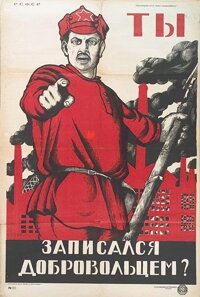
A soviet poster celebrating the Defenders of the Fatherland
Maxim spent the back end of last week busily scouring the internet for inspiration.
For homework, one of his teachers at school had given him the task of drawing a poster, (a gazeta), to commemorate February 23rd, Dehn zashitnika Otechestva, (Defenders of the Fatherland Day – otherwise known as Army Day or Men’s Day).
February 23rd used to be designated as “Army and Navy Day” in the Soviet Union. The holiday was declared as the “Birthday of the Red Army” in 1942 – and was supposed to have commemorated either (depending upon the source):an occasion in 1918 when rallies in support of the Bolshevik led Red Army took place across Russia …
A victory by the Bolshevik led Red Army over German troops near the cities of Narva (now in Estonia) in 1918, during the civil war, orthe first mass draft of young men (described by some commentators as “volunteers”) into its ranks in Moscow and Pertrograd.
It is sometimes called, “Men’s Day”- and is seen as the equivalent of March 8th, (International Women’s Day).
He found a number of images, (including a Soviet Army insignia, a picture of a soldier and a pistol), which he copied onto the sheet of A2 card that he had been given, and several jingoistic verses extolling patriotism or toasts given on that day which he printed out on the printer and duly stuck onto the card. The teacher wanted any text to be printed because, he said, people often had difficulty reading handwriting and, anyway, it looked more presentable.
Fortunately, Maxim is quite good at drawing, or at least copying drawings, so the finished product was actually quiet presentable and has found its way towards display in a prominent position in the school.
This year, the holiday has a little more significance and poignancy for Maxim, as he is now 16, (approaching 17), and has had to register with the local Voencomat – the Military Commissariat, essentially the military registration and enlistment office.
Here, military service is compulsory. When children become 16 they have to register with the Military Commissariat, (although only boys are conscripted into the Army, for a two year term). The draft is delayed whilst they are finishing school, and again if they enter higher or further education, so most are not actually drafted until the October when they are 18 and have left school. I remember on one occasion driving past a military post one October and seeing a whole host of young people standing around outside and my driver told me that they were new recruits waiting for the bus to take them to camp.
In theory, because military service is, (technically at least), compulsory the military of the country should reflect the demographics of the general population. It was a surprise, therefore when during last year’s events in the South, it was revealed that the Kyrgyz Army comprises almost entirely of ethnic Kyrgyz, with very few Uzbeks or representatives of other nationalities. This was probably the cause of much of the criticism levied against the army for alleged “bias” shown to the different communities.
In fact, not everyone is called upon to complete a term of military service
Those who go on to college, for example, don’t have to serve their two year tenure if they attend the special military training classes organized in their educational institution – a sort of Officer Training Corps, (OTC). Those in the medical academy, for example, have a special course which they all follow, and another acquaintance went to classes as an “artilleryman”.
Then there are some people who are excused service in the Army, (such as Jehovah’s Witnesses, disabled or the only son – especially when there is no father), who undertake what is called “Alternative Service”. They still have to turn up to the recruitment office on occasion and perform some tasks, usually, (as I understand it) menial tasks, and then contribute a portion of their salary for a certain period. There is come controversy about this as it is sometimes claimed that only the rich can afford this option and so those who serve come from the poorer families who cannot afford to avail themselves of this option.
There were suggestions a few years ago that Kyrgyzstan should stop conscription and create a small “professional army” recruited on a “voluntary” basis in the same way as many Western armies are recruited. Indeed, one of the questions which is quite often put to me concerns military service in the UK. I grew up just at the period when the UK ceased compulsory conscription, so I didn’t have to serve. Only one of my school friends went into the army as a volunteer. Most people, (young people that is, and their parents), seem to like the idea of a professional army of volunteers rather than compulsory conscription, but there are those, (particularly of the older generation), who do see that military service is a good thing and helps to make a “man” of their sons.
Some of the military hierarchy, however, is not too keen on the suggestion. They see military service as both promoting national pride as well as creating a body of available trained personnel that can be called upon in time of crisis.
.
After Independence in 1991, the Defenders of the Fatherland Day holiday was dropped in Kyrgyzstan, but it was reintroduced in 2002 … the rationale being, (according to one news source – Reuters), that the Kyrgyz people had reason to be grateful to the Bolsheviks for ending the genocidal policy which the Tsarist regime had embarked upon, following the events of 1916.
There are sometimes parades organized to commemorate the day, (one year the celebrations even included a Ballroom Dancing competition), however the day is usually a low-key event. Some schools organize special events, such as the poster competition that Maxim took part in, or concerts where the children sing patriotic songs and enact certain events from history.
As a public holiday, of course, it is a day off work for most people, although many shops and cafes, etc., are still open for business, and the previous working day is one hour shorter.
As the holiday is seen as “Men’s Day”, it is usual to congratulate men on the holiday. Here in the office, for example, all the female staff gathered together and held a little celebration, cake, fruit juice and a small present of toiletries, to “congratulate” their male colleagues on the holiday.





 Bishkek