Charity cooking master class
During the last few days I have been somewhat spoiled with lots of people fussing over me. Everyone has been very kind and attentive and one my neighbours has been preparing jars of compot, (boiled fruit juice), and saucepans of Chicken Soup for me. That’s one of the advantages of being ill, I suppose, but, to be honest, I would rather that it wasn’t necessary.
Compot is OK, but I get tired very quickly of Chicken Soup. A few years ago I was ill and the doctor wouldn’t let me eat anything but Chicken Soup for several weeks whilst we were waiting for the results of various tests.
Sometimes people are surprised when they hear that I don’t have a cook, but would rather cook for myself. I’m not particularly good at cooking Chicken Soup, even though it is pretty straight forward. It’s just not one of my specialities. I tend to cook things that are more spicy.
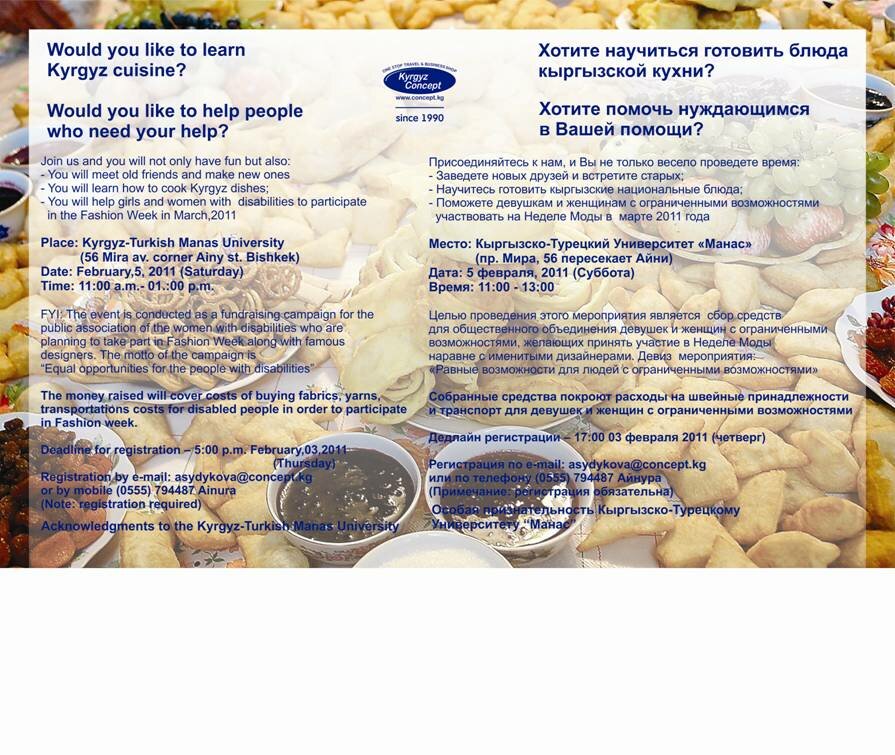
I have often thought, however, that I would like to learn to cook some of the local dishes, but never really got round to learning. I was particularly interested on Tuesday, therefore, when I received a notice about a special event being organized at one of the local universities in order to raise funds to help a group of disabled people to take part in Fashion Week in March – a special Cooking Master Class.
The Kyrgyz-Turkish Manas University has a School of Tourism and Hotel Management. It is quite a good institution and prepares students for work in the Hotel and Restaurant Industry. They run special courses for hotel and restaurant cooks and this promised to be a very interesting and useful class. The fact that it was also going to be in aid of helping disabled people was an added incentive.
Unfortunately, however, as is often the case here, the organizers didn’t give us much notice … the course takes place on Saturday and it’s necessary to sign up by Thursday evening. I don’t know how long the class has been in the planning stage, but it doesn’t seem unreasonable to ask that they give us a couple of weeks notice, so that we can plan our weekend accordingly. As it happens, I am not sure that I am going to be able to make it this weekend, so it looks like it might be another missed opportunity.
.
The event is conducted as part of a fundraising campaign for the Public Association of Women with Disabilities who are planning to take part in Fashion Week along with famous designers. Money raised will cover the cost of buying fabrics, yarns and trasnsportation costs for disabled people in order to participate in Fasion Week. The motto for the campaign is “Equal Opportunities for people with disabilities.”
.
Fashion Week is an event which is hosted a couple of times a year by Kyrgyzstan’s Garments industryin order to showcase the work of some of Kyrgyzstan’s talented Designers.
The textiles industry in Kyrgyzstan is quite an interesting aspect of the Kyrgyz economy. It has developed largely as a result of indiviual initiative, without any government encouragement or interference and with little foreign investment. Furthermore, in the first decade of the twenty-first century, it has been a success story with rapid growth in production, most of which, (estimates range from two thirds to 95%), goes as export to Russia, Kazakhstan and other neighbouring countries. It has been acquiring a good reputation in various markets – even in the high-end boutiques in Russia where it used to be sold with fake labels of foreign quality brands – something which led to an international investigation. Nowadays, however, it is just as likely to be marketed under a ”Made in Kg” label.
The industry is not exactly new to Kyrgyzstan. In the Soviet period there were several large manufacturers operating factories which turned out garments to Moscow’s orders using cotton from Uzbekistan: During the Second World War, the production of clothing in the republic made an important contribution to the overall war effort; The marble facade on the Western side of Ala Too square in Bishkek is just that – a facade, constructed to mask a clothes factory, (Ilbirs – which still operates today), and create a unified, impressive, symbolic architectural ensemble suitable for the main square in the capital of the USSR’s constituent Republics; There was, and is, a silk factory in Osh, but it is in need of modernization – the equipment dates from the Soviet period and can only produce narrow skeins of material. The collapse of the Soviet Union led to drastic falls in output and many of the workers were laid off in the economic upheavals in the following years and factories closed.
It is hard to give accurate statistics for the current state of the textiles industry because, (as in many places around the world), it is basically a cottage industry which for many years was operating largely in the Shadow Economy. The government has introduced some special reforms and initiatives in an attempt to improve transparency and bring the industry out of the “shadow” - and views differ as to how successful these has been. It is estimated that in the Bishkek region alone, approximately 35000 small companies involved in the clothing industry employ about 150,000 people – or 15% of the population – and, it is said. 10,000 sewing machines were sold in Bishkek in 2007 alone.
Despite the strength of the local industry, most of the local production, (about 95%), and the local market is dominated by imported clothing – especially from China and Turkey. The items available in local markets tend to be cheap and poor quality and counterfeit items abound. Specialist shops exist, especially in the capital, which offer better quality goods, but the costs are normally quite high – as expensive or more so than in the West.
About 80% of the exports are female garments. In particular, there are a number of fashion designers, (often specialising in combining traditional materials and styles with modern ones), and several modeling agencies that often organise fashion shows which are popular. Designers also participate in a number of trade fairs, for example in Kazakhstan, Russia and Turkey.
.
If anyone is interested and would like to participate, here’s a copy of the announcement, why not give Ainura a call and get some further details.
.




 Bishkek