Akhunbaev – Surgeon with a heart
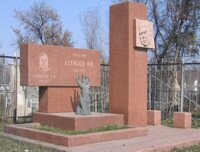
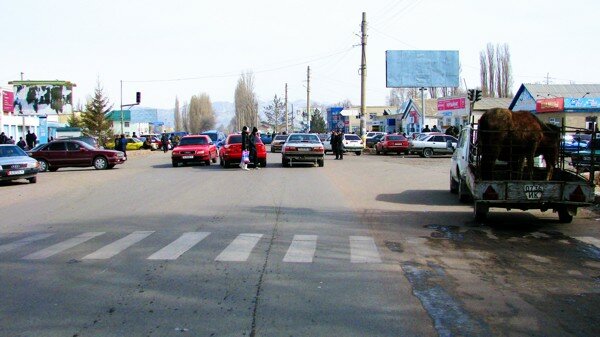
The Southern Ring road around Bishkek is named after Isa Akhunbaev, a notable Kyrgyz doctor and surgeon (who lived between 1908 and 1975). Akhunbaev is not well known today outside his native Kyrgyzstan – but he is held in very high regard amongst his own people – not only because of his achievements – but also as a role model.
He was born in the little village of Tory-Aigur, about 20 kilometers from Balykchi in Issyk Kul oblast.
He seems to have been an impressionable boy – with even small events taking on great significance in his life.
For example, serving as a shepherd boy, watching over a flock of sheep for a wealthy Kyrgyz, and there is a story that one day he was by a lake and in the still quietness he heard the waters whispering his name … “Isa … Isa …” and the question was raised : “is this the call of destiny?”.
When he was only eight years old, he and his family became refugees and fled to China as part of the Kyrgyz migration to escape the excesses of the Russian suppression of the Kyrgyz uprising which took place in 1916. In China they had a difficult life – and when they eventually returned they settled back in their native village.
He was seriously upset by the death of an old woman who had suffered a long and difficult illness. The doctors had not been able to help her and her relatives were unable to relieve in her pain and discomfort in any way. He couldn’t forget the look on her face and at nights he seemed to hear the sound of her moaning. He later ascribed his decision to become a doctor so as to be able to treat sick people down to this experience.
Walking the 20 kilometers to school each day meant an early morning start – a habit he never lost. Even as a professor, he would regularly rise at 04:00 am to prepare for his lectures and his day ahead.
Through all this he developed a strong sense of purpose and he devoted himself to his studies. It is hardly surprising, therefore, that he excelled in them. He was always seemed to be busy – never idle. However, he did take time out to meet and marry Bibikhani Bibikhan.
In 1936 he graduated from the Central Asian Medical Institute and began to work as a surgeon in Frunze, (now Bishkek). His first thesis was about childhood appendicitis, but his professional interests were wide ranging – endemic goiter, (he was instrumental in the decision to distribute iodinated salt amongst the Kyrgyz population to inhibit this malady), shock, anesthesia, reanimatology, lung and heart surgery.
He collected together a team of physicians and took them to Moscow to learn about heart surgery. The first heart operation had taken place in France in 1886 – but the practice was still very rare. In 1959, he conducted the first heart operation in a Central Asian hospital and after 12 days the patient was able to walk unaided – and told the surgeon: “You have given me a second life.”
Akuhnbaev was the first Kyrgyz to become a corresponding member of the Academy of Sciences of the USSR – and was instrumental in founding the Kyrgyz Academy of Sciences. He was well known throughout the Soviet Union and was consulted by other doctors from all over the USSR.
One particular story about him is often quoted. He and his wife were taking a holiday by lake Issyk Kul when, one day, he was taken ill and developed a fever. His temperature climbed to 39C. His wife, an experienced therapist, was very worried and it was only late at night that his temperature began to fall and he was able to sleep. Then, came a persistent knocking at the door. In a nearby village was a person who had been taken very ill and needed an operation – unfortunately there were no surgeons available. However, the locals knew that the great surgeon Akhunbaev was on vacation nearby – perhaps he could be approached to help. When he heard the story he immediately got up, despite his wife’s protests, and was driven to the neighbouring village. There he conducted an operation on the patient’s stomach and only when it was over did he relax – and faint. When the doctors administered ammonia to bring him round, his first conscious words were: “How is the patient?”, to which the medical staff replied: “Which one?”
Perhaps it is not surprising that such a man is held in such high regard by his people.




 Bishkek