Surprising winter scenes
I see from National Geographic that winter lasts for 21 years on Uranus. Thank goodness it doesn’t last that long here in Kyrgyzstan.
Last Friday, the sun was shining and the weather was warm. It made a pleasant change to the bitter, biting, wind and the frozen snow covered ground. One of my neighbours was bringing in the washing that had been hung out out to dry on the clothes line in the yard and paused to comment on the change in the weather. (It’s not just the Brits who seem to have a fixation of talking about the weather as our main topic of conversation.)
“So, Spring has finally arrived,” she said, to which I replied, “Which probably means it will snow tomorrow.” It was meant as a joke, and she took it as such. “Yes, we are in Kyrgyzstan where anything can happen,” and added something living in a topsy-turvy world.
The following day I came down to the office as usual to work on the weekly postcard, and it was dark outside. Having turned the computer on and waiting for it to “boot”, I opened the door to let the cats out into the fresh air and took a deep intake of breath myself before returning to review the draft that I had prepared the night before.
A couple of hours later, having duly dispatched the postcard, checked the email and overnight tweets and posts on Facebook, I once more rose from my chair, put the kettle on for a cup of coffee and went outside for a breath of fresh air.
I was greeted by a white carpet and a light flurry of snow. It wasn’t that cold, just hovering around zero. It wasn’t that windy. The snow wasn’t thick, but all the same, it came as a bit of a shock as just two hours earlier everything had been quiet and there was no indication of what was to come.
I recalled the previous day’s conversation and thought to myself that it was a good job that it was a good job this was the twenty-first century and not the Middle Ages, or Salem in 1692. People were burnt for less than this. (Incidentally, nobody was burnt as a witch in Salem, Massachusetts, in 1692 … they were hung.)
For the rest of the weekend, the weather was fairly mild and the snow was starting to clear, but then it started again on Sunday evening. Just a couple of centimeters but enough to create a reasonable layer of snow that required drivers to clear their windscreens manually by brushing it away rather than relying on the wipers.
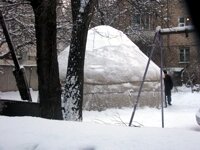
It also created quite a layer for the yurt that had been assembled in the yard during the evening.
Now, although the nomadic Kyrgyz used to live in yurts all year round, in summer and winter, in sun and snow, you don’t normally see yurts in winter these days. In fact, you don’t often see them in the city center. They are a common sight in the jailoo, (the high mountain pastures), during the summer as shepherds take their flocks up to feast on the luscious grass before returning to the lowlands again in the autumn, but in the cities they are usually erected as a dining room for a café … or to mark some special event such as a toi, (a family celebration) … or a funeral.
That was the reason this one was erected in our yard. A neighbor in the next building had passed away and the Ritual Uslugi, (the funeral directors), had been asked to erect one for the ceremonies on Monday morning,
The snow gave it a particular white colour. In their nomadic past, a white bozoi, or yurt, was a mark of wealth and importance amongst the Kyrgyz, not everyone had one. A yurt is a sort of tent with sheets of felt wrapped around a wooden lattice frame, (the kerege), topped by poles, (the auk), to support the roof, which in turn is topped by the tunduk, (the circle which is symbolized on the Kyrgyz flag). The felt would often be brown or grey as white requires special treatment and pure wool to manufacture. These days, many yurts are covered in a white material called brezent in order to weather proof the temporary construction and give it that whiteness which signifies wealth and importance.
One of the problems of felt is that it absorbs moisture and so in rain and snow it not only gets wet, it also gets heavier. As a result, on Monday morning, the workman walked round the yurt beating the snow off the roof of the yurt, but as they couldn’t reach the summit where the tunduk was it left a sort of white cap on the structure.
Monday morning was cold, -9 or -10 degrees, as a chill settled in to greet the crowd that gathered.
Normally, people are happy to see the snow … but I can understand that on this occasion, it was not a particularly happy moment.
At least we don’t have 21 years of winter.


 Bishkek