Teaching
A friend of mine was looking for work recently and came across an advert for the post of a Chemistry teacher. He asked what I thought … should he apply.
The obvious question that came to my mind was “why?” … First of all, his degree is in Restaurant Management … so why Chemistry? His answer was that he had studied Chemistry as part of his course … he really enjoyed the subject had even participated in a National Chemistry Olympiad. He felt that perhaps he had made the wrong career choice earlier in life … but at the time there hadn’t been the opportunities to enroll on a chemistry course. I must admit that, given my history, I had some sympathy with this – although I doubted if he had enough background to teach the subject.
Secondly, why did he think he could be a teacher. Some people think that teaching is easy … after all, everyone has been through school and observed many different examples of teachers at work – some successful and inspiring … others less so. Everyone seems to be an educational expert. I have even heard some tell me that “all you have to do is stand up at the front of the class and spout some facts, mark a few books and you are free to go home at four o’clock”. Put like that I suppose it does sound easy … if only that was the case.
There is a lot more to it than that, however. I remember when I first realized that simply knowing something didn’t necessarily mean that you could teach it to someone else … I was about 15 or 16 at the time and some people from church who knew that I was good at Maths, asked if I could help their son, who was about two years younger than me, because he was having difficulty. I wasn’t sure about this, mainly because we didn’t really get on … he was an only child and “very full of himself” … but I said I would have a go. I can’t remember the topic but it was something straightforward like Pythagoras – you have so know some basic facts, apply a formula and get the answer … the sums were easy, but “problems” could be a little more difficult because you had to find you way through the words to discover exactly what was going on and the words were a distraction. He couldn’t get it and at one point I exclaimed “Come on, it’s easy!” to which he replied … “It is when you know how.”
This experience was not exactly a success and I don’t think I inspired him … but it didn’t put me off. I had quite a pleasant time at school … got on well with the teachers and my peers … liked my subjects … and on the basis of this positive background and stories like “Goodbye Mr. Chips”, like so many others, I thought that teaching would be an easy career.
Once I got to college, I soon came to realize that there was a lot more to it. As well as studying my subject, developing my own skills and placing what I had already learned into a wider context, we studied the educational system and the history of it’s development, psychology and sociology (child development, socialization, how people see, how people remember, motivation …. ) and other practical skills that we would need such as educational technology (the use of duplicators, tape recorders, overhead projectors, video players and that sort of thing …); voice projection; presentation of displays, worksheets etc. To be fair, some of it seemed superfluous, like “teaching your grandmother to suck eggs” … and there were lots of things that I think we perhaps ought to have covered but never did … but I suppose they only had three years … and a lot of ground to cover.
In my three years of training I did teaching practice in three very different schools … and taught a wide variety of subjects and classes … children of various ages and abilities … one thing they all seemed to have in common was that they were totally different from what I had expected. There is no way that those three teaching practices prepared me for what was to follow … but they did provide food for thought …
My teaching career proper began in a large rural comprehensive school – on three sites so there was a fair amount of traveling to do throughout the day. I was Teacher in Charge of Religious Education … the only teacher of Religious Education, as it happened. Being the only one, however, I couldn’t take every class and there were a couple of people to help me … but basically I was left on my own devices.
The classes were not very interested in Religion … it was very much a chore and very little of what be called “traditional religion” seemed to grab their imagination. Bible stories were a real “turn off” – and I had to be very careful how I introduced them. Something with a practical element like “ethics” or “logic” sparked some discussion but the real surprise was when I introduced an element of comparative religion … they were very interested in this – especially as we based the work on a newly published book set in an inner city, multi cultural school. One of the reasons it was such a surprise was that everything was so alien … an inner city school – but we were in a rural community; multi-cultural – when the one we were in was mono-cultural, Christian. The only thing they had in common with the characters in the book was their ages.
I also had some Maths classes and because I saw them several times instead of just once a week, I got to them much better than the other classes.
It wasn’t all classroom based … one of my tasks was to organize the school’s big charity event … one of the Senior teachers was a great supporter of Christian Aid and every year they had a big fund raising effort for the organization … one year I was given the job of supervising the stage lighting for school productions … not that I really knew anything about the subject and had to do a lot of rapid learning … but, fortunately there was a pool of talented sixth formers who knew a lot more about it than I did and were quite happy to get on with it.
There were several incidents which stick in my mind from this time. One involved a pupil who wrote an essay for me. It was his first piece of written work for me and when I handed it back I said that there was one point I didn’t understand … to which he replied, “Oh, so you did read it then?” Pardon? Apparently he would often write a bit of gobbledygook, nonsense, somewhere in the middle to see if the teacher actually read it. It seems I had passed with flying colours.
In another I did not do so well. A pupil stayed behind after the end of a lesson and told me a sad and disturbing story. His grandmother had died recently and had returned and was haunting him. They held conversations. These events were accompanied by flashing lights. I didn’t know what to say … I felt very uncomfortable … I “passed the buck” and told him to talk to the local vicar as he knew the grandmother and would be able to advise him what to do. To this day I am still uncomfortable about this … and I still don’t know what I should have done, what else I could have done. The disturbing thing about this story, however, took place several years later … when I went on a course about “Dealing with Loss” … that is bereavement. There panels of sociologists and psychiatrists and when I told the story, hoping, expecting to get some helpful advice … they burst out laughing. To be fair … I think they were just as surprised, shocked and as much at a loss as I was … but it didn’t make me feel any better.
The Headteacher of the school had a basic rule of thumb … the first year a teacher worked in the school, especially if they were a probationary teacher like me, (that is they were newly qualified and new to teaching), then they were basically “taking” from the school – gaining experience and additional “on the job training”. Everything is a new experience. During the Second year its a case of “fifty-fifty” … they are still learning, but they are also putting into practice that they learned in the first year. By the time they get to the third year, they are “giving back” to the school. Now, it seemed to me, (and still does), that that’s a bit crude, but there is a lot of truth in it and it makes a lot sense in a school situation where there is a clear annual cycle. Anyway, I did my three years and and then felt that it was time to move on … so I started looking around for the next step in my career.
I applied for a job in London … returning to my “first love”, Mathematics. In fact, I didn’t get the job … at the interview we were told that someone else had been appointed, but “it was a close decision and thanks for applying”. So, I got quite a surprise a few days later when I got a phone call saying that the successful applicant had to withdraw and asking if I was still interested in the job. Yes, I was, and so moved to London where I was to stay for the next seventeen years.
Having been, nominally at least, my own boss as “Teacher in charge of Religious Education”, I now joined the rank and file as ordinary classroom teacher. I had fewer groups to get to know, (as an Religious Studies teacher I saw about 300 pupils every week … and it was difficult to learn all their names, but now I was down to about half that, which was a lot easier), and I was teaching a subject which, even if it wasn’t popular with everyone, was thought to be useful and not just a “necessary chore”, a statutory obligation. I got on well with the classes – although, yes, there were “ups and downs”.
Although it was a city school, it was suburban rather than an inner-city school. It was multi-cultural with large Jewish, Cypriot, (both Greek and Turkish), and Asian communities. Most of the time these groups got on well together – although, particularly in my early years, there was a sizeable group of “skinheads” under the influence of the National Front.
The “three year rule” seemed to come into play once more … no, I wasn’t really looking for a new job, but one came along. This time, I didn’t have to apply – it was offered to me. The funny thing is that I probably wouldn’t have applied for it. As it happened, the second in the Department got a job as Head of Maths in another school and so there was a vacancy. I assumed that the second in the department ought to be someone with, at least, a Maths degree – but, fortunately for me, the Head of Department and the Headteacher didn’t seem to agree. Now, when you are offered promotion like this, it is difficult to turn it down – and I didn’t.
I was fortunate in that I that there was a Statistics class that needed a teacher … now Statistics was my applied option … so I was asked to take it. A short while later I was asked by the local technical college to teach Statistics to an adult education evening class. I wouldn’t say that I was in “seventh heaven” but I was beginning to feel that I had “landed on my feet”.
The next big move came when yet another teacher moved on … she taught one of the two computing classes, and as they were timetabled at the same time, the other teacher couldn’t take it over, so someone else was needed. You’ve guessed it … I was asked. Now, up to this point I knew nothing about computers. My “computing” experiences were limited to log tables, slide rule, hand operated, rotary, mechanical calculating machines and simple electronic calculators. I had the summer to prepare, so I took home a set of text books and worked through them during the summer holidays. It wasn’t much of a grounding, but it was before the days of microcomputers … and I got away with it.
Practical work at that time involved writing programs on sheets of paper and sending these “coding sheets” off to the local technical college, where they were types into a terminal and we received the results a few days later. They rarely ever worked first time, so even a simple program often took several weeks to complete. We then got a terminal installed in the school which speeded the process up – but it was with the introduction of the RM380Z microcomputer that things really started to take off. At first we worked with just one microcomputer – but the BBC launched a special educational programme complete with a specially designed, affordable, microcomputer. The Head saw the adverts for the special, limited offer, and decided to spend what little spare cash the school had to buy some … and things started to move rapidly.
Now, he was even less technically minded than I was – but he saw the future coming … and I congratulate him for that.
As a result we put together a programme – a pioneering programme. Up until that point, Computing was always seen as a specialist subject – very much maths-orientated with lots of programming … not much in terms of word processing, spreadsheets, design, etc. We talked about a new kind of course and I drew up a proposal for Computer Awareness course to be taught to all pupils … not computer studies or computer science but concentrating on the use of computers. No-one else in the neighbourhood was offering similar courses. We were pioneers, pathfinders. He asked me to become Head of Computing and introduce the course- and that’s I got my second promotion.
I am amazed when I think back at what we were able to achieve with so little … to start with just one room with ten simple computers which were in use from 7:30 in the morning until 5:50, or later in the evening. Later we got a suite of three rooms with PC’s but they were still very basic. They were heady days.
There is a phrase in English that describes the ennui that occurs in the course of a relationship: “the seven year itch”. Apparently, after seven years the partners in a relationship feel the drive to seek new openings, new opportunities. At Ashmole it took, not seven years, but seventeen. To be honest, I was beginning to feel jaded and in need of a change. The opportunity came when my friend Tony offered me the chance to come to Kyrgyzstan. He suggested a year would be sufficient to open an office … and I was tempted. When I was at college the James commission suggested that teachers should be offered the chance to undertake a sabbatical once every seven years, (another example of the seven year itch?), and I thought then that it was a good idea. It would enable teachers to take a break, catch up on ideas and theories that would help them to make their teaching more relevant and practical … I still think that. However, the option was never implemented and to come to Kyrgyzstan would have meant giving up my job and a career that I had invested much over the years to develop. For this reason, I wasn’t very keen. The crucial point came when the school said that they would grant me a sabbatical … they would appoint a temporary replacement for the year and keep my job available for me … even if I decided not to come back to the UK and they would have to find a permanent replacement. After seventeen years in one school, even if my role had changed several times, I was suffering from fatigue and in search of new and different challenges. It seemed too good a chance to miss.
To be fair, I thought I would return to the UK and to teaching … but as it turned out … I ended up staying here longer than planned, (“the best laid plans of mice and men …” … and all that!).
I ended up staying and giving up a career that had meant much to me. On the other hand that same career had also given me much and taught me much. It was to be extremely useful to me in my time in Kyrgyzstan.
However, my career in formal education did not end with my move to Kyrgyzstan … I have maintained links with training and occasionally give lectures or conduct seminars on a variety of courses … and I feel that sometimes I still have a contribution to offer in this field and my experience as a practitioner is an invaluable element to this.





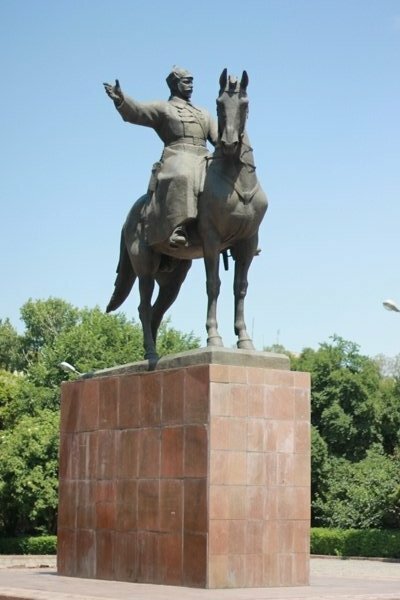
 Bishkek