Studying Theology
Several years ago there was a draft law “On Tourism” proposed for the Kyrgyz Republic. Fortunately, it was never adopted. Why do I say “fortunately”? Well, there were several reasons, including the fact that one of the measure it included was to require that the Director of a Tour Company had to:
- be a citizen of the Kyrgyz Republic,
- have a degree in Tourism, and
- have at least three years experience in tourism.
Under this provision I couldn’t be the director of the Celestial Mountains Tour Company. Although I satisfy the third of these conditions … the company was established in 1997, and so I have over ten years experience … but I fall foul of the other two. I do have official Residence status here in Kyrgyzstan – but my passport is of “a different colour” … I am not a Kyrgyz citizen. Also my degree is not in tourism, it’s in Theology and the Psychology of Education. I also have a postgraduate diploma, but that’s in Mathematical Education … and so wouldn’t help. Neither would the fact that I taught the IT units on a Tourism and Leisure vocational course back in the UK …
For the record … in 2009 there was another draft law proposed – and it included the same provision. The law was passed by the Parliament – but vetoed by the President in the face of opposition from the industry, and sent back with the instruction to revise it.
Most people are surprised to learn that I have a degree in Theology, (and the Psychology of Education!). Indeed, I think it was a surprise to everyone at the time – my friends and family included. We weren’t a particularly religious family. My parents, like most English people of their generation, were nominally Christians and would probably have answered “C of E”, (Church of England, Anglican or what is known in the US as Episcopalian), on any form that asked for their religion.
 These days I don’t normally talk much about Religion (and despite the name of this page, I am not going to now), but that wasn’t always the case. It might seem odd for someone with a degree in Theology, but I tend to agree with the old adage that there are three things that you don’t discuss in “polite conversation”: Sex, Politics and Religion … they are private matters, between a man and his lover, the ballot box, and his god.
When I was growing up, on the other hand, I took a lively interest in religion. It was a major part of my life. So much so that I wanted to become, (indeed, I planned to become), a Minister in the church. Looking back at it now, with the benefit of hindsight, it seems to me that a lot of it was social … rather than a question of conviction. There was no dramatic conversion, no “Damascus Road” experience, no “blinding lights” … but then again, not every believer has such an experience. Like many others, I sort of “drifted” into the church – and then out again … “a backslider”.
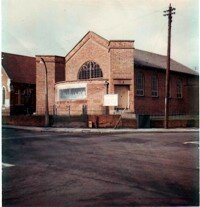
It started when I started attending the Sunday School at the local Salvation Army and then, later, at the Methodist Church, then the local Crusaders Group and finally Bible Classes at the local Gospel Hall … I don’t think I ever attended all four on one day, but my Sundays were pretty busy.
Basically I was taken along at first by one of my friends, but when they “dropped out”, I didn’t. The “classes” got smaller as more and more people stopped coming and soon I was one of the few left. The others all seemed to belong to families which were firm members of the church and so were like “conscripts”, whereas I stood out as a “volunteer”. I got more and more involved in Church affairs on an informal basis and eventually asked the Minister if I could join the church as a member. He was delighted and probably jumped the gun a little – instead of explaining everything to me and making sure that I understood and was ready he sort of rushed the decision and pushed the process through. The next thing I know, I am a member.
“Membership has its privileges” as the advertising slogan put it … but it also carries responsibilities and obligations. Was I ready to accept those? Looking back on it now I think that I can probably, honestly, say “No”, but at the time I felt ready. I didn’t, however, accept everything I was told blindly. Like the early Methodists I was very much a “freethinker”. I created quite a stir, for example, amongst members of the church, (who are traditionally teetotallers), when I took a summer job as a barman in a local pub. What was wrong with that? – didn’t Jesus turn water into wine at a wedding? – is the wine an important part of the communion ritual? The problem wasn’t alcohol in itself, it lay in the abuse of alcohol. Surely it was better to drink alcohol in the controlled situation of a public house, served by a barman than at home where there were no social controls.
Perhaps, however, I was a little too ready to accept what I was learning … to take things on trust, as a matter of faith. In life you have to take some things on trust … or faith … and perhaps, looking back with hindsight, I did take too much on trust without asking enough questions and analyzing the stories, accounts and precepts.
After a while I felt ready to take the next step – I really felt that I wanted to work in the church. So I asked the question about how I should set about it, and once again I found doors being opened for me … I didn’t feel that I was being rushed into something, but I was being “carried along with the tide”.
Finally, someone gave me some advice which seemed sensible. Our Minister had retired and his replacement was a young man, with a young wife who didn’t really see herself as a wife of the Manse. Most of the people in the church were a lot older than them and, to be fair, she, in particular, didn’t fit in. I don’t think it was anyone’s fault – indeed, it might just have been a mismatch … if he had been assigned to an inner city church, then I think they would both felt much happier. They would have felt that they were making a real difference rather than being tucked away in some backwater. Eventually, he decided that perhaps he had made a mistake and decided to resign … not just from his post as our Minister, but from the Church as a whole. It was a blow. I was shocked, but it was pointed out to me that I was also young and who knows what the future might bring. Instead of deciding to go to Theological College, perhaps I should think like an actor who always has a second string to his bow for when he is “resting” … that is – when he doesn’t have an acting job … a role to perform on stage.
I knew that this was good advice – as I have said elsewhere, I don’t believe in closing doors until you have to … so I looked around and chose teaching as a suitable “second” career. As things turned out, it was to end up being my main vocation for most of my life – sometimes, I think, even today when I am running a tour business.
The “backsliding” started after I left home to go to college. I had chosen my college for several reasons, including:
- it was not far from home,
- it was a Methodist college, and
- it offered me the opportunity to continue my studies in my two “favoured” subjects … Religion and Mathematics.
The Theology lectures I attended, however, started to raise more and more questions in my mind, as did the new subjects that I encountered, such as Psychology and Sociology … and what I was learning in Mathematics gave me the analytical tools to tackle, (although not necessarily to answer), those questions. I didn’t like the answers that I felt I was being drawn towards … and I started to wonder if I had, indeed, made a mistake. I then made a fateful decision, on purely emotional grounds, that I needed to take a breather … I needed to think things through for myself before I took an irrevocable step.
I wrote to my Superintendent Minister at home and explained the situation. I can imagine the shockwave that letter created – I felt some of the ripples sixty five miles away – a much bigger shockwave than my being a Methodist barman.
I wasn’t ready to leave the church at that time … I still felt that I believed … but I felt that I didn’t have (and I don’t have today) the conviction and certainty that I used to have – and that I felt I needed to have in order to become a Minister. So, I stopped attending church several times every Sunday … but not altogether … Slowly, however, I drifted away from the church. My membership lapsed and if anyone asks me now, I tend to say I am agnostic about religion … perhaps, veering towards atheism.
I was once asked whether I felt, as things eventually turned out, if I felt that I had wasted my time in University studying Theology. The answer is no, emphatically, NO. I learned a lot in that time – about the culture in which I grew up (- just think about how much of the music, art, history and literature is tied up in religion), about ethics, about people and how to deal with them and, of course, about myself.
It’s part of me. It helped to make me who I am, and what I am.





 Bishkek