Forgiveness Sunday
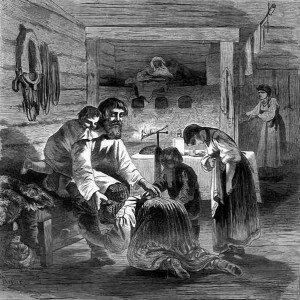
Forgiveness Sunday by the 19th century Russian artist K. Kryzhanovsky.
There is a saying that “to err is human; to forgive divine“.
It come’s from Alexander Pope’s lengthy poem An Essay of Criticism, written in 1709, (which is also the source of several other epithets, such as: “a little learning is a dangerous thing” and “fools rush in where angels fear to tread”).
It is easy to think that Pope is talking about God, that it is the prerogative of the Divine Being to forgive (… and, thus, presumptuous of humans to abrogate this privilege …) but, rather, he is talking about people making mistakes, or doing wrong … we all make mistakes – it’s a part of being human … and our reactions when that happens.
He is actually writing about writers and the critics that judge the worth of what they have have written. Some authors are good writer and convey a lot of sense in their work, whereas others may be poor writers and their work of questionable merit … but whereas the reaction of the critics may be fair and just, there were many who can be vitriolic and iniquitous, unreasonable and unmerited.
The first phrase from the quotation is, basically, saying that we all make mistakes, it’s human nature, a part of being human … and, as such, inevitable that people will make mistakes and do things that wrong others … that wrong us … at some time. Sometimes the wrong will be deliberate … at others it may be unintentional, perhaps a form of ‘collateral damage’.
How we react when this happens is the subject of the second phrase … do we submit to our human nature … or try to rise above it.
Forgiveness is the deliberate decision to try and rise above the natural inclinations and feelings of anger and resentment at some wrong that has been done, our basic instincts to seek revenge and the urge to hold a grudge. It does not necessarily mean, however, that the wrong will be forgotten and that the feelings will dissipate or that justice will not be sought – but that the person who has been wronged will try to come to terms with these feelings and strive to ‘wipe the slate clean’, ‘make a fresh start’ and restore a relationship.
It can be hard to achieve … in many ways it is easier and seems more natural – even ‘just’ – to allow our emotions and feelings to take control of us … and our relationships with others.
Indeed, although it’s not really in keeping with Pope’s sentiments (and I am not sure to what extent I agree with it), there is another saying that, in fact, Forgiveness is the best form of revenge … whereas it is easy to take revenge (whether it be ‘an eye for an eye’ or whatever scale is used), and equalizes both victim and wrongdoer … but forgiveness is hard to do … allowing the victim to assume the ‘higher ground’ whilst subjecting the wrongdoer to suffer a humiliation.
Now, today happens to be Voskresen’iye Provody – Forgiveness Sunday in the Orthodox Church.
It’s always the seventh Sunday before Easter (Orthodox Easter, that is), and so the date varies from year to year, (because it is based on the timing of Easter, which is the result a rather complicated formula involving the first New Moon after the Spring Solstice) … and, this year, Easter will fall on Sunday, May 1st. Counting backwards from Easter, we arrive at the date for Forgiveness Sunday, which will fall on March 13th.
It is also the last day of Maslenitsa – the ‘holiday’ and some of the practices surrounding it, are very old (indeed it is said that it might be the oldest Russian ‘holiday’ dating back to the ****** … ), and have pagan overtones … involving a straw man, dressed in women’s clothes, songs and dances … not to mention the pancakes.
… and … the day before Orthodox Lent begins …
… although, to be precise, in the Orthodox Calendar, the day runs from sunset to sunset … and so Lent actually begins at sundown on the Sunday …
One of the main features of Lent is the practice of Fasting … and there are complicated rules about what the faithful (or, at least, those who decide to keep post – the fast) are allowed to consume and what they are supposed abstain from eating … throughout the period fish, wine, and olive oil will be allowed only on certain days. As this Sunday is the last day before Easter when they can partake of dairy produce, it is sometimes called Cheesefare Sunday.
.
At the evening service, Vespers, the liturgy revolves around
… the expulsion of Adam and Eve from paradise for disobedience and intemperance, the loss of innocent blissful state worthy of tears … and …
… a reading from the Gospel of St. Matthew, (Chapter 6 verses 14-21), a part of the Sermon on the Mount which includes Jesus’s teaching about fasting and forgiveness so that they enter the season of the fast, Lent, forgiving one another so that God will forgive them … about fasting … and the gathering of celestial treasures:
For if ye forgive men their trespasses, your heavenly Father will also forgive you: But if ye forgive not men their trespasses, neither will your Father forgive your trespasses.
Moreover when ye fast, be not, as the hypocrites, of a sad countenance: for they disfigure their faces, that they may appear unto men to fast. Verily I say unto you, They have their reward. But thou, when thou fastest, anoint thine head, and wash thy face; That thou appear not unto men to fast, but unto thy Father which is in secret: and thy Father, which seeth in secret, shall reward thee openly.
Lay not up for yourselves treasures upon earth, where moth and rust doth corrupt, and where thieves break through and steal: But lay up for yourselves treasures in heaven, where neither moth nor rust doth corrupt, and where thieves do not break through nor steal: For where your treasure is, there will your heart be also.
Based on this Gospel reading, the custom has evolved whereby the faithful ask one another for forgiveness for their sins or wrongdoings, both those that were deliberately committed and any unknown offenses that may have been committed … , and of taking all possible measures to reconcile themselves with those with whom they are ‘at odds’.

Orthodox clergy prostrating themselves before the analogion , making confession and asking for forgiveness as part of the Vespers service on Forgiveness Sunday. Photo: pravoslavie.ru
The priests will make a poklon – a bow – or kneel and ask each other for forgiveness for any wrongs they may have committed, intentionally or otherwise … and then turn to the congregation with the same request. Then all the faithful, will approach the ambon – a raised platform from which the scriptures are read and prayers are led – and prostrate themselves before the analogion – a lectern bearing a holy icon – or bowing to each other and ask for forgiveness, “”Forgive me, a sinner” and in response will say “God will forgive you”.
I am not sure what Martin Luther and the other Protestant founders would make of this … given that absolution (and, in particular) the sale of indulgences were among the prime causes of the Reformation … although there is a difference in that, (at least, in theory), they are granting forgiveness in their own right and not in the name of the of the Almighty … and not in exchange for riches.
The idea being that the congregation can enter Lent with a pure heart and soul, reconciled with each other.
The next day, the first day of Lent, was known as Clean Monday … because, the day before, everyone had cleansed themselves … confessed their sins, asked for forgiveness and started a ‘new slate’.


 Bishkek