Canidae:- Dogs, Wolves and Jackals … and Dholes
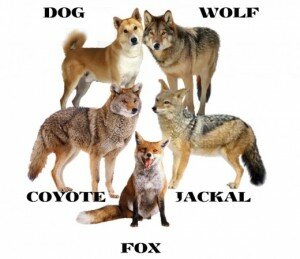
Canidae – The Coyote (a native of North and Central America) is the only one not found in Kyrgyzstan.
The internet is full of pages, photos and videos of cats and dogs … most of them looking ‘cute and cuddly’ or doing ‘adorably cute’ things. I admit, of course, that I have added to that with stories of my cats … and a couple of years ago, I wrote a postcard about Felis Kyrgyzstanus – Kyrgyzstan’s cats … so decided that, perhaps, it is about time I dedicated a postcard to Canis Kyrgyzstanus – Kyrgyzstan’s dogs.
I don’t mean the ‘stray dogs’ that are so often in the news these days … as a result of the authorities policy of shooting them because of the public unease at their numbers, sometimes aggressive behaviour or the health risks that they pose.
Although the biological family of Canidae includes domestic dogs (especially the Taigan – the Kyrgyz Borzoi), it also encompasses wolves, foxes, jackals, dingoes, and many other ‘dog-like’ mammals.
In particular, here in Kyrgyzstan we have the Grey Wolf, the Golden Jackal, the Dhole, the Red and Corsac Foxes.
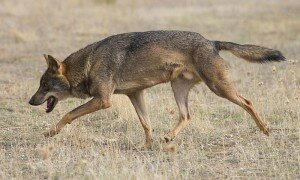
Canis Lupus- Wolf
The Grey Wolf, Canis lupus, is a relatively big animal (measuring anything from one to one and half meters long) which is found in various environs around Kyrgyzstan; in cultivated landscapes as well as in more remote valleys and in the high mountains. In the summer months they are likely to be concentrated in forests and sub-alpine zones where they feed on wild prey which they hunt and catch … but in Winter they migrate to where food, (for example, livestock, which is why they are seen as a considerable threat to people’s livelihoods), is more readily available. In particularly cold winters they have known to cross the border into Kyrgyzstan’s Northern lowlands from neighbouring Kazakhstan.
Physically, they have a thick neck and broad head. Although it is called the Grey Wolf, its colouring is a mix of grey and brown – particularly on the back and shoulders – and the ears are usually marked by clear black edges. Although wolves have five toes, only four appear in the tracks … making them appear like those of a large dog.
In the natural, they are a social animal, but persecution, (they are as a severe threat to animal livestock), they tend to be wary and shy – especially around man. They tend to be nocturnal.
A litter normally consists of about five cubs.
It’s thought that there are up to about 5000 specimen living in Kyrgyzstan.
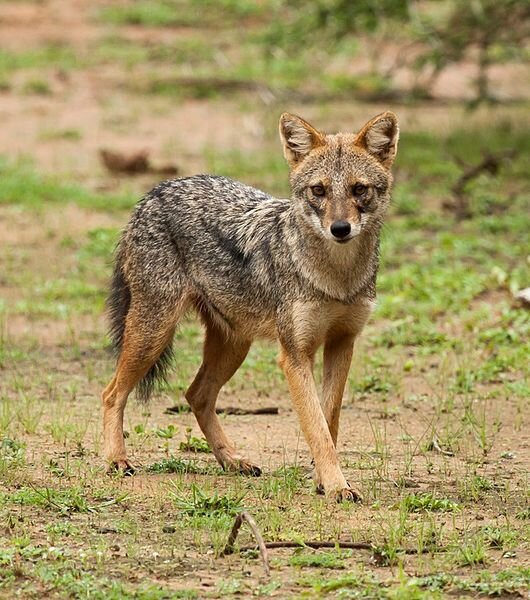
Canis Arueus – The Golden Jackal
The Golden Jackal, Canis aureus, is smaller, (measuring between 60 and 100 centimeters), more slender, with shorter legs than the Grey wolf, and it has a shorter tail which can look as if it has been cut off. Like the wolf, however, it is also sociable, living in small groups, and is generally nocturnal.
Although it is called the Golden Jackel, it sports a reddish grey coloured coat (with reddish spots) and pale red ears.
For habitat, it prefers open landscapes, reed beds, marchland and farmland rather than the mountains. so it is generally found in the lower parts of the country, (the Chui, Talas and Ferghana valleys). In fact, it was once thought that they had disappeared from Kyrgyzstan in the 1940s and 50’s, but in the severe winter of 1969 they were observed once more in Northern Kyrgyzstan – and in the 1970’s even in the Issyk Kul depression … and in more recent years there is evidence which suggests that there seems to have been a resurgence in the population in the Sary Chelek area.
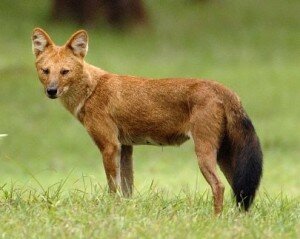
The Dhole – Canis Alpinus
The Dhole, Cuon alpinus, (also known as the Asiatic wild dog, the Indian wild dog, whistling dog, red wolf, red dog, and mountain wolf). is a large animal, (about a meter in length and looking like a large fox) with a large and fluffy tail, (which can account for half of the animal’s body length). Its back, neck and ears tend to be reddish, (perhaps with brown spots), but it also has black hairs on its back, whilst the throat, chest, sides and upper parts of the legs tend to be lighter in colour.
Now, they are normally found in South East Asia and the Far East although it is thought that they used range throughout Eastern Asia and the first description of the animal dates from the end of the eighteenth century – from Eastern Russia. The Dhole is listed by the IUCN in the Red Data Book as an endangered species, (it’s thought that there may only be something like 2500 adults left globally), and to be honest, it looks as if the Dhole has disappeared from Kyrgyzstan – especially as there been no reliable evidence of sightings since before the 1930s. On the other hand, they are known to be able to travel distances and to follow large herds of wild sheep and goats that are found in the Pamir and Tien Shan.
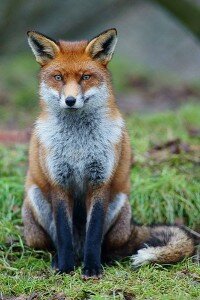
Red Fox
The Red Fox, Vulpes vulpes, is quite a large animal with a long body, (measuring between 60 and 100 centimeters), short legs, pointed ears and a long tail which is about half its body length. It usually sports a reddish brown coat and the tail has a white tip.
It lives in holes in the ground – usually with several entrances and exits. Although it is mainly a nocturnal animal, it is sometimes to be seen in daylight.
The Red Fox is by far the most common type of fox globally and in Kyrgyzstan inhabits forest regions up to an altitude of about 3500 meters but also needs open meadows – especially for hunting … it will hunt almost anything, but seems to prefer smaller prey such as chickens, goats or roe deer. I can be found throughout the country, one subspecies preferring high mountain areas and another the foothills, valleys and steppe regions.
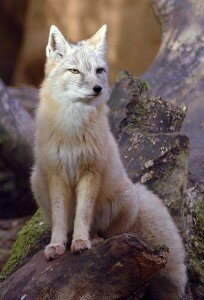
Corsac Fox
The Corsac fox, Vulpes corsac, is smaller than its cousin the Red Fox, (measuring about half a meter in length), and it is coloured differently – reddish with a greyish tint instead of black – except for the tip of the tail, which is black.
It prefers steppe land rather than mountains and was common in neighbouring Kazakhstan, and used to be found in the Chui and Talas valleys (and occasionally in the Ferghana valley), but it has not been seen recently and it’s not known whether there are any specimens left in the country.




 Bishkek