More stories to tell
It’s odd that in these days of the internet and Information and Communication Technologies, with i-pods, i-phones and i-pads, Blackberries and Bluetooth, the printed word is still in many respects the preferred version of many people when handling documents.
Last week I wrote about an Oral History Project, run as part of a journalism course at one of the local universities – Everyone has a story to tell. Having come across it by accident, I “tweeted” about it on Twitter, posted an entry on my Facebook Wall, mentioned it in the weekly Postcard newsletter as well as writing a separate postcard going into more detail about the idea of Oral History. I wasn’t really expecting anyone to follow it up. I was just really impressed by the project that I wanted to share the news. So, it came as a surprise that amongst the feedback I received this week, there were several comments about how interesting some people found the project. One person was so taken that he even ordered the book from Amazon.
My first thought was similar to my reaction when I saw that they had published a book. If everything is available on the internet – why bother with the book?
Although the internet resource may be “free” whilst the book costs money, there are advant6ages to the book. It’s a complete package, for example. It’s not necessary, for example, to go clicking on links and downloading pages … which takes time, and it’s easy to get lost and miss a link on a site. You can only read it when you’re on-line, unless you happen to download the pages and then copy it into something like Word – which involves an awful lot more work. Some people don’t like reading off a screen – and I, for one, am certain that this is something that has helped to make my eyesight deteriorate from the 20-20 vision that I used to enjoy. A printed version can be taken anywhere with you – to read on a journey, when waiting to be served in the bank, when stuck in a hotel without internet access, when sitting in the park or when lying in bed about to “drop off”. (Now you know where I do most of my reading!) I know this is sacrilege, but it is possible to personalize the text: underline or highlight points or make notes in the margins … something that is not so easy on-line.
Then again, a book is with you “forever” whereas a website can go off-line if the webmaster doesn’t keep up the registration, or decides it’s not worth keeping for some reason. In five years time, unless you’ve thrown the book away, given it away, it’s been stolen or burned, you can still take it down off the shelf and thumb through it.
So, I understand why he decided to buy the book instead of relying on the website.
During the week I came across a similar project. Similar, that is, in that it was a research project that involved interviewing about 30 people and then transcribing the interviews. It’s also available on the internet, but as the printed version had a print-run of just 35 copies, (yes, that’s right – it’s not a typing error – thirty five copies), I don’t suppose that Amazon will be interested in featuring it. Fortunately, it’s available for download in a pdf format!
Well, if those were the similarities, what were the differences? Well, this one was not conducted by a group of students as part of a course. It was performed by the staff and volunteers of a Public Association – a Non Governmental Organization (an NGO). There were only three of them: One was a professional psychologist, another was a “communications specialist” and the third an Assistant of Empowerment and Education” – but don’t let those titles put you off. They devised the project themselves rather than relying on tried and tested resources, (like release forms – although they might well have used some), developed by other projects. The interviewees are not named but there is plenty of information about them – but not so that can be identified, confidentiality was a key element in the survey … for reasons which will become obvious. The transcripts are not presented as a whole, but excerpts are cited in thematic “chapters” to illustrate a general point. In fact, the main body of the project report comprises almost entirely of quotations grouped together with introductory comments.
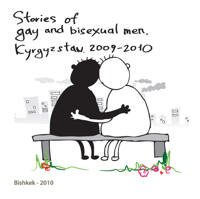
The report is titled: “Stories of gay and bisexual men. Kyrgyzstan. 2009-2010”
The NGO is called Labrys – named after the double headed axe that the Amazons were supposed to have used as their main weapon and which has been adopted by lesbians as symbol of power and independence. Despite this, it’s not just an organization for lesbians – as this survey shows, but addresses issues related to Gay, Lesbian, Bisexual and Transgender (LGBT) people in Kyrgyzstan in general. Their vision is a society in Kyrgyzstan in which everyone has equal rights and opportunities regardless of their sexual orientation and practices, race, nationality, age, gender and sexual identity, religion and social status. Their objective is to strengthen the capacity of LGBT people in Kyrgyzstan, to enable them to protect and guarantee the realization of their rights
The quotations, comments and statistics are aimed to show that the interviewees are ordinary people … with hopes and fears, ambitions and anxieties, dreams and nightmares. The report follows from a simple description of the families in which these men grew up; their schooling and further study; their work, their sexual self awakening and first sexual experiences – there is nothing lewd or pornographic in what they say, although some it may raise a few eyebrows, especially here; their relationships with family, friends and co-workers – especially if they were “found out”; the potential violence he faced and he dealt with it; their relationship with women and the desire for children; their social life – attitudes towards alcohol, drugs and tobacco; meeting new people and making friends – joining a community; their approach to sex – especially in these days of HIV/AIDS.
The quotations exhibit happiness and sadness; ordinariness and extraordinariness; hope and despair; certainty and confusion; success and difficulty …
I found it a fascinating if frustrating document. It’s not really possible to read it in “one go”, but that doesn’t matter because so many of the pages give one something to think about – provided we haven’t already put up the shutters and donned our blinkers.
The most important thing, it seems to me however, is that it has given thirty people the chance to tell their stories. I hope and I hope it helps to make a difference.
For those interested, the report is available at: http://www.labrys.kg/index.php?cat=38&language=en


 Bishkek