Tomush Okeev – Film Director
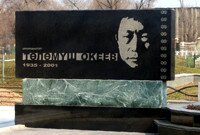
Tolomosh Okeev, (1937-2001), was a film director whose output attracted admirers from abroad as well as at home.
His shot his first film, “There are horses”, in 1965, and his last in 1986.
Okeev tells his stories mainly through their landscapes, within which people were simply one element. His storylines are usually minimal, with few plot twists. The subject matter varied … but often drawn from the world around him. He patiently studies the rituals of daily life at decisive moments during the eternal cycles of life – such as hunting or harvesting. The people found much in the films with which they could identify and reminisce. For example:
- There are horses, was a short documentary about one of the typical symbols of the nomadic Kyrgyz lifestyle – the horse.
- The Fierce One (1973) which is often considered as his masterpiece, is set in pre-revolutionary Kazakhstan, and tells the story of a boy who “adopts” a wolf cub, raising him as a dog, who quickly learns about the savagery of both animals and humans. (The film contains vivid, dramatic, scenes depicting violence against animals, for example there are sequences of a pack of wolves raiding a herd of sheep by night, and a wolf hunt on horseback, contrasted with dramatic landscapes and snowscapes. According to one reviewer: “The story of love and loyalty will touch your heart.”)
- The Snow Leopard’s Descendent is described as ”a hymn to the surrounding world”, with episodes that will be familiar to everyone “who has spent a childhood in the mountains”.
His films were entered in many festivals around the world and won many awards. He gained a number of admirers in the west for his use of landscape. One commentary, for example, says:
“The first thing that strikes you is Okeev’s way of filming the mountainous landscapes of the area. He uses a pretty stable frame, though he often reframes with tracks and zooms (I like his zooms better than almost anyone’s); he tends to shoot from a slightly elevated angle, so that the mountains and valleys fill the frame, often without too much sky. It’s quite beautiful. I don’t believe there’s a landscape shot in the film that’s just landscape: he’s always tracking people, often in long shot or extreme long shot, and their movements within the story. Though the landscape has an abstracting kind of power, he keeps things pretty concrete with his visual storytelling. For such a landscape-filled film, it has an odd intimacy. “
It is said that his ambition was to shoot a film about Genghiz Khan – but it was never fulfilled.
He is credited to have had a major influence over the development of the film industry, actors, and *** in the country.
When he died in 2001, (at the age of 66), the national film studio in his honour.
His films included:
- There are Horses (1965
- The sky of our childhood (1966)
- Kneel for the fire
- The Red Apple
- Ulan
- Golden Fall
- The Fierce One (1973)
- The Snow Leopard’s Descendant (1984)





 Bishkek