Skobolev – The White General
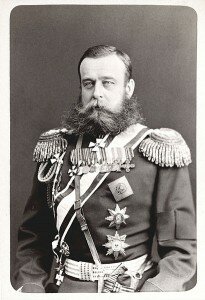
Skobolev – The White General
One of the names synonymous with the extension of the Russian Empire into Central Asia is Mikhail Skobolev … although it has to be admitted that his involvement in the territory that is now known as Kyrgyzstan was limited.
Skobolev was born, into a noble Cossack family, in Saint Petersburg on 29th September, 1843.
He attended a school in Paris and later, having been “sent down” from the University of St. Petersburg for “participating in student unrest”, he graduated as a staff officer from the General Staff Academy in 1868. Shortly afterwards he was sent on an expedition to Turkestan … and remained there until 1877, (except for a couple of years when he served on the General Staff in the Caucasus).
He commanded the advance guard marching from the Caspian Sea to Khiva and participated in the capture of the city. Later he was given an important command in the campaign against Kokand under Kaufman and gained a reputation for winning actions against overwhelming forces. He was promoted to the rank of Major General and awarded the Order of St. George for his role in the action.
Between 1873 and 1876, a group of Kyrgyz, led by the pretender Pulat Khan, rebelled against Kokand and In the early months of 1876 a large Russian force under Skobolev advanced and defeated the rebels in Andijan and Uchkurgan. Although Pulat Khan escaped and found refuge in the mountains, he was tracked down, captured and was executed. Not only did this lead to the collapse of the rebellion, as a coup de grace, the Russians then formally abolished the Kokand Khanate and created the Ferghana oblast, and Skobolev was appointed as its first Governor.
In 1877 he returned to Russia and took part in the Turkish War of 1877, distinguishing himself in the liberation of Bulgaria from the Ottoman Empire, commanding the Cossack Brigade.
He returned to Turkestan and led the force that captured the city of Geok Tepe, but, even though this action broke the back of local resistance, the “slaughter” that this action involved, (not only of the forces defending the city but also claiming many civilians), led to his recall to command the garrison at Minsk.
Apparently he was a great believer in the cause of Russian expansion into Asia, and even drew up plans for an invasion of India, which caused considerable anxiety among British intelligence circles and helped fuel what we know today as the Great Game.
He became involved in politics supporting the Russian Nationalist and Pan Slavic movements, creating some tension between the Slavic and Germanic populations. He was recalled to Moscow and whilst travelling to to his estate, he died of a heart attack in a Moscow hotel on 7th July, 1882, at the relatively young age of just 38.
He is particularly remembered for wearing a white uniform and leading his forces on horseback from the front, always “at the thickest of the fray”, which made him a prominent target. This led to one of his nicknames: The White General. He didn’t, however, always dress in white: during the Khiva campaign he explored much of the countryside dressed as a local Turkoman.
Although he was considered a successful commander, being promoted and decorated several times, and was also very popular, and drawing praise from both within Russia and abroad, (General Montgomery, for example, describing him as “a skillful and inspiring leader”), his career had not been without controversy.
His desire for rapid victory, for example, led to heavy losses in the Turkish War of 1877 – far greater than those suffered by the other side, by as much as a factor of four.
The Geok Tepe massacre which led to his recall from Central Asia was typical of his philosophy of hitting the enemy hard and persistently as long they showed signs of resistance, but once opposition had been defeated, “to be kind and humane to the prostrate enemy”.
There are those who consider that this particular campaign was a sign that he was suffering from an inflated ego and “delusions of grandeur”. Certainly, there appears to have been a suspicion that he harboured political ambitions … which might well have been substantiated by subsequent events.
There is even a suggestion that his fatal heart attack occurred not in a hotel, but in a brothel.


 Bishkek