Pulat Khan
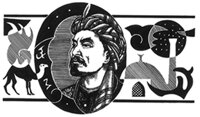
Pulat Khan
November 23rd, 1499, saw the execution of one of the most enigmatic characters in English History: Perkin Warbeck … and Perkin Warbeck always reminds me of Pulat Khan.
There are several similarities in different aspects of the stories of Perkin Warbeck and Pulat Khan. They both involve Pretenders to the throne at a time of great uncertainty and unrest, where the pretender bore a striking resemblance to a real claimant … they both gave the incumbent a difficult time and both eventually failing in their campaign and suffering execution.
For nine years Warbeck had been a thorn in the side of King Henry VII who had assumed the throne after his victory over Richard III at the Battle of Bosworth in 1485. Some historians consider that Henry’s claim was one of the weakest of any of the people that have sat on the British throne – and so, no matter what steps he took to strengthen his position, the appearance of people claiming to have a stronger claim was going to present him with difficulties for some time.
Warbeck was just one of those pretenders … claiming to be Richard of Shrewsbury, one of the Princes that Richard III is alleged to have had murdered in the Tower of London … so that he could assume the throne himself.
Another “pretender”, Lambert Simnell, was put forward by Henry’s opponents, claiming that he was the other Prince, but his challenge was easily dealt with and the young Lambert was given a job in the royal kitchens. Warbeck, however, was a challenger of a different calibre. We are not of all the details of his story, because much of the official account comes from his “confession” which Henry VII himself helped to supervise. Some historians think he may have confessed to certain in an attempt to escape execution … and some even think that he may well have been a relative of the dead king – perhaps a bastard offspring.
It seems, however, that he was born into a family of the minor nobility in Flanders and spent time in Belgium and Holland before eventually arriving in the court of Burgundy where he was “recognized” by relatives of the Prince and later in Ireland his resemblance to the former King, Edward IV, gave momentum to his campaign to claim the throne of England. He travelled throughout Europe visiting many of the royal courts and gathering support, albeit support which was to melt away.
Pulat Khan led the Kokand Rebellion of 1873-76 which although unsuccessful, was eventually to lead to the collapse and demise of the Kokand Khanate.
The Kokand Khanate was a powerful force in Central Asia in the seventeenth and eighteenth centuries which held sway over a large geographical area and a population which consisted of Kypchyks, Tajiks, Uzbeks and the Kyrgyz. The Southern Kyrgyz were subjects of the Khanate for the whole of its 107 year history, from 1769 until 1876, whereas the Northern tribes maintained their independence for most of this period, formally being subjects of the Khan only between 1825 and 1863.
It was not an easy time for the Kyrgyz and there were over twenty separate Kyrgyz rebellions against Kokand.
One issue which caused tensions was the level of taxes that were levied – according to one account “people had to pay tax on the birth and death of a person; only the air was not taxable”. Another contentious issue was compulsory military service.
One of the leaders of the Kyrgyz rebellions at this time was Taylyk Baatyr – “a lion of the mountains” – led one of the rebellions. (He was quite busy because, in 1825, he also led an army of ten thousand against a Chinese army which sought to invade the Tien Shan.) He led a coalition of several tribes but failed in his attempt to unite them all.
There were others who tried to unite the Kyrgyz tribes … perhaps the most significant was Alymbek Baatyr, the husband of Kurmanjan Datka. Alymbek ruled the Kyrgyz tribes of the southern Alai mountains and rose to hold high office in the Khanate, and used his power to try and alleviate the suffering of the Kyrgyz. He died in a “palace coup” having failed to unite the forty tribes.
Another important Kyrgyz character at this time was Shabdan Baatyr. At the age of 11, in 1850, he was held as a hostage by the Khan of Kokand. In his youth he took part in a number of raids on neighbouring tribes. Respected as a soldier he rose in the ranks to the modern equivalent of Lieutenant Colonel, despite the fact that he had no formal education. He was highly decorated, even being appointed as the “bek” of the city of Azreti-Sultan, but he wasn’t happy with the situation and joined with opponents of the Khan. Having fought against the Kokand Khanate in 1860, he was imprisoned in Pishpek in 1862, but he managed to escape.
1862 saw the fall of the fort of Pishpek to Baitik Baatyr, a manap of the Solto tribe in the Chui valley, who invited the Russian forces based in Verney, (now called Almaty), to come to the support of the Kyrgyz tribes and end the power of Kokand in the northern region of what is now Kyrgyzstan.
In 1869 the reigning Khan of Kokand, Alim Khan, was assassinated. His death, or rather the manner of it, was to overshadow and to helped to shape events for some sixty years later.
The internal political situation in Kokand had been one of intrigue and rebellion. Indignation and revolt among the people, a number of uprisings, a cattle pestilence, a famine … all helped to make for political uncertainty. Khudoyar Khan, who occupied the throne at this time, was getting on in years and attention turned to the question of the succession. One candidate was Pulat Bek, grandson of the ill-fated Alim Khan.
In 1873, a group of Kyrgyz elders was dispatched to see Pulat Bek in order to urge him to accept the mantle of Khan. He was mindful, however, of the fate dealt out to his grandfather … and various other holders of that office – and so he declined the honour. The throne passed to the ageing Khudoyar Khan.
According to legend, the delegation then made their way back to Tashkent, and in a house where they lodged for the night they met the local mullah – Ishkak Khasan uulu. Ishkak was an educated man, (he was, after all, a mullah and a graduate of the madrassa), with an engaging and charismatic character. More importantly, perhaps, apparently he had a striking resemblance to Pulat Bek.
After some discussion, he was persuaded to renounce his own identity – and to take the name and title of Pulat Khan – grandson of Alim Khan. Ishkak, who had been born into the Boston clan of the Ichkilik tribe from Southern Kyrgyzstan – now found himself the “pretender” to the Khanate of Kokand.
His appearance as the “legitimate” heir to the throne, along with his personality and drive, drew to his side many of the protesting opposition factions – as well as some of the “establishment” figures of the day. The rising tide of rebellion swept him along and in 1875 his forces captured several of Kokand’s fortresses, forcing Khudoyar Khan’s son, (and rightful heir), to flee – straight into the hands of the Russian military. Russia and the Khanate had signed a treaty of friendship in 1868, and the Russian Empire now decided to throw in it’s military might into the arena of Kokand in support of the fugitive Khan.
A large force of Russians, under General Skobolev, advanced and defeated the rebels in Andijan and Uchkurgan in the early months of 1876. Although Pulat Khan executed. It was an unequal fight – and led to the inevitable defeat of the rebel forces. Pulat Khan was wounded and escaped and found refuge in the mountains, he was tracked down, captured and handed over to the Russian troops. On March 1st, 1876, he was executed in the market square of Margelan.
As a coup de grace the Russians abolished the Kokand Khanate on 19th February 1876.


 Bishkek