Pavel Kosharov
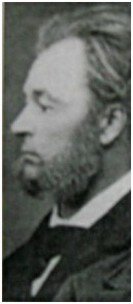
Pavel Kosharov
Pavel Kosharov was born in Russia in 1824 into the family of Prince Golitsyn. He showed a talent for drawing at an early age and after studying at the St. Petersburg Academy of Arts he qualified as a teacher of drawing.
He undertook a teaching post at the Gymnasium in Tomsk and was warmly remembered by his students for his kindness, natural tenderness, patience and even temper, never over reacting to even the most outrageous antics … whatever the provocation … rather smiling softly and issuing a slight reproach of “Oh, Lord, Lord”. He is credited with creating a passion for painting among his students.
He spent all his free time painting, and even produced works while he was travelling. He is famous for his drawings and paintings of various parts of Siberia and the Tien Shan, but more of that below, both landscapes and of the peoples and their customs which he later published in the form of an ethnological collection. These albums are still kept in the archives of the Russian Geographical Society and apparently there are copies in the Library of Congress.
In the summer of 1856 he was a member of an expedition to the Altai and the following year he was invited by Semenov to accompany him on his expedition to the Tien Shan. From the outset he was active producing sketches and watercolours of the scenery, portraits of the people, drawings of historical monuments and everyday objects, household goods, weapons and clothing.
Semenov was duly impressed and if we say that “a picture is worth a thousand words”, Semenov describing Kosharov as a “venerable artist”, put it this way when refering to Kosharov’s contribution to the expedition as a whole : “Much of what we saw is beyond words, only a picture will suffice, it would be lost without Kosharov’s concomitant.”
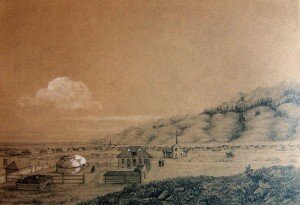
Almaty in 1857
One sketch in particular is of note – showing the town of Alamty – or Verney as it was known at that tine – the first picture ever of the new settlement; it had only been established three years earlier.
Indeed, it is said that he was the first artist to enter the Tien Shan,
The expedition lasted just three months and on his return to Tomsk, he organized an exhibition of his work in 1860; reputedly the first such exhibition in Siberia.
Many of his pictures of the Tien Shan are still held in the museum in Tomsk, many with short explanatory notes penned by the artist himself.
He died in Tomsk on 26th September. 1902.





 Bishkek