Kok Buro
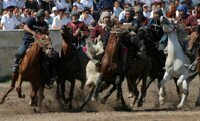
A game of Kok Buro
During my enforced rest and recuperation, I missed out on a number of important events. One of those was the First World Nomad Games, hosted by Kyrgyzstan up by the shores of Lake Issyk Kul and attracting hundreds of competitors from a wide variety of countries … and not to mention many visitors from around the world.
I had been planning to go up to Issyk Kul for a couple of days, but in the end had to settle for watching some of the games on local television.
Although there were a number of sports represented, the highlight was the Kok Buro competition, (not surprisingly, won by the Kyrgyz team). Kok Buro, in one form or another, is played throughout Central Asia and is known by several different names such as Ukak Tartysh. In the West it is often referred to as “Goat Polo” … but I think that is simply because both games involve teams of riders on horseback trying to score goals – in one case by using sticks to hit a small ball between a pair of posts, and in the other by dumping the carcass of a goat into a specially prepared well.
.
Apparently, the name, Kok-boru, means Grey wolf.
There are several legends about the origin of the game.
- According to one version, young horse riders chased and caught a wolf and beat it with large sticks so that the animal was close to death and then the players would throw the wolf to each other.
- Another story tells of a herdsman who was inspired one day when he saw how young wolves played with each other and took goat meat from each other – so, it is said, wolves were the first kok-boru players.
There is also a description of the game in the Epic Semetei – the second part of the Manas Epic.
Apparently, the game originally historically developed in antiquity when herds of cattle grazed in the steppes and mountains all year round – exposed to possible attacks by wolves. Having no firearms, the shepherds could not deal with wolves. Brave djigits (horse riders) chased after the wolves until the beasts of prey fell, and then they began beating them with sticks and lashes, trying to snatch them away from each other.
It is also said that the game was devised to train skilled horsemen – helping warriors to learn the secrets of horsemanship and combat on horseback.
Over the course of time, the place of the wolf was taken by the carcass of of a goat. The skin endures the heat of battle well, and their long hair is easy to grab hold of.
Later on when the people led a more settled life the more informal version of “kok-boru” was replaced by an organized sport. It transformed from being a game for the participants into more of a spectator sport. In the original version of the game, the field of play was not fixed and it was possible for the players to gallop away for over a kilometer – out of sight of those watching. Also the “gates”, or goals, were not well defined leading to numerous disputes.
There are two teams, consisting of an equal number of riders – in formal competitions it is four players. The playing ground is 300 by 150 meters. The opposite sides of this area, marked with flags, present symbolically “the gates” – or “goals” but in the Hippodrome special “wells” were constructed and the outer walls lined with rubber car tyres.
The objective of the game is to seize the goat’s carcass and deliver it into the gates of the contesting team.
In the center of the playing ground the carcass of a goat, weighing on an average of 30-40 kilograms, is placed on the ground and one player from each team tries to place their horse between their opponent and the carcass, bending over to try and catch hold of it and lift up off the ground and then galloping off to deposit it in their opponent’s goal.
Of course, the opposing team do all they can to interfere with his progress and there can be a lot of barging, pushing and shoving. It’s a very physical game!
In the hurly burly of play the carcass is often and players are allowed to pick up the carcass from any place within the limits of the field, take it from their rivals, (hence one writer refers to it as “wrestling on horsebak for a goat’s carcass”), pass or fling it over to their partners, carry it pressed to the horse’s side or suspended between the horse’s legs.
During the course of the game some unlikely, unforeseen and ad hoc alliances may be formed among the participants. These alliances are usually short-lived, dissolving in the rapid fluidity of the competition as quickly as they are established. So one moment brothers may be vying for the honour of becoming the new champion, whilst old rivals can be seen aiding each other. All this fosters fast-thinking teamwork that is absolutely vital under actual combat conditions, (which the game very realistically simulates).
The rules forbid rearing the horse, making your horse collide with a rival’s at a high speed, seizing the rival’s horse by the bridle, taking the reins off it, striking blows with a kamcha, (horse whip), shouting or entering into conversation with one’s opponent.
Typically, a game lasts 15 minutes – although competition games are divided into three parts of 20 minutes each.
Kok-boru tournaments are frequently held. Teams from all areas Kyrgyzstan participate in these competitions. In particular, special tournaments are held at in Bishkek at Noorus – March 21st – and on Independence Day – August 31st, when teams compete for the President’s Cup, (including, sometimes, teams from other countries).
It is said that kok-boru is one of the most popular sports in Kyrgyzstan today.
There is an International Kok-boru federation based in Bishkek with founder members from all of the Central Asian states.
.
As a sign of the times … there are experiments with a new, lighter, carcass, made of rubber. It is hoped that this will help make the sport even more attractive to European and American audiences and lead an ever widening familiarity and popularity for the sport. If nothing else, if it takes off, the initiative should allow spectators to marvel at the skills exhibited by horse and rider without being upset by the thought of an animal having being slaughtered simply to provide for the entertainment of the audience.





 Bishkek