Shashlik
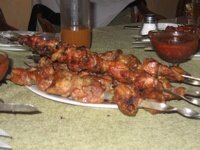
Shashlik … mmm-mmm!!!
One of the most popular meals during the summer is Shashlik – which is the Russian name for a type of Shish Kebab – pieces of meat on a skewer … indeed that’s what shish means in Turkish – skewer. Kebab on the other hand refers to meat that is cooked over or next to flames.
Apparently, the name Russian name Shashlik dates back to the sixteenth century, when it was borrowed by the Cossacks from the Crimean Tartars.
Shashlik is ordered by the palechki - or skewer.
It is a popular dish – and found in many cafes and restaurants … especially roadside stops, (such as the yurts in Boom Gorge on the road to Issyk Kul). However, in some cafes, although it may be on the menu – it may not be available all the time.
Originating from the Middle East, (excavations on the Greek island of Santorini, for example, provide evidence of something similar that dates back to 17th century BC), it seems that the Mongols adopted the dish and it gained in popularity here in Central Asia.
Originally, it seems, the kebabs were made using lamb, but these days there are lots of variety, beef, pork, liver, chicken, fish or even a variety of vegetables – such as: mushrooms, onion, pepper and tomato.
It can take the form of pieces of meat, (marinaded to make it tender), placed on a skewer which are suspended over burning coals or twigs- as in a barbecue on a special grill called a mangal.
The marinade is usually a vinegar based, (possibly wine or fruit or vegetable juice) with a mix of vegetables, herbs and spices. Every chef seems to have their own recipe which is a closely guarded secret.
The chunks of meat are then placed onto a skewer … Sometimes, there is just the chunks of meat, but sometimes these are alternated with vegetables.
Here in Kyrgyzstan, if the skewer typically has for, five of six pieces of meat, then a piece of fat is also added. To Westerners, this can seem strange, but the fat is considered important … the Kyrgyz have a proverb that “cheap meat has no fat” and the Russians consider sala - raw pork fat – is considered a delicacy … but there is also a practical reason … the fat drips onto the burning coals beneath the skewers and adds to the combustibility … also adding flavour in the smoke that rises. many Westerners find the piece of fat inedible … and one received a surprise when he was given a discount, “because he had ordered shashlik without fat”. (This isn’t common practice.)
The burning embers are usually sticks or wood – although charcoal may be used (as in a barbecue) it is not very common. The wood is placed in a special metal tray called a ”mangal“, set alight and fanned to encourage the flames and build up the temperature. The flames die out and the fuel left to smoulder – building up heat. Then the palechki are laid across the sides of the mangal – suspended about 10cm above the embers. It can take 10-20 minutes for the meat to be properly cooked.
When cooked the skewers are lain on a bed of sliced onions on a plate and served to the diner together with some lepyoshki bread.
In some cafes and restaurants, the meat will have been removed from the skewers before being put onto the plate – but if it is still on the palechki, then it can either be eaten from the skewer itself, or pushed off the skewer onto the plate using a fork.
It is usual to dress the shashlik with ooksus - vinegar, which is a clear liquid, usually made from a concentrate diluted with water.
There is a tradition that shashlik is always prepared and cooked by a male member of the family.
.
It may be best to advise caution when buying shashlik as “street food” … but when served by your host or in a cafe or restaurant there should be no problem. Provided the meat hasn’t been standing for long and is well cooked, then shashlik can be a filling and tasty meal.
One or two palechki are often sufficient for most appetites … but as it can take time to prepare, cook and serve additional skewers, it is wise to decide early on how many to order so that additional, supplementary, orders are not needed.


 Bishkek