Oochastkoviy – The Beat Cop
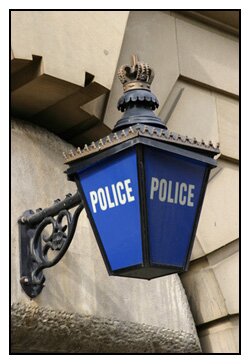
Traditional Police station sign in the UK (from Home Office website)
Just down the road from the house where I grew up in Malvern there was a large, White detatched house … which had a sign nailed to the wall declaring that it was a “police station”. That always struck me as a bit off because, to me, it was really the home of Chris, one of my school friends, and his family … his father being a policeman – a Sargent if I remember correctly – and this was the equivalent of “married quarters” for the force.
The “station” as it were, was just one room which served as an office and a garage which housed the local “panda car” rather than a family car … but those seemed to be the only things that marked it out as special in any way. As far as I know, for example – although I was never given a guided tour – there was no cell or lockup, to house drunks or miscreants.
The idea was an embryonic form of “community policing” … the traditional policing policy dating from the late 19th century was to have police patrolling a particular district, which was known as a beat. The idea was to build up a relationship between the force and the local community, strengthening the effectiveness and encourage closer cooperation and, hopefully, leading to a safer community.
Originally Beat Officers would patrol on foot, or perhaps on bicycle The districts would be shown on a map in the police station and officers assigned to particular beats with certain “fixed points” which would be used in order to “report in” – perhaps a blue police phone box like the Tardis.
The advent of the motor car meant that more and more officers became motorized. This enabled them to patrol a larger district … and they usually drove around in pairs. I remember the Panda being introduced … when there was one officer in the vehicle. The use of personal radios also made it easier to contact officers if and when the need arose, in order to respond to an incident.
One of their responsibilities was to learn all that they could about the community: who lived where, with whom, what they did for a living, who thier friends and known associates were, any regular habits … and so on. I understand that these days there is a special “intelligence officer” or “records officer” who will keep such information on index cards or databases, never sure when some snippet of information may prove useful in some future case.
.
We’ve recently had a few encounters with out local Ojchastkoviy – the local Beat Cop. They are sometimes referred to as the “Precinct police”, which sounds a bit American to me … but it gives a food idea of how the system works.
The city is divided into rayons - or districts – and these in turn are divided into administrative units – or oochastoks, and there’s a local police station or office located in the neighbourhood. Some of the Rayon stations are purpose built, others are converted Kindergartens … and some of the oochastnik offices are built into a residential or office building – they comprise basically just an office and maybe a room equipped as a holding cell.
As in the UK, there’s usually a large map of the district, marked out with the area of responsibility. They keep registers of who lives where, which should, technically, be relatively easy to maintain because of the system of propiskas – registration of addresses without which it is difficult, if not impossible, to gain access to schools, medical and other social facilities. They keep a special register for foreigners like me and once a year the oochastkovie comes round and makes a note of my passport and residence permit.
Over the years I have been here, I have met several of these law enforcement officers, and a couple of weeks ago a new officer appeared and started asking questions about who lived in which apartment. At first I was suspicious because I thought I knew the local beat officer … so who was this new guy. It turned out that the officer I had known for several years had gained a promotion and this was his replacement.
Having checked his ID documents, and answered his questions, shown him my passport and residence permit, I made a comment about the fact that he wasn’t writing anything down – he didn’t have the journal with him and so was going to have to rely on memory.
He then started asking about the other apartments in the building … a couple are rented out and so don’t have people living in them permanently. There was no-one in these apartments at the time, so he had to come back … several times … in order to find someone at home. It was a bit awkward because the subsequent visits tended to be late in the evening and I had to try and tell him that foreigners may not even open the door after dusk – pointing out that some embassies even have a standard instruction/advice to their citizens, advising them to refuse to open the door if they don’t know the person calling … “But, I’m a policeman, in uniform”, he said. ”Even if they are in uniform”, I said … do you realize how many different uniforms there are, and a visitor to Bishkek may not be able to determine which uniform is which … which is not to mention the uniforms that are stolen or simply on sale in one of the special outfitters.
I was a bit concerned because he said that one of the reasons for his visit was that there had been some complaints about some Turks in one of the apartments … which was off, because we haven’t had any Turks in the building – ever, as far as I can recall. Kyrgyz, Russians, English (of course), Germans, Indians … and so on … but never, as far as I can recall, any Turks. It sounded to me like a case of mistaken identity … especially as both of the flats had been empty during the timeframe that he was referring to,
Then, a couple of weeks later, two strange men appeared and stared demanding over the domophone that we open the door … as it happens, I didn’t see them, and was told about their visit by the kids and neighbours, later on, The men said that they were police, but there in were not in uniform, but in civilian dress (grazhdanskiy odezhda). There was something about their manner that was a little disturbing, only one of them seemed to have any form of Identification, which looked a little different from that which we normally see.
I looked at the video from the security cameras and decided that there may be an issue … they could indeed have been policemen … but could just as easily have been “casing the joint”.
As a result, I called the oochiskoviy and asked him to come and pay me a visit … I explained the circumstances and showed him the video. He watched the video several times … and finally told me that he thought he “knew” the officers … they were from a different district and worked as detectives in the CID – Criminal Investigation Department (… or as we used to call it when I was kid: Cops in Disguise), rather than in the Uniform section … but he did recognize them. If we wanted him to do so, he said, then he would have a word with them – and their superior officer. In the end, however, I said that it wasn’t necessary … I felt happier knowing that they had been identified … and that I had passed the information about the incident on to the Beat Officer … let him file it away … maybe … just maybe … some time in the future, it may prove to be a useful piece of information.

Policeman – District Cop
All this came to mind because I noticed that, on one of the local video sharing sites, someone had placed a copy of Oochiskoviy - a comedy film shot this time last year and which was premiered in the Autumn.
The film had been proposed by the Chief of the Chui Police Department and the film director Sanjar Abdyjaparov decided that it sounded like a good idea. It features several famous actors (well, at least, locally famous). There is something about Cops and Robbers that makes films and TV series and makes crime stories an appealing genre. Knowing how such films can help to create a positive image for the police and foster good relations with the local community, the local police authorities offered moral and logistical support for the shooting. According to those involved, they learned a lot about the work of the police during the filming as officers opened up many “professional secrets” to them.
The plot revolves around a third generation policeman who graduates from the Kyrgyz Police Academy and on his grandfather’s advice accepts a rural posting. Here he meets and falls in love with a young woman … who, unfortunately, hails from one of the local families of the criminal fraternity,
To be honest, as the film is in Kyrgyz most of the details of the film passed me by – because I don’t speak Kyrgyz. There weren’t even Russian subtitles, at least not in this version that was posted. However, it’s well filmed and many of the incidents seems to be to be typical … even if you don;t gat past the opening scene of the graduation ceremony – which was soooooo reminiscent of official functions here in Kyrgyzstan.
All in all, however, it provided an interesting one and half hours.
One of the things that struck me as I sat through it … was how vibrant the Kyrgyz film industry if proving to be … with some forty odd films being shot in the last year or so … and what a pity it was that so few of them were to get an airing in the outside world.






 Bishkek