Something new every day
Today, I learned something new. That’s not unusual, as Tom Jones used to sing …
In fact, a piece of “homespun advice” that one of my schoolteachers gave us when I was young, was that we shouldn’t think of education as a process that finished the day we left school. It is a lifelong, on-going process. That stuck with me … and helped to shape my attitude to in-service training as a teacher … I’ve written about that elsewhere, (see: Perpetual Student). He told us, “You should try to make it an aim in life to learn something new every day.” I am not sure that I succeed in fulfilling this commandment … but I do remember it … and thinking it was good advice and I should have a go at trying to do so.
Quite often the things that you “learn” are pure trivia … but that is probably one reason that I used to enjoy playing Trivial Pursuits … or looking at the Wikipedia “random” Featured Article … and why I like looking at “On this Day” features in newspapers or on the BBC website – and Wikipedia … or why I have subscribed to daily emails from the Oxford Dictionary of National Biography … or … well, you get the idea … you never know what fascinating facts you might come across.
Of course, you need to be careful … sometimes the tings you see are not necessarily true … and judging how to assess the veracity of what you read or hear is another important skill that needs to be developed.
The “something new” that I happened to learn today came about in a funny way.
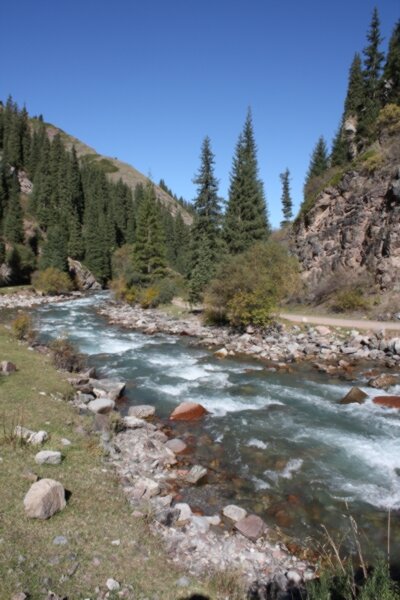
I happened to be looking at our redesigned website about Kyrgyzstan: www.celestial.com.kg … in particular at a some photographs that the webmaster has been uploading. There was of photographs taken in the Juuka Gorge (see: http://celestial.com.kg/gallery/Juuka_gorge.htm)… and as I’ve never heard of the Juuka Gorge before, I thought I had better call him in and ask him about it.
He wasn’t surprised that I hadn’t heard of it … it’s not a very well known spot in Kyrgyzstan. It seems that the Juuka Gorge is a small valley on the Southern shore of Lake Issyk Kul, between The Barskoon valley and Djety Oguz, both of which are much more well known.
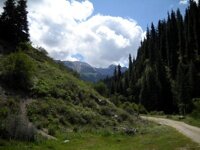
The Barskoon valley leads up into the Tungey Ala Too mountains, (the “Shady” mountains) from Lake Issyk Kul towards the Bedel Pass which crosses the border between Kyrgyzstan and China. At the moment, however, it is not possible to cross the border here, although there is, from time to time talk, about opening a road through the Bedel Pass. It is very high, remote and extremely difficult country.
When, for example, in 629, the Buddhist monk Hsuan Tsang crossed here on his way to India in search of authentic copies of Buddhist religious texts in order to resolve the many inconsistencies, contradictions, discrepancies and anomalies in the holy texts that were available in China at that time, (… no he wasn’t lost, he had been forbidden by the Emperor to travel and so he embarked on a round about route that was going to take seventeen years in all to complete …), it proved to be a very traumatic experience … heavy snows had delayed his departure from Ak Suu in China, which was a portent of worse to come. In a 40 mile stretch, (about 65km), he lost a third of his companions and animals.
More recently, in 1916, when huge numbers of Kyrgyz – it is estimated that about 120,000 out of the total of 768,000 Kyrgyz alive at the time – tried to cross the border in order to escape the bloodshed and excesses in putting down a popular uprising and many died en route in the snows: of hunger or as the victims of bandits. Nearby is Ashu Surk – “the Pass of Bones” – which got its name from the number that died here in their attempted flight. One recent writer described the scene as “a river whose banks are covered with human bones.” Apparently, in the Soviet period, there was a military garrison posted near here but soldiers from the Muslim republics of the USSR were never posted there.
A couple of years ago we had some Japanese tourists who wanted to visit the pass. Apparently, one of the first subjects that Japanese children learn about in their history lessons in school is The Silk Road, so they are usually very well informed about people such as Fa Hsuen and Hsuang Tang. This particular group included some former prisoners of war that had worked on the construction of the Military Sanatoria in Tamga, where Yuri Gagarin used to come for his holidays, and they wanted to revisit the area. Unfortunately the weather conditions that summer were not very good and although we had all the necessary permits for them to enter the border zone, they had to turn back before they reached the pass.
Also, up the Barskoon valley is the Kumtor Gold Mine which is part of the economic backbone of the country … unfortunately, they don’t give free samples.
Djety Oguz is another famous valley and home of the “Seven Bulls” rock formation made from Red Sandstone from which the valley gets its name and the Broken Heart rock formation. These two rock formations are often cited by Kyrgyz as amongst their favourite places in the country. It’s a popular destination for tourists who visit the Karakol area at the Eastern end of Lake Issyk Kul. Up the valley is the famous “Dolina Svetov”, or “Valley of Flowers” which is a blaze of colour in May and June. The valley is also used as a venue for an annual Festival of Cuisine and Folklore run by the local CBT (Communit Based Tourism) group, and offers a wide range of trekking routes.
“So, what has Juuka Gorge got to offer? and why haven’t I come across it before?”, I asked.
Just like in the Kyrgyz Krebet, the range of mountains to the south of Bishkek, the Terskey Ala Too mountains have a number of valleys each with their own character and attractions. As well as Djety Oguz and Barskoon, for example, there is Skazka Valley, (Skazka = “fairy tale” in Russian), which has sandstone cliffs that have been shaped and eroded into a variety of crags and pillars varying in colour from red to orange. Juuka is one of those valleys.
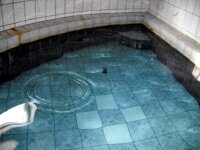
Apparently, a group of tourists had heard about the various sanatoria in Issyk Kul and the different sorts of treatments on offer and had expressed an interest in trying one of the numerous radon baths that are found around the lake, and said they wanted one which was off the beaten track. In Juuka there is a spa with pools in specially constructed houses made to resemble traditional yurts. Not simply radon baths, the mineral composition of the spring water gives off a strong smell approaching rotten eggs … but the chemical that create this effect are supposed to be very efficacious in the treatment of several types of ailment.
It’s not very well known, even in Kyrgyzstan … so, I was assured, it’s not surprising that I had never heard about … but now I have.
In a way, its a pity that I didn’t know about Juuka Gorge last week … I happened to be in Issyk Kul last weekend and, even though it would have meant quite a big detour, it might have been worth a visit … still, there will be another chance sometime in the future.
So, I learned something new today … I wonder what I will learn tomorrow?




 Bishkek