Picturesque Placenames
In a recent postcard, I referred to the fact that as a student I had a job working in a poster shop. It was there that I came across many artists and works of art for the first time … learning about the different schools and genres … and also learning to know what I liked … and what I didn’t. One of my favourite paintings was a picture of Old London Bridge by the Dutch artist Claude De Jonge.
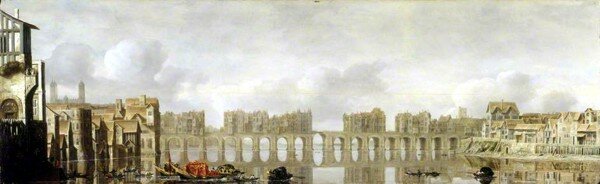
Old London Bridge by De Jongh
It was a peaceful scene, realistic and almost “graphic” depicting the many arches of the bridge showing the houses built on it under a dull overcast sky. There was just one flash of colour – a red canopy on one of the “boat taxis” that road up and down the river conveying foodstuffs, goods and/or passengers, across the river rather than up or down stream. True o its name. the bridge that was depicted was clearly an “old” bridge that was no longer standing and had been replaced by a “new” one.
Later I was to be delighted to discover the original painting hanging in Kenwood House, just a from miles from my home in North London.
For the record: there is at least one more version of the painting, from more or less the same standpoint but larger and much more colourful … with a blue sky – and the River Thames has a blue hue.
The title struck me as a little odd … after all, it was unlikely to be the original name … after all it wouldn’t be “Old” London Bridge unless there was a “New” London Bridge …
For the record - construction of the bridge had started in 1176 and it stood – albeit with certain accretions – until the buildings demolished sometime around 1760. At the start of the nineteenth century it was replaced by the “new” London Bridge – which in turn was demolished, to be replaced by the current box girder bridge, sold to the Americans and rebuilt in Lake Havasu City, Arizona.
The Pont Neuf in Paris, on the other hand, (… which connects the Isle de la Cité with the two banks – left and right) belies its name. Although the name means “New Bridge”, it is actually the oldest of the city’s bridges across the Seine … of course, at the time when construction on the bridge started on 31st May , 1578, it was the “new bridge” and the older bridges which flanked it and resembled the one in London with the buildings built along its span as part of the structure.
Now place names here in Kyrgyzstan can also often have special meanings … which can be interesting, picturesque and descriptive … and it helps to know some basic Kyrgyz vocabulary, such as:
- Ak – White
- Altyn – Gold
- Arashan – Spring
- Besh – Five
- Bulak – Spring
- Chon – Big or Large
- Debe or Dobo – Hill
- Kara – Black
- Kishi – Small or Little
- Korgon – Grave
- Kul – Lake
- Kyzyl – Red
- Mazar – Grave or Tomb
- Min – Thousand
- Oi – Earth, soil or bowl
- Sary – Yellow
- Suu – Water
- Tash – Stone
- Unkur – Cave
Here are some Kyrgyz place names – and their associated meanings … some are in Kyryz, others are from Russian and at least one is Tajik:
- Kyrgyzstan – Land of the Kyrgyz
- Ak Chiy : Issyk Kul : White Chiy
- Ak Debe : Talas : White Hill
- Ak Suu : Chui : White Water … In Issyk Kul, The Semyenovka Valley is also known as Chon Ak Suu (Big White Water) and Grigorievka is also known as Kichi Ak Suu (Little White Water)
- Ak Tash : Naryn White Stone
- Ala Myshyk : Naryn : Motley Cat
- Altyn Arashan : Issyk Kul : Golden Spring
- Arpa : Osh : Barley
- At Bashi : Naryn : Horses Head
- Balam Kaldy : Osh : My Baby was left there
- Balykchy : Issyk Kul : Fisherman
- Besh Tash : Talas : Five Stones
- Besh Terek : Osh : Five Poplars
- Boom Gorge : Issyk Kul : Shoestring Gorge
- Chatyr Kul : Naryn : Heavenly Lake
- Chichkan : Djalal Abad : Mouse
- Cholpon Ata : Issyk Kul : Cholpon’s Father
- Chon Aryk : Chui : Big Canal
- Chon Tash : Chui : Big Stone
- Chon Tuz : Naryn : Big Salt
- Chytty : Osh : Cotton
- Chil Ustun : Osh : Forty Columns
- Djety Oguz : Issyk Kul : Seven Bulls
- Dolina Svetov : Issyk Kul : Valley of the Flowers
- Dostuk : Naryn : Peace
- Ece Naryn : Naryn : Second Naryn
- Golubinyi Vodapad: Chui : Pigeon’s Waterfall or Dove’s Waterfall
- Holodnaya Voda : Chui: Cold Water
- Issyk Kul : Issyk Kul : Warm Lake
- Kant : Chui : Sugar
- Kapchygay : Batken : Gorge, mountain valley in Kyrgyz
- Kara Balta : Chui : Black Axe
- Kara Dobo : Osh : Black Hill
- Kara Oi : Naryn : Black Earth
- Kara Suu : Djalal Abad : Black Water
- Karakol : Issyk Kul : Black Hand
- Karkara : Issyk Kul : Black Crane
- Kerben : Djalal Abad : Caravan
- Kol Ulkock : Naryn : Lake in a Chest
- Koshoi Korgon : Naryn : Koshoi’s Grave
- Kuhl Garmo : Osh : Warm Mountain
- Kypchylma : Ish : Squeeze through
- Kyrgyz Ata : Osh : Father of the Kyrgyz
- Kyzyl Oi : Chui : Red Bowl or Red Earth
- Kyzyl Suu : Chui : Red Water
- Kyzyl Unkur : Djalal Abad : Red Cave
- Leilak : Batken : According to legend, the region is named after the stork (“ilek-ilek”) which lives here for a while on its migratory journey.
- Lukovaya Polyana : Osh : Onion Field
- Muztag : Issyk Kul : Ice Mountain
- Ottuk : Naryn : Cud
- Saimaluu Tash : Djalal Abad : Painted Stones
- Sary Bulak : Naryn : Yellow Spring
- Sary Chelek : Djalal Abad : Yellow Bucket
- Shaitan Mazar : Issyk Kul : Devil’s Tomb
- Skazka : Issyk Kul : Fairytale
- Son Kul : Naryn : Last Lake
- Suuk Dobo : Osh : Cold Hill
- Svetly Myz : Issyk Kul : Bright Cape
- Tamga : Issyk Kul :
- Tash Bulak : Chui : Stone Spring
- Teplokluchenko : Chui and Issyk Kul : Warm Springs
- Tokmok : Chui : Hammer
- Tunduk : Naryn : Northern
- Volchi Vorota : Chui : Wolf’s Gate




 Bishkek