Durak – A Fool’s game
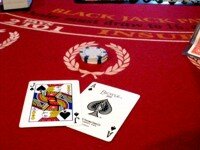
A winning hand in Blackjack
I am not a great one for playing card games.
As a child, of course, I learned and played the traditional games: Snap, Rummy, Whist, Cheat, Fish, Strip Jack Naked and so on … and of course Patience, although mainly just the standard version packed with Windows and Solitaire and Clock Patience. (And that infamous Drinking Game – Three Jacks - but that’s another story!) Windows has taught me a couple of new card games … and I suppose I have to be grateful to Bill Gates for that at least.
I also learned and played Pontoon and although I thought it was a pretty universal game, it’s surprising how many different variations there are … in Casinos it is known as Blackjack but it is also known as Pontoon, Vignt-et-un, Spanish 21 … and so on, with variations like twist and stick, burn and buy, split and royal pontoon. In some games you play against everyone and in others you play one-on-one, against the dealer.
They all all very similar and based on the idea of dealing cards to players in turn – each of whom tries to obtain the highest point count among a group of players with up to five cards … but not exceeding a score of more that 21. The court cards, (King, Queen and Jack), are assigned a face value of 10 and the Ace can have a value of either 1 or 11 …
It seems obvious why the game is sometimes called vignt-et-un, which is French for 21 … but why Spanish 21? I am not sure if this is the reason, but although nobody really knows when or where the game originated but the first written reference to it appears in the work of Cervantes, (who is perhaps most well known for writing Don Quixote).
To make life more interesting, the Spanish game is often played with a Baraja deck – that is, one without the 8s, 9s, and 10s … which is a complication that a Brit like me has to bear in mind when calculating the odds when considering his next move.
When the game was introduced into Casinos in the States, or so the story goes, in order to make it more enticing, various additional features were added – including a bonus payout if the first two cards a player was dealt were an Ace and a black Jack – either the Jack of Clubs or the Jack of Spades – and this was called a Black Jack winning hand – and the name just stuck.
When I moved to London to teach, I encountered the game of Bridge … in the staffroom there was always a game on the go – sometimes two, and on the odd occasion even three. Once I walked into the staffroom at lunchtime and there were only three people sitting round the table … waiting impatiently for a fourth to turn up. The hands had already been dealt and the cards lay face down on the table … time was ticking away, so they looked at me and told me to pick up the fourth hand and make a bid. I had no idea what I was doing – but they explained the basic principle of the point count and once a contract had been struck it was just a game a Whist … “easy peasy”.
I soon got hooked and was happy to play a hand … or watch gaining vicarious pleasure, and learning some of the “tactics” of game play. Every now and again, one of us would host a Bridge evening at home and one great occasion, much to my amazement and amusement – and everyone else’s – I actually won. On the all the other occasions, however, I was down in the ranks of the “also played” and I acknowledge that my one great success rested as much in the skill of my partners as in the game play that I had managed to pick up in the odd hand in the staff room. I was lucky enough to get the adventurous, reckless, partner for those hands which rewarded risk taking and the more conservative and careful players when the cards penalized such behaviour.
Since I have been here in Kyrgyzstan, I haven’t played much Bridge … or any of the other card games for that matter. I have tried to teach the kids the basic rudiments of Snap, Cheat and the like … but with little success. They do know about Blackjack but, for some reason, are not very keen on it.
On the other hand, they are avid players of Durak – which is Russian for Fool and seems to be the only game that people here know.
It is a very fast and furious game … and although it is supposedly very simple – I have to admit that I have never really grasped it. I put that failure down to the fact that I was introduced to the game when I was still learning Russian and didn’t really understand the rules as they were explained to me. Someone stood looking over my shoulder and was forever, (or so it seemed at the time), interfering and stopping me from playing the cards that I wanted … they kept giving me all their reasons why this card should be played and not that one … but it seemed as if the rules were arbitrary and I soon lost interest in trying to make head or tail of them … so I never really mastered the game.
The kids, on the other hand, are experts … and have been ever since they took the game up at some incredibly early age.
For the record: apparently, just as with Pontoon/Blackjack, there are several variations and the family of games are all known as Durak – which goes a long way to explaining why the rules seemed to change whenever I tried to play the game.
If I understand correctly, the idea of the game is very simple … to lose all your cards as quickly as possible … the Durak, (or the loser), is the one left with cards in their hand when everyone else has been eliminated.
It’s a game for two to five players … and is usually played with a continental pack of cards – with just 36 cards … the cards 2 to 5 in all four suits having been removed. The deck is shuffled and each player receives six cards – although there is a five card version. The top card of the remaining deck is turned over so that the valuie and suit is visible – it’s usually placed under the remaining cards at right angles to the rest of the pack.
This top card determines the trump suit …
The player with the lowest trump card (the 6 of trumps – Aces are “high”) starts the game and lays it, face up, on the table – it’s called the attacking card. The player to their left, (called the defender), then has to try and “beat” it … with a card of higher rank or a trump card – or at least a card of the same rank, in which case he starts a new attack, creating a new attack pile (as a second front) and taking over control of the game thus passing the role of defender on to the player on their left.
If the defender cannot beat the attack then he picks up the cards on the table which are added to his hand.
If he succeeds in then the cards in play are discarded
If there are still undealt cards in the deck on the table, (including the trump card which is face up) then those players with less than six cards replenish their hand. If the deck has been exhausted, then play continues using just the cards in each hand.
The game continues with a new attack being mounted on the next player in turn … by the person who won the last turn with the next player to the left becoming the new defender.
The “winners” are those who manage to dispose of all their cards … whilst the loser is the Durak who is left with cards after everyone else has been eliminated. There is usually a forfeit to pay – if the Durak is fortunate, that involves dealing the next hand, but it seems that some people treat it as a drinking game …
OK – if that sounds complicated – try this video explanation from youtube and hopefully it will become clearer:
Personally, however, I think it is still as “clear as mud” – and you probably need to play a few hands to get the feel for the game and its intricacies.
Give me Bridge any day!


 Bishkek