Ch … ch … ch … changes
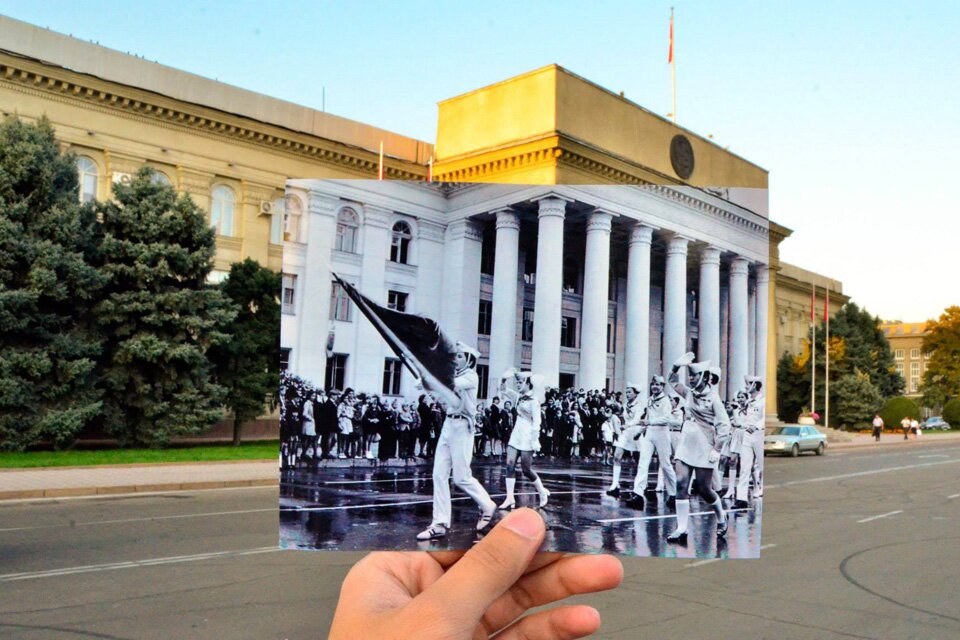
Central Square – Then and Now … bringing changes into focus – you can see more examples of photo montages like this here.
A short while ago I met a journalist who hadn’t been to Kyrgyzstan for many years … as it happens, it turns out that he had written one of the first, (if not the first), guide book to Central Asia after Independence and he was interested to see that we had a copy on the bookshelf in our office. (For the record: He’s also written an account of an early historical visit to the region – but I don’t have a copy of that one.)
As a result, our conversation took a slightly different turn; usually I am asked “what sort of changes have you seen over the years?”, but this time, instead of being asked the question, I got the chance to ask it instead.
“Yes,” he said, “it has changed a lot since my last visit.”
Of course, he had the advantage of comparing his impressions and with the current situation with which he was faced … I tend not to notice the changes until I am faced with the question or happen across some old photographs, because they tend to happen gradually over the course of time …
Normally, however, whenever I am asked the question I give three answers:
-
The amount and type of traffic on the roads: Back in the mid mid-90′s there was much less traffic than there is today … I often tell how it was possible to cross even the main roads in the city center without having to think about the “Kerb Drill”, (there I go again … showing my age … even in Britain it hasn’t been called the “Kerb Drill” for decades … it was replaced in 1970 by the “Green Cross Code“), yet alone having to make the adjustment it “Look Right, look left, look right again …” to “Look left, look right, look left again …“, (because here they drive on the other side of the road), for the simple reason that there was so little traffic … and you could hear approaching vehicles …It would be a very big mistake to try that nowadays … you would be taking your life in your hands -What’s more, the vehicles were quite different … apart from public transport, (buses, trolleybuses and minibuses), the traffic was a mix between old Soviet style vehicles such as the Moskvitch, Zhigulu (Lada) or Volga … there was a mix of European modals such as BMW and Mercedes. American vehicles such, as Fords, were not very popular – mainly, as I understand it, because of the difficulties experienced in terms of maintenance and obtaining spare parts.
Nowadays a large number of vehicles are imported – but rather than being shipped in from factories in other parts of the same country (the Soviet Union), they are imported from abroad … and most are second hand, “Used Cars” that the original owners have discarded as they upgrade to a later model rather than new vehicles. This has become a fairly major business with individuals regularly traveling to Europe where they buy a vehicle and then drive it back. It used to be that the vast majority were bought in Germany, but later the Baltic Countries became the main supplier … and then Japan. Japanese vehicles are popular because they tend to be reliable … and, perhaps, more importantly, they are also cheaper than equivalent European models.
The Japanese connection has also introduced a new, controversial element in that the Japanese, like the English, drive on the Left hand side of the road … which means that the steering wheel is placed on the Right hand side of the vehicle. These Right Hand Drive vehicles are said to be involved in far more accidents than their Left Handed equivalents and there have been a number of moves to ban them … either altogether in an absolute ban or their import, (basically prohibiting anyone buying one), or in terms of their use – prohibiting their use for carrying paying passengers (e.g. as a taxi) or, indeed, for any commercial use.
Another relatively recent arrival – is the 4WD SUV or People Carrier. A lot of the international organizations have brought such vehicles into the country – they are reliable, sturdy and good for Kyrgyzstan’s road conditions. As a side effect, they also became a status symbol with the more affluent people electing to move away from sedan cars, no matter how prestigious the model.
-
The number of restaurants and other places of “entertainment”: When I first came here there were lots of cafeterias in the city center which people would frequent, especially at lunch times. There were precious few cafés, and even fewer restaurants (which tended to be cavernous and either sparsely populated by diners or “closed” for a “banquet” – such as a Birthday or Wedding Party). As for bars they were basically cheap, of the “spit and sawdust” variety, often open air and under canvass hoardings.In a way, that’s understandable … people tended cook and eat at home … they only went out for special occasions. As the level affluence and disposable income has increased, (at last for some people), there is a greater trend for people to take the opportunity to “go out” for a meal …As a result, nowadays there are a growing number of such establishments. Many of them well appointed and comfortable and serving an incredible choice of cuisines – at least here in Bishkek, although not such a great variety elsewhere in the country.
There’s even a variety of “fast food” outlets. To be fair, there always has been “fast food” outlets in the form of Stoliyaya, (literally Dining Rooms), Cafeterias, and Ashkana (literally Tea Houses … but they sold sorts of food). Now there are hamburger joints, such as Begemot, (literally Hippopotamus), Pizzerias, and even our own KFC – Kyrgyz Fried Chicken).
One of the more recent innovations is the Kaffeinaya - the Coffee Shop – a sort of up-market cafe specializing in serving Coffee (the real stuff – Espresso, Cappuccino, Americano, Latte … etc., not just Nescafé or some other brand of instant coffee), specialty Teas, Hot Chocolate and a variety of cakes … and sometimes some serious dishes as well.
- The amount of construction: sometimes it seems as if Bishkek is just one big building site. Apart from the self-build that takes place in the micro regions, there are a large number of large buildings being erected around the city. I’ve said elsewhere how on the ten minute walk from the building which houses both my office and apartment and the hotel, everyday I pass more than ten large construction sites – apartment blocks, office buildings, … and new hotels … .I won’t comment on the number of hotels, but most of the apartment blocks tend to comprise expensive, “elite”, apartments. This is sometimes a source of contention … provision of housing was an important issue in the Soviet Union where one of the chief responsibilities of the state. That included the provision of low cost accommodation for “first time buyers” and social housing for people like the disabled or former inhabitants of orphanages. There have been moves to require those building apartment blocks to allocate a quota of apartments for such social housing.
Of course, there are other things that I could highlight … here’s just a few examples … I would be interested to from others what they might think are worth noting:
-
The rise of the Mobile Phone: One of the most notable features of modern day Kyrgyzstan is the predominance of the mobile phone. Sometimes it seems that almost everyone has a mobile phone. Indeed, according to official statistics, more phones have been imported, sold and registered than there are people in the country.
I remember back when I first arrived here there were no such telephones, and people often had a long wait for a landline to connect them to the national network so the appearance of the mobile was a great boon to many.And not just in the cities; although coverage is not universal it does reach across vast swathes of the country and even into many remote mountain settlements. Indeed, driving through the mountains on the way up to Naryn, we pass by several antennae which help to give this extensive coverage throughout the country.
- The power of the Internet: I tend to consider my mobile phone as exactly that … a “mobile telephone” – so I am not limited to a single location and out of touch when I am on the move. These days, however, mobile phones, offer a whole host of facilities: – a Short Messaging System, (SMS); as an address book; calculators; as a calendar and a diary; as cameras for taking photographs and video clips; as a games machine … and even for internet access.The country has a remarkable record when it comes to internet usage – with a sizeable proportion of the population “internet literate”, using it not only as a source of information but also as a means of communication; there is lively community of bloggers and social media users.
- Shop windows: It’s a small thing, but back in the mid 90′s there were very few shops which had large plate glass windows – virtually everywhere else had small windows, especially where the shops were basically converted apartments. Basically, you had to actually go into the shop to see what was on offer. Nowadays, although there are still plenty of such shop fronts, there are also many with laegr display windows with bright, colourful and cheerful displays.Another innovation with shop fronts – and also offices and other enterprises and oganizations … even, in some cases government agencies – is the display of the name … which used to take the form of a small plague – maybe 45 cm square – but is now more likely to be emblazoned across the whole of the shop front – often lit up and colourful, with a graphic instead of the simple bare text.
-
Advertising: Shop Fronts are just one way in which enterprises can attract the attention of potential customers. There are lots of other possibilities – some of which still exist … but then there are a whole host of new techniques which have opened up. Back in the mid-90′s, the most common form of advertising seemed to be the classified ads in the back pages of the newspapers – and they still serve as a major form of getting the word out. There were also display adverts back then, but there are far more now – and even specialist publications with pages and pages – many printed in colour on glossy paper. There were also adverts on the television and radio … and they still exist and although some look as if they could have been produced back then, others have been adapted to fit the twenty first century.
What has been very noticeable, especially here in Bishkek, the emergence of the advertising hoarding along the main roads of the capital. These emerged towards the end of the 90′s but there are now many more of them – and they seem to be much bigger and more colourful than in most Western city centers.
By far the biggest change, however has come with the internet … most enterprises, no matter how small and specialized, now seem to have their own website and make extensive use of internet facilities to publicize their offerings. In particular, social media and internet forums are scoured for the latest offers before any major shopping decision is undertaken.
-
The resurgence of the Kyrgyz Language: When I first came here, Russian was definitely the predominant language … although that may well have been a function of the fact that I was based in Bishkek. Kyrgyz was used and some signs, adverts and so forth were to be seen, but Russian predominated and I am sure that if I had been based in another part of the country, then Kyrgyz would have been the predominant language.
In the period since Independence, there has been a resurgence in the use of Kyrgyz … and a definite official policy to support its development and use. As a result, you are much more likely to come across notices and adverts in Kyrgyz – and although they are sometimes, (frequently even), displayed in two languages, there seems to be a greater, and growing, number of cases where the text is solely in Kyrgyz.
.
These are just some of the changes that I think are worthy of note … I can think of others … such as the number of women drivers, or the level of political engagement … but I would be interested to hear from others what they think I could have included … any suggestions?





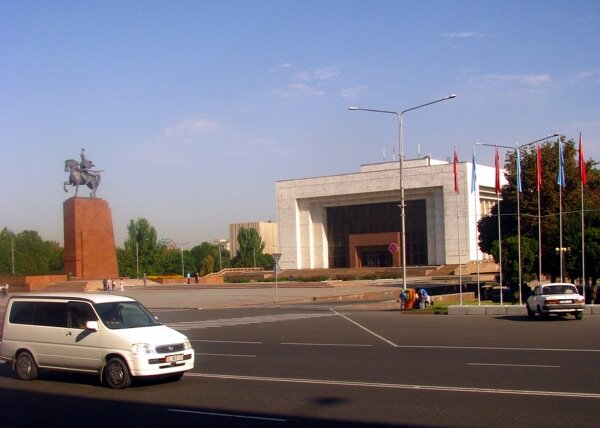
 Bishkek