Casting votes
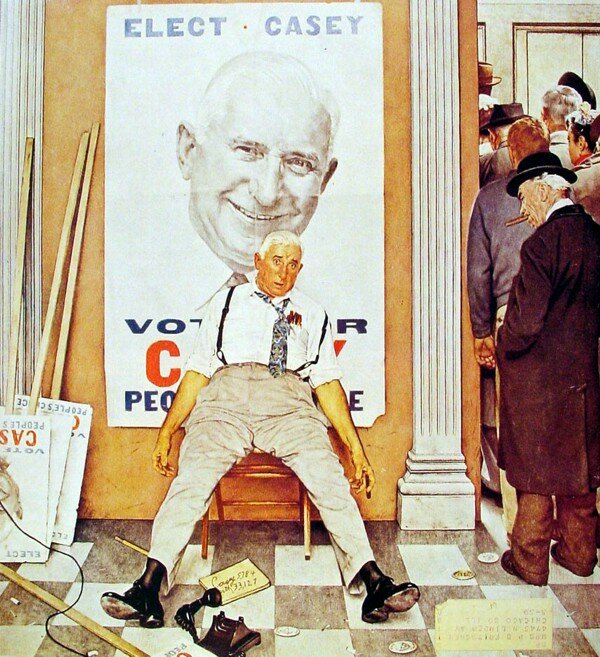
Norman Rockwell’s “Elect Casey” – also known as “Before and After“
I know that some people don’t consider Norman Rockwell as a serious artist, including, incidentally, Rockwell himself – who modestly referred to himself as many of his critics did – as an “illustrator”.
He was, however, a prolific artist, producing over 4000 paintings in his working life … but he is probably best known for the three hundred or so that were featured as cover pictures for the Saturday Evening Post.
I din’t know all them, but one of my favourites is Elect Casey – which appeared on the cover of the magazine in November 1958. It is also known as Before and After … because it juxtaposes a pair of portraits of a politician … one on an election poster – produced before the election – full of optimism and promise … the other – expressing shock, disappointment and exhaustion after the results have been declared – and at the feet of the politician is a note of the results – Casey: 5718 votes, and for his opponent Smith: 33127. A landslide defeat!
There are other things to note about the painting, but one of the most interesting is that Casey was a real person … Bernard T. Casey, from Boston, who served eight terms a Massachusetts State legislator. I don’t know if he ever used the slogan “The People’s Choice” as the posters in the picture proclaim, but I understand that he he actually “sat” for this painting.
Now, why he should agree to such a portrayal is a mystery … or, for that matter, what contribution he might have made to the composition – especially given the fact that, apparently, he never actually lost an election … yet alone lost one by such a landslide margin.
.
It is easy to see, therefore, why such a result might be surprising … especially to anyone from Massachusetts who knew the lawmaker and his winning ways. Some election results do come as a surprise … for example:
- there was the victory of Harry S. Truman, which went against (virtually) all the predictions, in the 1948 Presidential race;
- the victory of Clement Atlee’s Labour Party over the Conservatives led by the wartime leader Winston Churchill in 1945;
- the British general election of 1992, which took everyone by surprise when it was won by the conservatives under John Major in basically the last two days of the campaign;
- the cliffhanger finish to the 2000 Presidential race in which the choice of the next “leader of the Free World” hung on the odd “hanging chads” in the state of Florida.
Then there was the General Election of 1997, when Michale Portillo, (the man tipped by many pundits to be Britain’s next Prime Minister), lost his seat in a “safe conservative seat” as the result of a massive seventeen and a half percent swing, to an unknown character called Stephen Twigg … who seemed as amazed as everyone else at his victory. This one sticks in my mind because the constituency, Enfield South, was my constituency … but I basically missed out on the event because I was already here in Kyrgyzstan, although I did actually see the declaration broadcast live on BBC satellite TV.
Now, it just so happens that today is Polling Day in Britain … it’s not a General Election; they are not voting to decide who sits in the Parliament – and hence for the next government of the country. Today sees three different elections –
- local government elections – to various local councils up and down the country … which includes
- the election of three mayors in different parts of London, and
- who take up seats as British representatives in the European Parliament – it’s the first of four days of voting across Europe.
This means that, whilst for some people it may be that there is no vote, (… for example, if there is only one candidate standing for a particular seat), other voters may be faced with one, two or even three different ballot papers … and the rules governing the system will be different. In some cases it will be a Winner Takes All, or First Past the Post with just one winner – the one that gets the most votes. In others, the voters will be given the chance to express an order of preference and procedures will be applied in “the count” to try and make sure that the winners actually have the confidence of the electorate – or, at least, of more than half of those who cast a vote.
.
Running an election is not easy … and elections here in Kyrgyzstan are often criticized as falling “short of international standards” in one or more ways. I am not going to comment on that here – maybe another time … but I thought this brief history might also be interesting.
Since Independence in 1991 we have had six Presidential elections, (in 1991, 1995, 2000, 2005, 2009 and 2011 … there was also the Referendum in 2010 which resulted in approval the appointment of Roza Otunbaeva as an Interim President), five Parliamentary elections, (in 1995, 2000, 2005, 2007 and 2010 … the first Parliament had been elected in 1990 as the Supreme Soviet of the Kyrgyz SSR), and seven referenda, (in 1994 – in January, 1994 – in October, 1996, 1998, 2003, 2007 and 2010 … there had also been a referendum across most of the Soviet Union in 1991 – although it was boycotted in Armenia, Estonia, Latvia, Lithuania and most of Georgia and Moldova).
The Supreme Soviet of the Kyrgyz SSR – which was to declare Independence and sit until 1995 – was elected in two rounds in February and April 1990. Although, at that time, the only political party in the country was the Communist Party, some Independents were elected. The turnout was said to be about 92% – with 90% of the seats won by the Communist Party.
The All Union Referendum on the future of the Soviet Union held on March 17th, 1991, saw a turnout of almost 93%, with almost 96& voting in favour of preserving the Soviet Union.
Following Independence, the Presidential election held by universal suffrage was held on 13th October, 1991 … but there was only one candidate – Askar Akaev, who had been elected to thewly created post by the Supreme Soviet the previous year. In this election of the populace he polled 95.4% of the vote, on a turnout of 89%.
In January 1994, a referendum was held on constitutional changes and confirming the status of Akaev as President – the result was an affirmative vote of some 97% of the reported turnout of 96%.
That was followed in October the same year by a second referendum – this time asking two questions: if the population approved the use of referenda as an appropriate instrument for deciding questions about amendments to the constitution and other basic laws – a referendum on referenda - and if the Parliament should be reorganized into a two chamber institution. Both questions were approved – by votes of almost 89% based on a turnout of 86%.
The following year saw election of 105 members to the two chambers of the newly reorganized parliament – and although turnout was 76%, the results were far from convincing in that members were elected representing 11 different parties … four gaining just a single seat, the Part of Communists gaining three seats, and the Social Democratic Party becoming the largest party having 14 seats … however, they were still outnumbered by the 24 members from other parties … and the 67 Independents.
At the end of the year, the Second Presidential election was held – with a turnout of just over 86% – in which Askar Akaev, (with 72.4% of the vote), defeated Masaliev, ( the candidate from the Party of Communists – who polled 24.7%) and an Independent. Interestingly, just over 1% of the voters cast their ballot “Against All” (i.e. “None of the Above”) … with a similar number of spoiled papers.
The following year, in February, another referendum was held to approve a law introducing amendments to the Constitution … which was passed with 98.6% of votes cast in the 96.6% turnout.
There were still a number of issues that proved to be controversial and in October 1998 a referendum was held to approve changes to the structure of the Parliament, limiting some of the powers of the parliament and, interestingly, introducing the private ownership of land. These measures were passed with an approval rate of 95.4% of the 96.4% of the electorate who cast their vote.
The second parliamentary elections were held in February and March, 2000. This time the turnout was just less than 65% and only four parties won seats – but the Social Democratic Party remained the largest … this time far outnumbering the opposition parties with their 11 of the 15 seats won by political parties … whilst the number of independents who won seats rose to 73.
Askar Akaev went on later that year, (in October), to defeat five alternative candidates with over three quarters of the votes cast to win another term on office, (based on votes from 78.4% of those registered as being able to vote).
More constitutional changes were proposed – including increasing the powers granted to the President, changing back to a smaller, single chamber parliament; changing the distribution of powers between President and the parliament powers – all of which was approved by about 90% of the votes cast in a referendum in February 2003.
Parliamentary elections were held in 2005, the first round on 27th February with run-off votes on 13th March. Over 400 candidates stood for the 75 seats in the new parliament, and although the majority were Independents, only six won seats in the first round … outnumbered by what was seen as pro-government candidates. Protests were held before the run off elections, and although they were held the results were not officially compiled before the events of the Tulip Revolution rendered them obsolete. The new authorities under Bakiev originally said that they would hold new elections but in the end, following a see-sawing process of transferring authority, they decided to work with the new legislature.
In July a Presidential election was organized. Six candidates were registered but Kurmanbek Bakiev was expected to win easily … and he did, gaining just short of the 90% of the votes cast … his nearest rival attracting less than 4% of the votes.
Following the revolution, a number of constitutional amendments were introduced – but these were overturned by a decision of the constitutional court, which led to a referendum on a new proposed constitution and a new law on elections – based on party lists. It was claimed that the turnout was over 80% with over 95% of the votes cast in favour of both questions.
Following the referendum, new parliamentary elections were called for December 2007. Although 22 parties originally applied to field candidates, only twelve actually participated. In the end, only three parties won seats: Ak Jol – the newly formed “Presidential party” who gained 71 of the 90 seats and thus became the majority party , the Social Democratic Party of Kyrgyzstan with 11 seats and the Party of Communists with 8. Other parties were denied seats on the basis that they had failed to meet certain threshold limits.
In 2009, the four year term of office won by Bakiev in 2005 was coming to an end … and a new election was called for July, 2009. Six candidates contended the election, but on election day two of them announced their withdrawal from the race – claiming fraud and other irregularities. In the face of the confusion, a turnout of just under 80% produced over 76% of votes for the incumbent, Bakiev, just over 8% for his leading rival – Almazbek Atambaev, (despite his eleventh hour withdrawal of his candidature).
Following the revolution of 2010 which resulted in the overthrow of Kurmanbek Bakiev, a referendum was arranged for 27th June, designed to approve a new draft constitution which would reduce presidential powers and effectively approve Roza Otunbaeva as the legitimate Head of State until new Presidential elections could be arranged. In the lead up to the plebiscite, riots and disorder erupted in the south of the country … and there were considerable concerns about the effect this might have on the turnout and validity of the results. As it happened, the eventual turnout amounted to 72.25% of the electorate – with almost 92% voting to approve the new constitutional arrangements.
The referendum cleared the way for a new parliament to be elected … and this took place in October 2010. Originally, it had been planned to hold Presidential elections on the same day but in the end it was agreed that Roza Otunbaeva would remain as an interim leader and head of state, charged with the task of organizing new Presidential elections within a year. In the meantime, over 3000 candidates competed for the 120 seats … each party had to pass specific thresholds in order to be allocated seats. The eventual turnout ion polling day, at 55.9% is a record for the lowest turnout so far. Five parties passed the threshold figures, (with one more falling just short), but the percentages of votes gained by each of these parties – and hence distribution of seats allocated to them by the Central Elections Commission – were more or less evenly distributed betwee. the parties: The largest party, Ata Jurt, winning 28 of the 120 seats and Ata Meken, the smallest, just 18 seats. No single party could claim a majority and a coalition had to involve at least three of the five parties in order to command a majority.
Eventually, Presidential elections were called for October, 2011 and achieved a turnout of just over 61% of the electorate. The Prime Minister, Almazbek Atambaev, was clearly the “Front Runner” and with over 63% of the votes, duly being declared the winner.
.
Already, people are looking to the future with an eye on the next round of elections – first the Parliamentary elections due in 2015 followed by the next round of Presidential elections in 2017.
It is true that, over the years, most of these elections have been criticized – with a lot of skepticism expressed about the turnout figures and the number of votes that it is claimed have been cast for individual candidates or parties – but I think that coping with three different ballot papers and coping with three different voting systems, (as some people in London will have to do today), might also be a little a daunting.
Deciding on exactly who is “The people’s choice” is not as straight forward as it might seem at first glance. Even if he has suffered a landslide defeat, I am sure that Casey would have tried to come back … next time round.




 Bishkek