Azamat Sydykov – Concert Pianist
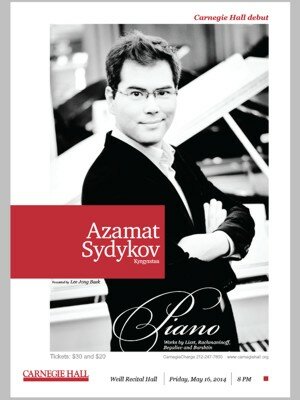
Flyer for tonight’s concert at Carnegie Hall
There will be a concert recital tonight in the prestigious Carnegie Hall in New York, given by the Kyrgyz pianist Azamat Sydykov. Although he is now based in New York and performed at many of the the other prestigious venues in the city, this will be his first performance in the Carnegie Hall … indeed, it will be the first solo performance by any Kyrgyz musician in the hall.
He is very articulate and has recently given a number of interviews which have quoted at some length … (for example: here, here, here, here, here - they are all in Russian … but his official website is here - it’s in English) … with much more detail than I will draw on for this postcard. They touch on his life so far, and his “philosophy of life” and his aspirations for the future.
Sydykov was born in Frunze, (as Bishkek was then called), on 3rd February, 1986, into a musical family, (his mother being an academic at one of the universities and his father the Artistic Director and Chief Conductor at Opera and Ballet Theater), and he grew up in a musical environment, (the family lived in a hostel for musicians – his neighbours were all talented musicians – performers or teachers).
In 1991 he was sent to the Abdraev National Special Music School where he studied for the next eight years – in this time winning national music competitions five and also the Musician of the Twenty First Century competition in Kazakhstan.
If you’ve done the maths you’ll have realized that he was five when he started at Music School, (! – schooling here normally starts at seven) … and that competition in Kazakhstan was held in the Twentieth Century(!)
Although he grew up surrounded by music, it wasn’t taken for granted that he would also be a musician. He says that his mother wanted him to become a lawyer. Despite that, she tried to interest him in learning the violin … although his teacher thought he would be better suited to the larger viola … but then he was introduced to the piano – which immediately captured his attention and affection.
He came to the attention of President Akaev, who took an interest in his development … often taking him on State visits to perform for different heads of state. That obviously gave him a lot of valuable experience and he speaks highly of the opportunities it gave him. Later, however, it was to be the cause of some criticism … especially from some of those who came to oppose Akaev.
Despite this early introduction to to the world of political elites … he does not seem to be entirely happy with the idea of politics – although he often asked if he sees it as a possible career for himself. He says that he thinks that creative people should take an active interest in society – including politics – but at the moment does not see such a role for himself. He is an artist, a musician, a performer.
When it comes to the administration of the arts, for example, he argues for “Art outside of politics”. He is adamant that the two should be separate – that the state should establish the necessary infrastructure and a a conducive environment in which the arts can survive … but it should not try to manage the arts – theater, music and so forth. Drawing on examples from both the former communist regime and the “free market economy” he argues that political control over the arts leads to stagnation and stifles both creativity and potential and that what is needed are talented “managers” who can enable the artists to develop and fulfill that potential.
Then, in 2000, he moved to Moscow where he lived and studied for the next twelve years – apart from when he was giving concerts; traveling extensively throughout Russia … and abroad. At first he attended the Moscow Central Music School, then in 2004 entering the Tchaikovsky Conservatory.
In 2011 he moved to the States, enrolling in the Mannes College of Music at the New School university located in Greenwich Village, New York, (the third largest university in the city and counts Gershwin and Copland among its graduates) … once more combining studies with numerous concert recitals.
Some of those concerts have been in aid of various charitable organizations or causes. For example, he has performed for the Meerim foundation, (a children’s charity established by Meerim Akaeva when she was First Lady), and more recently at special concerts for those who suffered as a result of the events in Southern Kyrgyzstan in June 2010.
As well as performing, he has also been involved in the organization and management of several events, for example as the Music Director of festivals.
One of the recurring themes in the interviews was his Love of Music – he is quoted as saying that he wants Kyrgyzstan “to love Classical Music”. He says that he is not particularly ambitious, comparing himself to a footballer who “likes to kick a ball around”.
He tells of two months when he undertook an office job … and says that he was moderately successful. It had its advantages, like a regular paycheck, but … he gave it up because he realized that he was missing the music.
When asked about what sort of music he prefers, he says that he particularly likes the Romantic classics, and cites both Listz and Rachmaninoff in the interviews … but he also admits that his “favourites” vary over time as he encounters something new … and that his “always open to new and interesting” music.
As well as here in Bishkek, he has appeared in concerts in China, Finland, Germany, Iran, Italy, the Netherlands, Russia, Spain, Switzerland, Turkey, Ukraine and the United States. Amongst his recordings are renditions of Tchaikovsky’s First Piano Concerto, Liszt’s First Concerto and Beethoven’s Fifth.
Here’s the promotional video for his concert in Carnegie Hall:





 Bishkek