Kaulbars
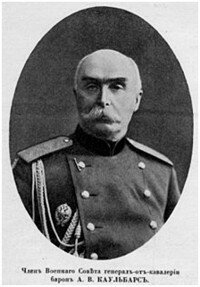
Alexander Vasilyevich Kaulbars
One hundred and seventy years ago, (on 14th May, 1844), Baron Alexander Vasiliyevich Kaulbars was born in what is now Estonia. He was to go on to become a General in the Imperial Russian Army serving in the Russo-Turkish war, the Russo Japanese war the suppression of the Boxer Rebellion and the occupation Manchuria, not forgetting the First World War … oh, yes, and an explorer of Central Asia.
He was born into a family of the Swedish aristocracy that decided to remain in Estonia when it was ceded to Russia and both his father and brother also rose to the rank of General in the Imperial service, and he followed in their footsteps, studying at the Nikolaev Cavalry School and seeing action early on in his career suppressing a Polish uprising. He then went on to study at the Nicholas General Staff Academy and received a commission as a Lieutenant beign assigned to the Turkestan Military District which covered Central Asia.
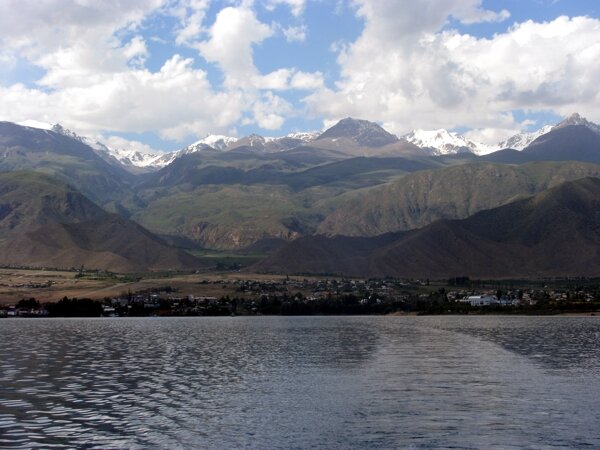
He quickly rose through the ranks and explored the country around Lake Issyk Kul, publishing a report under the title Materials on the Geography of the Tien Shan, which won him a Gold Medal from the Russian Geographical Society.
In 1869, the Turkestan Military District of the Russian Empire sent an expedition commanded by Kaulbars who was charged with deciding upon the site for a fort, administrative center and associated settlement. Attracted by the location at the foot of the Terskey Ala Too mountains, his party began surveying and planning the layout for what became the city of Karakol.
The garrison which was to take up residence consisted of an infantry battalion, a mountain battery and 200 Cossacks. As with other settlements designed by military engineers at that time, the town plan was based on a rectangular grid of streets. Later regulations ensured that every house that was built had to include a garden and an avenue of trees outside. These avenues of Silver Poplars are still evident today. Construction proceeded rapidly. Within two years of Kaulbars’ arrival in the district there were several streets already built up, and the community consisted of 80 rich farmsteads and five mills. In the streets there were over 50 benches.
He also explored the Russian Chinese border looking for passes into China, surveying the summit of Khan Tengri in 1870. (He actually visited Kashgar a couple of years later in order to undertake negotiations for a commercial Treaty with Yakub Beg, who was then the de facto ruler of the city.)
He participated in the conquest of the Khanate of Khiva by the General Konsatantine von Kaufman in 1873, exploring the Anu Darya and Syr Darya’s Rivers – as far as the Aral and Caspian Seas … his reports of which earned him another Gold Medal.
Although his name will always be associated with the region, that marked the end of his direct connection with Central Asia, as he was promoted to the General Staff and his career took him to other theaters.
He was finally dismissed from the Army in 1915, when he was serving as the the commander of the North Western front and was responsible for military aviation. It wasn’t the end of his public career, however, as he was appointed Governor of Odessa the following year.
Following the Bolshevik Revolution in 1917, he moved to Southern Russia and, a confirmed monarchist and amti-Bolshevik, he joined the forces of the White Russians … albeit, as a reserve, given his advanced age. When it was clear that they had lost the Civil War, he evacuated to Constantinople and later to Bulgaria … and finally to France.
He died in Paris on 25th January, 1925.





 Bishkek