Vasily Radlov
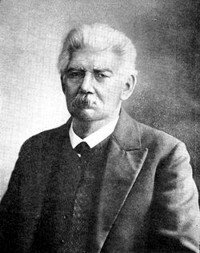
Vasily Radlov (17/01/1837 – 12/05/1918)
Vasily Radlov was born Friedrich Wilhelm Radloff, in Berlin on 17th January, 1837; the only child of a local police commissioner. The change of name is just one of the fascinating things about his story.
In 1854, after finishing school, he enrolled at university and studied Philosophy. His initial interest was in Theology but he developed an interest in linguistics - especially comparative historical linguistics - attending lectures by some of the experts of his day. This led him to learning several Oriental languages especially those of the Ural and Altai districts of Siberia. He decided that it would be advantageous to travel to the region to study them in situ and so he also started to learn Russian.
In 1858 he defended his thesis on the “Influence of Religion on the People’s of Asia” … and was awarded his Ph.D.
Immediately afterwards, he traveled to Russia in order to further his studies in Asiatic Museum, earning a living by giving lessons – eventually being appointed to a position teaching German and Latin … at the Barnaul School of Mines (!) in the Altai. The mind boggles … German and Latin ?! … I suppose the students were not necessarily typical of the normal stereotypical image of a Miner) … but this had, for him, the great advantage of this post was that it gave him the opportunity to study the languages of the Altai directly.
The following year he obtained a formal teaching qualification and became a Russian citizen … changing his name to Vasily. He also got married to his fiance whom he had met in Germany … and together, over the years, they had five children.
Now that he was established, he set about studying the local Turkic languages, history and folklore. At first he took an adviser with him on field trips to act as an interpreter, but within a couple of years was fluent enough to converse directly with the locals on his annual summer expeditions and a few years later began publishing the results of his studies. He started with a selection of texts in Turkic languages together with translations into German in what was to be four volume collection … and was to make his name as an expert in the field.
He wasn’t just interested in linguistics and folklore, but also undertook archaeological excavations in different regions of Central Asia – in six years in the 1860′s excavating over 150 burial mounds. In a way he was a pioneer and developed new techniques - and improved existing ones – for studying these ancient monuments.
Returning to St. Petersburg via Kazan where he received a new appointment … and set about organizing several aspect of the education system, establishing a girls school, writing and editing new textbooks … and studying the local Turkic languages – publishing several scholarly papers.
In 1844 he found himself back in St. Petersburg where he was elected to the Imperial Academy of Sciences, where he was appointed as the Director of the Asian Museum, whilst teaching at the Faculty of Oriental Languages. As well as continuing his studies and publishing, her also led a number of expeditions – including the one which discovered the famous Orkhon-Yenesei runic inscriptions in Mongolia. Although he found the key to deciphering them and completed the translation, the initial work was done by the Danish linguist Thomsen.
He was later appointed to head the Museum of Anthropology and Ethnography. In this role he was able to draw contributions from many new sources, explorers and travelers, (such as Prezherevalsk), scholars who had been ostracized because of their anti-monarchist sentiments and so forth – thus expanding the range, breadth and depth of the museums coverage.
It wasn’t all smooth sailing, however, as there was considerable anti-German sentiment among the members of the academic community – and in one particular review he was accused of plagiarism and the “unfair use” of materials collected earlier by Russian missionaries.
He died on 12th May 1918 and was buried in Lutheran Cemetery in Smolensk.
.
Although, as far as I can tell, he never made it to the Tien Shan … he did encounter the Kyrgyz (or, as he refers them, Kara Kyrgyz - Black Kyrgyz – to distinguish them from the steppe Kyrgyz – now known as Kazakhs) and there is and interesting section in his Diary, From Siberia. It offers a comparison of the Cossacks and the Kyrgyz … and it is not always complimentary, (describing them as a “tricky and unreliable people, curious and flattering, always a lot of promise and never fulfill its obligations”), but, as he says himself, he “lived with black Kirghiz too little” and therefore “can not make any judgments about them”.
He also says that he is also convinced that they are better than their reputation among their neighbours who carry a “hatred” for them resulting from the raids and looting. This hatred tends, he says, to act as a unifying force among the people that did not have a Khan. He draws attention to their being passed, like a “ball”, between different powers for centuries, who abused them and taxed them heavily.
One surprising aspect of his account is that the Kyrgyz were, as well as being pastoral farmers with herds and flocks, were also engaged in agriculture, achieving greater yields than those achieved among the Cossacks and made extensive use of irrigation.
Radlov is particularly remembered among the Kyrgyz for his description of the Manas epic. Writing in 1885, described an encounter with an unnamed Manaschi who performed excerpts from the epic saga for him … from which he made made notes. He said that the language used in this version was “very modern, corresponding to the present day Kyrgyz language without archaic words or phrases” – suggesting that in at least this respect, up until this time, the oral tradition was adapted to the “contemporary” audience – and that the manaschi was sensitive to the restlessness of the audience adapted his performance accordingly; “… because any talented narrator’s performance is guided by inspiration, he never performs word for word the same piece twice,” - although that doesn’t mean he was inventing new verses, but was simply adapting the basic elements to reflect the mood and context of the performance.
.
Radlov’s work had played a vital role in the developing knowledge of the peoples, language, history and folklore of the peoples of Central Asia – including the Kyrgyz. During the Stalinist repressions of the late 1930s, however, the NKVD and state science apparatus accused him of Panturkism, – a serious crime in the face of the Soviet attempts to deal with the Nationalities issue and mold a new unified following the Revolution and a devastating Civil War. As a result any perceived connection with the long-dead Radlov was treated as incriminating evidence against any Orientalists and Turkologists, some of whom were executed as a result.


 Bishkek