History Man – Vladimir Mikhailovich Ploskikh
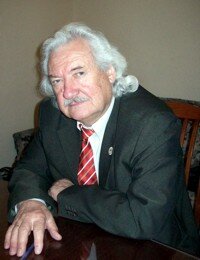
Professor Vladimir Mikhailovich Ploskikh … the History Man. Photo from the site of the Kyrgyz Russian Slavic University named after the first President of Russia B. N. Yeltsin.
I have a confession to make … my diary for today had a mistake … and it is probably a result of my bad handwriting.
I had today, 16th April, down as the birthday of Kyrgystan’s version of “The History Man” – Professor Vladimir Mikhailovich Ploskikh … in fact it should have been 10th April. It’s an easy mistake, confusing a ’6′ and a ’0′ … and I only found my mistake when I came to prepare this postcard to commemorate the occasion.
A simple mistake, but an embarrasing one – I hope Vladimir Mikhailovich will accept my apologies and belated Birthday greetings!
Ploskikh was born in a small apartment in Akmola in Kazakhstan, (which is now known as Astana and is the capital city). That was in 1937, but he has a long association with Kyrgyzstan where he now lives and works.
His father was an official of the local railroad and during the war years, when he was still a young child, the railroad was one of the major arteries of the Soviet Union, carrying arms, armies and vital supplies Westwards – and bringing materials and equipment back for repair … along with a varied human cargo, (refugees, exiles and prisoners), back Eastwards.
His ancestors family had been serfs in the Cherniev but were exiled to the Urals for taking part in a rebellion – having first been severely flogged. The land to which they were were assigned was not good and after 24 years his great grandfather took the family to the Kazakh steppes – the great flat lands, which it is said, was probably the origin of his surname.
As a youth having followed a teacher training course, he worked in the Pioneer Organization in his home town, Akmola, before entering the Kyrgyz State University, (now called the Kyrgyz National University named after Djusup Balasgyn), in Frunze, (as Bishkek was then called), from which he graduated in 1960. It is said that his choice was guided by a love of the mountains.
After a period as a school teacher of History and Literature in the Alamedin region, when he also simultaneously followed a graduate course of study, he began working in Archaeology and Ethnography section of the Institute of History at the Kyrgyz Academy of Sciences … rising through the ranks, as it were, to become the Vice President of this prestigious organization in 1993 and Head of the History Faculty at the Kyrgyz Russian Slavic University – also in 1993.
During this time he participated in a number of archeological excavations.
He continued his studies and, in 1966, defended his thesis about the relationships of the nomadic Kyrgyz in southern Kyrgyzstan to the land.
His first book, on the Kyrgyz Agrarian Relations on the the eve of joining Russia, and this was to be followed by many more. He is particularly well known for his vast output of learned articles, academic papers, (over 300 of them), and books – some of which are the standard textbooks used by History students throughout the republic, from High School to University.
He gained his Doctorate in 1979 – with a thesis on the Kyrgyz and Kokand.
His range is also substantial, touching on topics as varied as the emergence and development of the Kyrgyz state over the centuries; the traditional Patriarchal-Feudal relations of the Kyrgyz;Diplomatic and International Relations of the Kyrgyz down the ages; the ancient and late medieval civilizations around Lake Issyk Kul – and also Osh.
It wasn’t always easy going – for a period his writings were criticized for “idealizing” the past, concentrating on individuals, personalities with their own aspirations and interests, rather than socio-economic trends … and of not giving enough credit to the “will of the masses”. During the 1970s and 80s, however, he was a prolific writer and his views gained more acceptance.
He has also studied the repressions of the 1930s – and he has played a role in the “rehabilitation” of many of the innocent victims of those times with his biographies of them. His book “Manas pleads not guilty” tells the story of the Kyrgyz opposition leaders – the so called “thirty”.
One of his other enduring interests is the history of ancient civilizations around Lake Issyk Kul and in particular underwater archaeological exploration of the Lake – working last year as the consultant on a special National Geographic expedition.
He has also written, and co-authored with others, several historical novels: In 1990, for example, under the pseudonym Aman Haziyev, and together with Yuri Borodin and V. Mokrynin, he published an historical novel about the Saks of the Tien Shan and Alexander the Great called “On the banks of the Jaxartes.” The following year he published the documentary novel “Kurmandjan-Datka – the uncrowned queen of the Alai” and in 1995 the novel “Pulat Khan”
Over the years he has been granted many awards including Honoured Worker, the Polivanova and Buninskya Prizes from Russia and the State Prize of Kyrgyzstan in the field of Science and Technology - twice – as well as the Order of Manas, the Dank Medal, .
He is married and has a daughter.
Perhaps one of the greatest accolades a professional can achieve is that from his colleagues … here is what one of his fellow Academicians said of him:
There are historians who are conscientious but handle events coldly;
There are historians who who are servile to authority;
There are historians who are biased and “rippers” of the past;
There are historians who are passionate creators and sow the seeds of fruiting grain from the past to the future. Amongst these I include Volodiya. Ravenous to work but he does everything easily, without strain, He is neither a workhorse, nor a “high spirited” horse.
Not everyone, and not every historian can compete with him in fertility. He feels the pulse of the times.




 Bishkek