World Health Day
An infographic about Vector Borne Diseases
Something really incredible happened last week … it was announced that Bishkek is to commemorate World Health Day today.
The Department of Health and the Mayor’s Office of Health Promotion Center in Bishkek would be conducting a number of activities in order to acquaint people with the problems of the transmissio of infections including reports in the media over a ten day period; art educational institutions in the city would be holding events on the theme “Healthy lifestyle, prevention of infectious diseases (plague, encephalitis and typhoid).“ In addition, a wide variety of informative and educational material would be distributed and there would be a series of round tables and conferences.
Whilst the day was really interesting was that advance notice was given – which doesn’t happen very often. All too often we only get to hear about events just before – or even,sometimes, after – they happen!
World Health Day is commemorated each year on 7th April – the anniversary of the founding of the World Health Organization, (WHO), in 1948. The first such World Health Day was held in 1950 and every year the relevant bodies in the 194 member nations of WHO conduct events to help bring special issues to the public’s attention, and each year these focus on a particular theme … last year, for example, the theme was Healthy Blood Pressure: “Healthy Heart Beat – Healthy Blood Pressure” and previous themes have included:
- Aging and Health – “Good health adds life to years” – exploring the issues associated with the increase of life expectancy which leads to changes in the demographic structure of societies as people are living longer;
- Anti-microbial resistance and its global spread - focusing on the need to implement policies and measures to prevent and counter the rise of resistance in microorganisms that cause diseases;
- Urbanization and Health;
- Making Hospitals Safe in Emergencies - drawing attention to the need to invest in the health service infrastructures serving people, sick and/or injured, who are already vulnerable and fragile condition … and the need to avoid the Crimean War syndrome when being admitted into hospital was more deadly than serving on the front line;
- Protecting Health from the Adverse effects of Climate Change - which seems particularly apposite given the strange variations in weather patterns that we seem to have been experiencing;
- Investing in Health to build a safer future - emphasizing that the threats to health know no borders (as the recent outbreak of Ebola in Africa goes to show … which is just the latest in a long line of examples stretching back through history – AIDS, SARS, Bubonic Plague … ), and that Health leads to security but insecurity leads to poor health; the need to be prepared in order to provide a quick response in order to improve international health security;
- Working together for health - concentrating on Health Professionals whether they are physicians, nurses, midwives, physiotherapists … or whatever.
The theme for this year is “Small bite – Big threat” … the danger of Vector borne diseases.
For the record: in epidemiology, a vector is any agent, (a person, animal or microorganism), that carries and transmits an infectious pathogen into another living organism – for example: mosquitoes, flies, sandflies, lice, fleas, ticks and mites – even snails. Many of these pests feed on blood at some point in their lifecycle and the disease bearing parasite enters the victims body as they feed.
Mosquitoes, for example, are instrumental in the transmission of malaria, (the most of all the deadly vector-borne diseases, causing an estimated 660 000 deaths annually worldwide); dengue fever, lymphatic filariasis, chikungunya, Japanese encephalitis and yellow fever. Although much progress is being made in comatting and limiting the effects of some of these diseases – others are continuing to spread at alarming rates.
The aim of this year’s World Health Day is to campaign for better protection from these vector borne diseases, especially for those families living in areas where these diseases are common, but also for travelers visiting such regions.
On the WHO website there is a host of information and educational materials on such diseases, some of which are sadly neglected – and although it is possible to get vaccinated against some of them … there are a wide variety which
The site has lots of authoritative material similar to that available from the Center for Disease Control (CDC) in Arabic, Chinese, French, Russian and Spanish … such as this infographic.
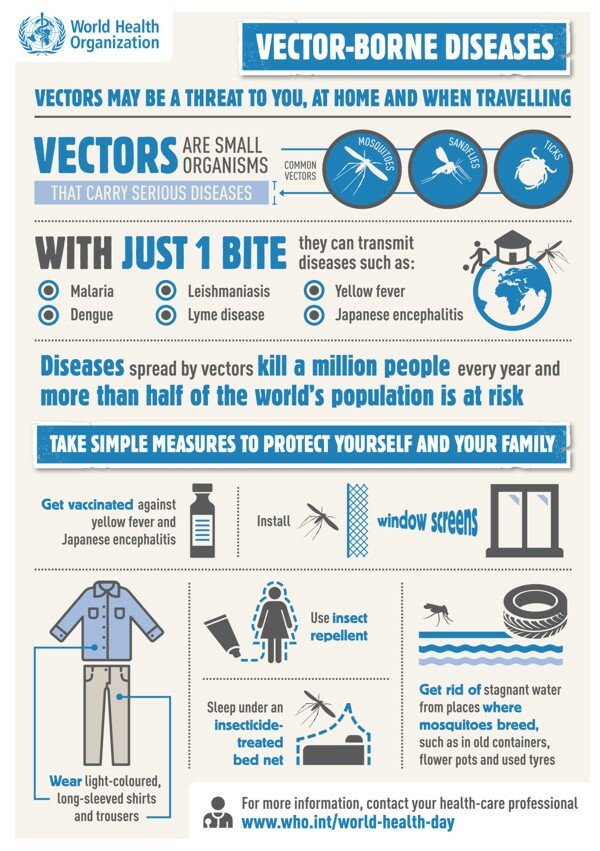
An infographic about Vector Borne Diseases
For the record: World Malaria Day is on April 25th.
Malaria is a serious disease that is transmitted to humans by the bite of an infected female mosquito. which usually bite sometime between dusk and dawn.
Symptoms may include fever and flu-like illness, including chills, headache, muscle aches, and fatigue. Malaria may cause anaemia and jaundice. Some infections, if not immediately treated, may cause kidney failure, coma, and death. Malaria can often be prevented by using anti-malarial drugs and by using personal protection measures to prevent mosquito bites. However, in spite of all protective measures, travellers may still develop malaria.
For most people, symptoms begin 10 days to 4 weeks after infection, although a person may feel ill as early as 7 days or up to 1 year later. Some forms of malaria can relapse and the parasites that cause the disease remain dormant for several years.
Malaria is always a serious disease and may be a deadly illness. If you become ill with a fever or flu-like illness either while travelling in a malaria-risk area or after you return home (for up to 1 year), you should seek immediate medical attention and should tell the physician your travel history.
Malaria used to be prevalent in Kyrgyzstan, but was eradicated from the country in the late 1950s. Since 1980, there have been sporadic “imported” cases in the country, brought here by travelers who had been infected abroad. In the early 1990s, the number of such cases started to increase gradually and in 2002, a major outbreak witnessed the return of malaria. In 2004, there were reports of over 30 hospitalized cases in the region near to Osh – apparently, among the patients were people suffering from anemia and those, who had been infected in the past (and possibly not fully recovered). In 2009, according to Ministry of Health, there were 196 cases of malaria registered in Kyrgyzstan. It is thought by some experts, that the effects of Global Warming may result in the disease reasserting itself in the region.
The Centre for Disease Control in Atlanta, on the page of their website giving advice about Malaria in the CIS countries advises that there is a risk in Southern and Western regions, (Batken, Osh and Djalal Abad oblasts) – especially the border areas with Uzbekistan and Tajikistan.
Some health officials cite growing labour migration as the main source of the disease, while others say an increase in swamps in the area and the pollution of reservoirs are the main contributing factors.
Visitors to Kyrgyzstan, (whether people coming to live and/or work in the country for an extended period or simply holiday makers here for just a short time), should consult their doctor or travel clinic before travelling and ask about the various anti-malarial drugs which can be prescribed – and which would be the most suitable for you to use.
But it isn’t just Malaria that is a serious issue … there is also, for example, tick borne Encephalitis, (TBE), a viral infectious disease which attacks the central nervous system – encephalitis is an acute inflammation of the brain. There is no specific drug therapy for TBE although anti-inflammatory drugs are often prescribed. Prevention is best achieved by using insect repellents and wearing suitable protective clothing. Apparently there is also a vaccine, but I am not aware that it is available here … it seems that it’s not available in the US, either.





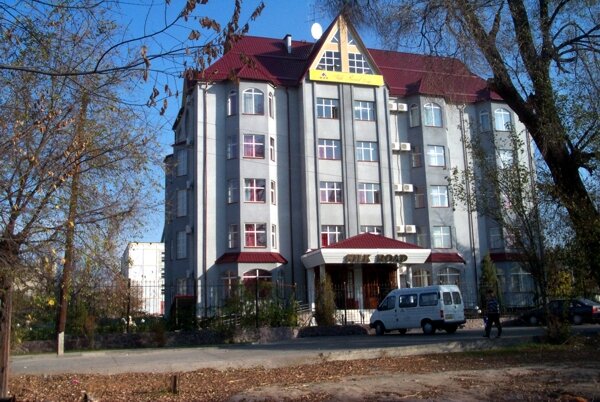
 Bishkek