Navigating a minefield
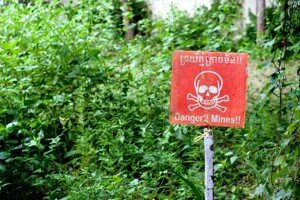
Photo: Reena Mahtani/Foter/CC BY-NC-SA
The subject of my Postcard today might seem odd, coming from someone involved in Tourism and eager to attract visitors to the country … but:
- I believe that it’s important to face reality and describe the situation “as is” – “warts and all” – rather than trying to gloss over things that seem unpleasant or inconvenient … and, anyway …
- although the subject might make some people uncomfortable, it shouldn’t actually stop people from wanting to visit, to come and see the spectacular landscape, enjoying the traditional nomadic hospitality and experiencing all that Kyrgyzstan has to offer … but, as in so many other places around the world, it is important to see the issue in context and remember that there are sensible precautions that need to be taken into account … and, anyway …
- it’s an important topic and deserves to be considered in its own right.
As it happens, today is the International Day for Landmine Awareness and Assistance, which was established as an annual event, (to be commemorated on 4th April every year), as a result of a resolution of the United Nations General Assembly, passed on 8th December 2005.
In today’s world of hi-tech, hi-precision weapons, the old fashioned mine seems out of place. They remain, however, a formidable force and although, at their most basic, their simple design, ease of deployment and operation, (easy to install and requiring no additional maintenance or commands - especially when compared to other more sophisticated weapons … and all at a very reasonable price), making them a particularly valuable element in the arsenal of those countries without a strong military, (and also among several terrorist organizations, unable to buy the latest “state of the art” weaponry), in some versions they have even been enhanced by those very same new technologies.
The dangers and damage of unexploded landmines was one of the causes supported by the late Princess Diana and her contribution helped to raise global awareness of the issue. She was spurred on by the stories, in text and pictures, of civilians, both adults and children, who had fallen victim of these weapons – many of which had simply been forgotten after being laid, left waiting for someone to pass by. It wasn’t, however, just the mines that had been forgotten – but in many cases the conflict in which they had be scattered was also confined to history. The mines, however, lay in wait, silent witnesses waiting for the call to action.
Thus the aim of the Day for Landmine Awareness and Assistance was to urge member states to create and develop national funds for demining activities in those countries where the “explosive remnants of war” still pose a serious threat to the health, safety and even the very lives of civilians … and which hinder socio-economic development.
Now Kyrgyzstan usually these commemorative days, but Kyrgyzstan has not acceded to the Mine Ban Treaty, the Convention on Cluster Munitions, nor the Convention on Conventional Weapons, nor although according to the Ministry of Foreign Affairs it technically supports the idea of total ban on antipersonnel mines mines and advocates its “successful implementation” – the reason it has not acceded to the treaty is that it “doesn’t have the necessary alternatives for border defence and lacks the financial and technical resources” to implement it. In December 2011 it changed its stance and, instead of abstaining, voted in favour of a implementation.
The Ministry has also reported that it has never produced or exported antipersonnel mines – although it did inherit a stockpile – which have technically expired – which it continues to hold “for guarding the more vulnerable sectors of the state border with difficult access in high mountains.”
.
The travel advice of the British Foreign and Commonwealth Office (FCO) for visitors to Kyrgyzstan, like that issued by many other Western governments includes the following warning:
… You should only use officially recognised border crossings in this area; there is a risk that uncontrolled Kyrgyz/Uzbek border areas may be land-mined. Check in advance which border posts are open.
This situation resulted from the Batken incidents of 1999 and 2000 when a group of insurgents crossed the border in Southern Kyrgyzstan and mines were laid by the military of Uzbekistan along certain remote and difficult to control areas of the porous border between the two countries. There were occasional press reports of people and livestock falling prey to the devices which cost something like 10 human lives, with six people suffering injuries, (although there are some other statistics quoted – one source claiming up to 20 fatalities), and about 100 animals up until about 2004/5 when, in theory, once the incidents were resolved, in 2005 the Uzbek forces undertook operations to clear the area of mines … but … it seems that rainfall and landslides had caused some of the mines to shift and some were “missed”. The local population sought to verify that the area was clear by sending cattle through the previously “contaminated areas”.
The Kyrgyz authorities also claim that, in 2003, Uzbek forces also laid mines around the enclaves of Sokh and Shakhimardan, which are sounded by Kyrgyzs territory. Once again demining operations were undertaken in 2004/5 but it’s thought that the territory around the Sokh enclave was only partially cleared although area around the Shakhimardan enclave was totally cleared of mines.
Kyrgyzstan has also admitted deploying “a small amount” of antipersonnel mines in mountain passes to stop cross borer movements of bandits during the 1999 and 2000 incidents, but stated that reports and maps of the mined areas were produced and that after the end of the military operation, the mines were removed and destroyed.
The last incidents occurred in 2008 when a two boys and a woman were killed and a man seriously injured in the Osh region.
In June 2011, a government official confirmed that “We do not have any minefields on the territory of Kyrgyzstan”.
In 2007 two people were injured trying to defuse a Mine in Bishkek and during the civil unrest in April 2010, two “mines” were reported to have been found on a road in the capital, raising fears of possible further incidents – but, fortunately, nothing further emerged. The devices were reportedly defused by a Krrgyz Special Forces team.
.
Although it sounds bad … the situation is not one that is “out of control”. The landmines were laid in remote regions to prevent further border incursions and measures have been taken to remove the unexploded ordinance. Since 2008 there have been no further incidents.
The FCO advice is probably correct in pointing out that people should only use recognized border crossings. The landmines were deployed in remote regions to prevent further border incursions and no danger should exist around official border crossings. Most of the fatalities and injuries appear to have involved people approaching or crossing the border at other points … for example locals farmers going in pursuit of livestock that had strayed.


 Bishkek