Taylik Baatyr
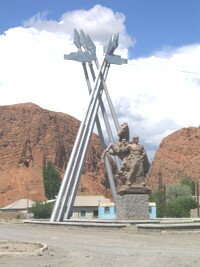
Taylik Memorial in Naryn
The brothers Alantay and Taylak were leaders of the Sayak tribe of Kyrgyz, which settled in the Naryn river valley in the region of Ak Talaa.
They are renowned for the resistance which they put up to a number of occupying forces. Their first campaign, in 1820, was against a Chinese (Tzin) unit, which had crossed the border from China in search of a group of Kashgar rebels. They attacked a Kyrgyz settlement and over a hundred people lost their lives. Taylak vowed to avenge them, gathered an army and began to pursue the intruders. The unit was completely destroyed and Taylak’s reputation as a hero warrior was set.
For the next twenty years he was to be the de facto leader of the Kyrgyz in the Central Tien Shan.
The Khan of Kokand built a number of fortresses throughout the Central Tien Shan in an attempt to cement his authority in the region. In 1831 a force under the command of Taylak and Alantay led a campaign against the Kokand overlords – but were defeated and the brothers were carried off into captivity. In an attempt to broker a peace, the Khan gave the brothers high ranking titles and set them free. After a period of time amongst the neighbouring Kazakhs, they eventually returned home. Peace, however did not last long.
In the late 1830’s, local resentment at the Kokand authorities welled up into a rebellion – and Taylak was at the centre of the uprising. His forces attacked the fortress of Kurtka – totally destroying it after a siege. A party of Kokand dignitaries happened to be in Naryn at the time and were taken captive. An attempted rescue in the form of a relief force was defeated. The Khan then resorted to subterfuge and a spy, posing as a doctor, was dispatched to poison the troublesome Taylak.
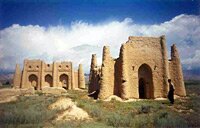
Before rennovation
Taylak Baatyr’s mausoleum is located at Ak Talaa in the Naryn region, at the foot of the road up to Lake Son Kul. As well as being striking for it’s architecture, it is interesting because it has two entrances which is very unusual. This is because it is actually two mausoleums joined together. There are two different accounts given to explain this … the first recounts that the mausoleums belong to the local khan (Taylak Baatyr) and his brother, Alantay – however, Taylak’s brother was apparently never a khan and did not merit such a grand mausoleum. The other account proclaims that the second was actually built for Taylak’s wife. In Kyrgyz tradition, women never attend the graveyard – and would not not have merited a mausoleum in their own right – but, so the story goes, on one occasion when Taylak was away, the local community was set upon by raisers and his wife successfully organized their defence and hence merited the special distinction of being granted a grand gumbez.
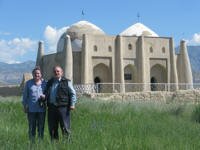
... and after
The mausoleum was renovated in 2004.
In 2002, a festival was held on the shores of Lake Son Kul to mark his 200th anniversary.



 Bishkek