I’d Like to Teach the World to Sing in Perfect Harmony

Coca Cola
Back in 1971 a new advert for coca Cola appeared on TV … and although it was based on a not so successful radio jingle … it turned out to be a highly successful advert, not only for Coca Cola also in it’s on right becoming a chart topping single in the UK, (spending 4 weeks a No. 1, although it only made No. 7 in the States).
For the record: Coca Cola was first brewed on 29th March, 1886, in Atlanta by Colonel John Pemberton, a pharmacist who was trying to find a headache cure … a syrup made from coca leaves, sugar and caffeine. Originally sold by the glass – the prescription called for nine glasses a day – at five cents a glass. Carbonated mineral water had been added to the recipe so it could be served from a soda fountain. After Pemberton’s sudden death in 1888. the recipe was bought by Asa Griggs Chandler and it’s been a closely guarded secret ever since. Chandler the product turned into a soft drink rather than a patent medicine and in the early In 1890′s introduced the sale of the drink in bottles. Now, the Coca Cola company produces a concentrate and then a local “bottler”, like the one here in Bishkek, produces finished products in cans and bottles with a combination of sweeteners and filtered water, and distributes it in their own designated area.
The advert is also known as the Hilltop commercial … it portrayed a multicultural group of young people singing on a hillside just outside Rome … each holding a bottle of Coca Cola labelled in different languages. It’s positive message of hope and love tapped into a sense of “feel good” and “flower power” arising from the “swinging sixties”.
You can see the 59 second advert here.
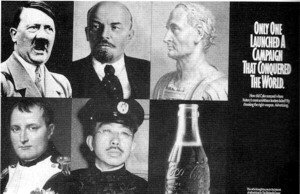
A vintage advert for Coca Cola
The approach was slightly different than that in a previous ad campaign … featuring Julius Caesar, Napoleon, Lenin, Hitler and Emperor Hirohito together with the instantly recognizable bottle of the world’s favourite hangover cure – and the caption “Only one luanched a campaign that conquered the world.”
It was, of course, a different sort of campaign: economic and cultural rather than a military and political one … and when it claimed to have “conquered the world” we have to read “dominated the market”.
Still, in many ways it marks a significant change of approach and let’s hope that it is reflected in other “campaigns”.
.
In some respects we are seeing something like that here … after the experiences of 2005 and 2010, not to mention more events in the Ukraine, the atmosphere here seems to have dropped the antagonistic, adversarial approach for a more “peaceful” one involving persuasion. The protest rally that had been planned for 17th March was postponed, with allegations that different sides were planning “provocations”, to next Monday, with calls for a “peaceful assembly” designed to “take back” Parliamentary Democracy.
Following the collapse of the majority coalition last week, the President signed the order dismissing the government in accordance with the constitution and the Social Democratic Party, (SDPK), were commissioned with trying to form a new coalition. They have until 11th April conclude negotiations and form a new coalition and government.
All the five parties represented in Parliament were invited to enter into discussions – and all five agreed … apparently saying they were willing to enter the government coalition. That includes a condition laid down by the SDPK that members of the new coalition had to support the general direction of the policies being implemented for the country’s development … which might be a bit difficult for at least one of the opposition parties. If they did all unite in a single coalition, of course, that raises a serious question about the nature of the Parliament … where’s the opposition?, What will the be the nature of debates?, and so on.
It’s actually quite an important question because the rules lay down that some committee places – even the chairman of some committees – have to go to the opposition … if there isn’t an opposition … well, they’ll have to be some rethinking of the rules.
As it happens, a couple of the parties have also indicated that they are also prepared to be the opposition depending on the results of the negotiations currently underway.
In the meantime, the existing government Ministers continue in office in a caretaker or “acting” capacity, but as the main contentious issues seemed to revolve around the Prime Minister, he decided to “fall on his sword” and formally resigned. The President then signed the order transferring the Prime Ministerial functions and responsibilities to Djormat Otorbaev, the First Vice Prime Minister, (still in an acting capacity). It is not clear if he will eventually be chosen to fill the post … there are several other likely contenders.
Even if he does get the post, there are some that won’t be happy. There was a rally outside the parliament during the week complaining that the collapse of the coalition and fall of the government was all one big political game … and that seems to be a fairly commonly held opinion. The protesters, however, went further, in that they said that nothing will change – apart from members of the government changing portfolios. They pointed out that many of the current administration held posts under both the Akaev and Bakiev regimes … and they called for a policy of “lustration” – excising from government all who had connections with the government’s discredited predecessors. When it came to the new Acting Prime Minister” they said that he was known as a mouthpiece of the international community and would be active in supporting the interests of international businesses – investors and their shareholders – rather than those of the country.
The protest got a fair amount of press attention, but when I saw the photographs I was surprised how small the gathering was. It’s not the first time I have received the same impression about a rally. In this case, I am told by someone who passed through the main square at the time that there were a maximum of about 200 people present – but the photographs made it look much smaller … and I wonder how many were representatives of the authorities policing the event.
The fact that rallies do not seem to “rally” large crowds might well be a feature revealed in a recent survey which suggested that 55% of the population are “not interested in politics”. The vast majority, 93%, said that they were not members of a political party … I wonder what the equivalent figures for other countries might be. Perhaps more worrying is the fact that the majority, 56%, said that they weren’t even aware of political parties … which makes me wonder how they voted in the parliamentary elections which operate on a “party list” basis across the whole country as opposed to constituency representatives.
Perhaps that’s a reason why virtually everyone agrees that there won’t be a “third revolution” this spring … people are not being driven by political activism – even at Monday’s Rally.
.
The requirement of the SDPK that its new coalition partners should support the current direction of policy could be a crucial issue. Although the outgoing Prime Minister, Satylbaldiev, in his Valedictory address, thinks that there are definite signs of progress with 7% growth projected for this year, tax revenues increased by 9% and salary levels growing by about 5% last year and despite all the difficulties the government achieving virtually all its targets in its relatively short 19 month life … not everyone agrees with this.
Another recent survey of 1500 people around the country reported that 49% of respondents said that Kyrgyzstan is “on the right track” … but, of course, that means some 51% don’t agree and indeed some 39% said that they thought it was definitely “on the wrong track”. Actually, that still represents an improvement on a year ago – when the figures were more or less reversed with 39% in agreement with the direction the country was taking and 48% opposed. Perhaps the most interesting thing in the report was that the responses from Bishkek showed greater pessimism than in the other regions.
The current policy is not without problems … although Satylbaldiev is adamant, for example, that he’s managed to get the best deal possible for Kyrgyzstan in the discussions with Centerra over the Kumtor Gold Mine … which he estimates occupied half of his time in office … not everyone agrees with him. Indeed. this is one of the crucial issues behind Monday’s Rally – the organizers insisting that the Mine should work in the interests of the country as a whole, (however that is to be defined), and not just the interests of a minority and the shareholders.
Work on another Gold Mine has come to a stop, with the Australian company Z-Explorer stopping all work due to protests by local residents who fear pollution which have been ongoing for some three years, blocking traffic and calling for an end to the operations of the company and culminating last October with an “attack” on the offices of the company and destruction of equipment, instruments and equipment. Apparently, they haven’t decided to discontinue work on the site completely, just discontinued it until there is a “constructive” dialogue with the local population.
The residents of Kadamjai in Batken are not alone in expressing their concern for the environment … there has been another protest against the planned oil refinery in Kara Balta.
Yet another survey of 1500 people revealed, somewhat unsurprisingly, that corruption is a “very big issue” for Kyrgyzstan – with only 1% saying it wasn’t a “big issue” and virtually nobody, (0.2%), saying it’s not an issue at all. Despite all the publicity given to measures undertaken in the “war on corruption”, over three quarters of the respondents still considered that the government does not make enough of an effort to overcome the problem. There were, however, some surprises in the report. When it came to identifying the most corrupt institutions in the country, the police – especially the traffic police – came top of the poll … with Universities not far behind. In previous surveys the Architectural/registration/planning authorities, Customs, the courts and even medical services have all featured prominently … so I wonder what happened this time so that the results should be so different?
Two more surveys are worthy of note:
The first showed that the majority of people (62% of those participating) consider that the Soviet period was the “most prosperous time” here in Kyrgyzstan with only 22% citing the present – about the same as those (20%) who referred to the period of the Kyrgyz Khanate – which was sometime back at the turn of the first millennium. This might be important when considering the question of whether Kyrgyzstan should join the Customs Union – seen by many, both here and in the West, as an attempt to recreate some form of reincarnation of the Union, bearing in mind that Dormat Otorbaev has reiterated that accession won’t go ahead if the Parliament and people are opposed to the move. Even though this survey was based on just 1500 respondents, it suggests that the majority of the population may well be in favour.
The second concerned how people thought the rights of women were being observed in Kyrgyzstan – with the vast majority considering that they were “observed” – or “somewhat” observed – in business, political and social life and the freedom of religion – with only between 11% and 14% reporting a negative view on these issues. This seems to contrast “somewhat” with other recent survey results about attitudes of both men and women to issues like contraception and domestic violence which seemed to suggest that people may well have a different idea about what these issues involve than we do in the West.
There certainly seems to be a different idea when it comes to Gay rights – the draft bill prohibiting any form of propaganda of “non-traditional” sexual relations has gone on line for public discussion. It’s attracted some comment here but the biggest response seems to have come from abroad – with Human Rights Watch calling for it to be withdrawn. Even though it outlines why the they consider it would be blatantly discriminatory and breach both the constitution and international Human Rights commitments the country has entered into, that won’t be particularly helpful to the cause as part of the concern of the bills proposers is the influence of Western NGOs pushing a “non-Kyrgyz” approach to the issue. Their call for the Council of Europe to “send a strong message that the bill is unacceptable, and make clear that partnership status is wholly incompatible with legislation of this kind” when it considers Kyrgyzstan’s application for special status under the “Partnership for Democracy” programme – no matter how valid or logical such a move might be – may simply add to the view of this being an issue where outsiders are trying to interfere with Kyrgyz internal affairs. The bill’s proposers are also not too worried about the international position pointing to the existence of similar opposition to “Gay rights” around the world – including eight states in the US. If it came to a poll of public opinion on the matter – I think most people would probably express agreement with the bill, even if, privately, (as in the case of politics), they don’t have particularly strong feelings. Certainly, I expect the majority of comments received as part of the “consultation” process to be in favour of it.
Religion has yet again been in the news. Politicians have been lining up to offer support to the “two traditional religions” in the country: Islam and Orthdoxy, proposing some funding from the public budget in the form of grants, even if the country is technically a secular republic according to the constitution and some tax incentives have been implemented – especially for the Hajj pilgrimage.
In the past the Muftiate has been the subject of several controversies – tax scandals, sex scandals, and intrigue. Now it seems to be the turn of the Orthodox Church … last week saw the abortive attempt to conduct inspections related to tax and labour legislation and now a number of accusations have emerged about the new head of the Church here in Bishkek who is accused of badly treating members of the church and the clergy in his former diocese … which, it is said, have reemerged once he assumed his post here virtually replacing the whole of the former hierarchy – hence the interest in labour regulations.
In the meantime there was a report about the problems created by religious adherents changing allegiances … over the years there have been all sorts of stories about converts to different Christian denominations facing difficulties as their decision leads to family feuds and problems especially when it comes to things like funerals. There’s a new law that forbids evangelism with a view to getting people to convert from one faith to another. One of the main groups groups this affects, of course are the Jehovah’s Witnesses who can no longer simply hand out their literature as they once did.
Among the other difficulties they face is the requirement for all able bodied young men to perform military service. The system has been reviewed several times in recent years and is under scrutiny once more. There is an “alternative” form of service which involves paying a fee to be excused from the requirement but in a recent debate in parliament it was suggested that other forms of community service could be substituted. Although some deputies felt that special concessions for be made for conscientious objectors on the grounds of their religion one deputy was not keen in making exceptions; special cases for individual groups. The debate continues.
There is also concern about extremists in Islam … with another organization being added to the list of banned “extremist” organizations, arrests of Hizb ut Tahir supporters and the revelation that a number of people participating in the conflict in Syria … under assumed identities.
Once again I am running out of time and space in reporting on the past week here in Kyrgyzstan … and there’s a whole host of stories that I haven’t been able to mention: Children dropping out of school and/or going missing; road building with cracks appearing in sections of the newly reconstructed Bishkek-Torugart Road and alleagtions of corruption and “abuse of power” by officials here in Bishkek; international relations including some agreement of border demarcation with Uzbekistan – even if there’s no obvious movement over the Tajik border; the blacklist which has seen thousands of migrant workers barred from entering the Russian Federation and the call by the Kyrgyz-Russian Association to simplify the procedures for applying for work permits here in Kyrgyzstan – Russians being foreigners also need work permits; the resurgence of TB cases in the republic and the problems facing the blood transfusion service; the incessant rise in “mobile communications”; yet more speculation about impending increases in energy tariffs and yet more dire predictions of trouble in store in the future as deficiencies in the system are become even more apparent; the decision to adopt and implement an Open Skies policy … and, of course, relationships with both Russia and Ukraine in the wake of the situation in the Crimea.
In some respects the old approach of one group in society seeking to domineer others is still evident in many of these stories, but in other cases there is a hint of an approach of inclusion and tolerance emerging and, (despite having to struggle in order to make headway – even if only out of cynical indifference as the majority of the population try to get on with their everyday lives), making progress.
It would, indeed, be nice if we could indeed teach the world to sing in perfect harmony … I hope it doesn’t prove to be a forlorn hope.
_______________________________________
Postcard from Bishkek: the weekly postcard that I send out as an email also gets posted on the website ianbek.kg each week – and there are other postcards which don’t get sent out. This week, for example, there has been the following postcards:
- First impressions can make an ‘el of a difference - They say you only get one chance to make a good first impression, but a single letter can upset the best laid plans – 23/03/14
- Banking on it. - On the anniversary of the foundation of Bishkek’s first local bank – a look at the history of Banking in Kyrgyzstan – 24/03/14
- Djalal Abad - Lying on a branch of the old Silk Road, Djalal Abad is a regional center in the Ferghana Valley - 25/03/14
- Spinach … Toot Toot! - To marh the anniversary of Popeye becoming the first, (and only?) cartoon character to have a public statue dedicated to him, what of his favourite food … shpinat is good gor you even if it is not to everyone’s taste – 26/03/14
- All the world’s a stage … - Some thoughts to commemorate World Theater day – 27/03/14
- The Chui Chamber Orchestra - On the anniversary of its foundation, a look at what has become a cultural institution in Bishkek – 28/03/14
It is possible to follow me on Facebook, (where we also have specific pages for Celestial Mountains, the Silk Road Lodge, The Celestial Mountains Guesthouse in Naryn and also links.kg, Kyrgyz Diary and Kyrgyzstan Visitki … and not forgetting ianbek), and also on twitter, (@Bishkekpostcard and @celestialM




 Bishkek