Djalal Abad
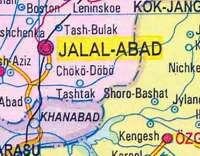
The spelling varies from time to time
Djalal-Abad is the administrative, economic and cultural center of Djalal-Abad oblast (province). It lies in the south of the Kugart valley, in the foothills of the Babash Ata mountains to the North.
The climate is noted for dry, hot summers, warm and sunny autumns with rare rain bursts and winters are warm with high humidity. The region is a center for fruit and vegetable growing.
One of Kyrgyzstan’s main branches of the Silk Road passed through Djalal Abad and the region has played host to travelers for thousands of years, although little archaeological remains are visible today – except in some of the more remote parts of the oblast – such as Saimalu Tash and the Chatkal valley. These have included travelers, traders, tourists and pilgrims (to the various holy sights) and sick people visiting the curative spas such as in the Ayub Tau mountain, at the altitude of 700 m above sea level some three kilometers out of town.
Abad is often used in Asian place names to refer to the person who founded the community. It is said that Djalal Abad was named after Jalal ad din, who was renowned for setting up caravanserais to serve travellers – and especially the many pilgrims who came to the holy mountain.
Djalal-Abad is famous for its spas. Perhaps the most famous is the Djalal Abad sanatoria, “Kurort”, on one of the hills overlooking the town – the waters are salty, but people from a wide area to collect bottles of it. Near the entrance to the Kurort (the health resort) is a café with a fine view over the town – the “Ikram-Ajy” Panorama, at a height of 1000 meters, with a complex that consists of a “national crafts hall”, souvenir shop and an entertainment hall –from here you can appreciate how green the city is, as the trees rise above the low-rise building. The spas are also the source for several different brands of mineral water.
There is a legend that the water from the Hozret-Ayub-Paigambar spa cured lepers. According to the legend there was a grave, a mosque and the khan’s palace near the spa.
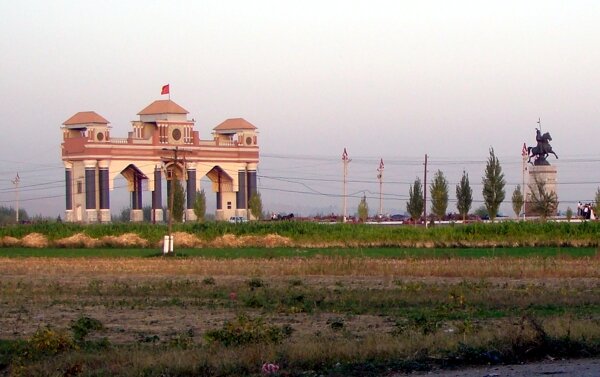
The city gate in Djlala Abad
Another legend tells of Ayub, a rich man who led a very good life. Unfortunately, he came to the attention of God who decided to punish him for his arrogance and wayward lifestyle. God took everything from Ayub, destroyed his house and sent him many divers diseases. His body was covered with sores which were so bad that worms thronged amongst them. Ayub suffered this for forty years, grew weak and eventually could not even rise from his bed. In due course, God forgot about Ayub. One day, however, an old man came across him and took pity on him, promising: ”I will cure you with Living water”. He took the invalid to a picturesque valley, laid him down on the ground and said ”Hit the ground with your right leg.” Ayub did as he was told, striking the earth with all the strength that he could muster, and from the earth a fountain of hot water gushed forth. On the old man’s instructions, Ayub bathed in the water and strength returned to his ailing body. Then the old man said, “Now strike the ground with your left leg”, and once again Ayub did as he was told. A new fountain erupted from the earth, but this time the waters were cold. On the old man’s instructions he drank the waters and his ulcers disappeared, and the worms left his body and began to spin cocoons in the tress that grew in the valley. Ayub’s strength grew, and he lived for a long time, never getting sick again. Just like Ayub, the legend has it, anyone who bathes in the hot spring and drinks the waters of the cold spring will live a long life and never get ill.
In early 19th century a small Kokand fortress was built, and a small village (kishlak) grew up around this. The local people were engaged in agriculture, trade and provided services to the pilgrims visiting the spas. Then, in the 1870’s, Russian migrants came to the region. They set up a garrison town and military hospital.
Jalal-Abad developed as a market town. Where cattle were bought and sold, and so became known as a place of interaction between agricultural and nomadic peoples.
The town had medieval narrow curved streets and the houses were surrounded with high clay walls. Only mosques were decorated with colourful ornaments.
In 1916 a railway was built from Andijan to Djalal-Abad.
When the Soviets established their power in the region, great importance was attached to the Djalal-Abad spas. Health resorts were built and both agriculture and the food industry developed rapidly.
The city underwent a major period of reconstruction in the 1950’s.
Nowadays Djalal-Abad is home to enterprises in the oil, construction, wood processing, electro-technical, light and food industries. There is a thriving market – and a local shop, which specializes in things like “walnut jam” – made from immature fruits (before the husks have formed) and honey.
Near the bazaar is a shop, which sells a local delicacy – walnut jam. The “fruits” are taken from the tree before the hard husk has formed and boiled. The fruit is whole and suspended in a sweet syrup, rather than a thick jam. They also sell things like walnuts in honey. In the bazaar it is possible to buy all sorts of fresh fruits and a wide variety of nuts.
As in all former Soviet towns the main street was called Lenin Street – and in Djalal Abad it has retained it’s name, fountains and statue of Vladimir Illych Lenin.
There is a historical and cultural museum.


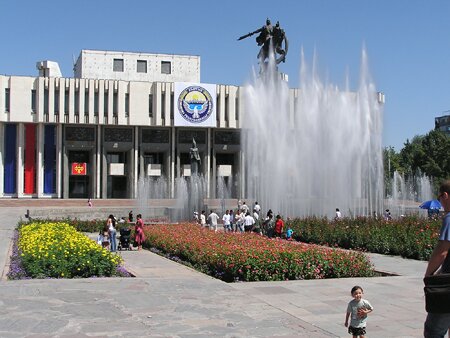

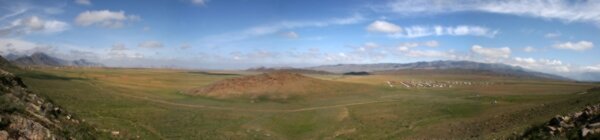
 Bishkek