New build
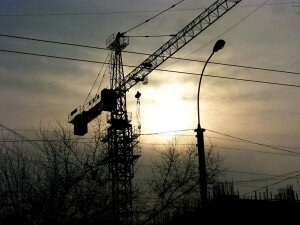
A common site on the Bishkek skyline these days …
One of the questions I am most frequently asked , by foreigners and locals alike, concerns what changes I have seen here in Bishkek in the eighteen and a half years I have lived here.
Although there are other things I could note, when answering I normally concentrate on three topics … the number and types of vehicles on the road, the number and range of restaurants (… and other retail outlets – not to mention what you can buy from them), and the amount of construction going on.
Every day, for example, as I walk down from my office to the hotel, looking around me I see some ten different construction sites – all high rise monoliths which are going to dominate the skyline.
Construction has always been an important issue here in Kyrgyzstan and in recent years it has become a growing and substantial sector of the economy.
Housing, especially, has been a controversial issue over the years; especially during the latter years of the Soviet period when there was generally a housing shortage. Since then, population growth and urban drift have added to the need for housing. This, together with pressure of the allocation of land, this may well have been among the contributing factors to several incidents in the country’s volatile history.
Recently, however, the construction industry has been undergoing somewhat of a surge in activity – a boom – although some of the construction sites of eighteen years ago are still unfinished.
Not long ago, one of the news sites posted an article – a photo report on the state of some construction projects in the city. Last summer, they sent a photographer out in a taxi with instructions to photograph construction sites in the city center. Six months later, they sent him out again and then compared the pictures The results were very interesting … although some progress was obvious on some of the sites – at others there was no visible indication of anything having been done in the intervening period.
As it happens, they didn’t include one of our neighbours at the Silk Road Lodge. I understand that there has been some confusion over the ownership … and I presume there may be questions about finance … because when I first arrived in Bishkek it consisted of a concrete framework and although avery summer a little bit more work has been undertaken … there is little or no sign of it nearing completion.
Then, opposite my office there is the Bishkek Park shopping center – and t hat has also shown signs of a Stop-Start cycle of work. Several years ago the site was cleared of kiosks and other small, ‘temporary constructions, … and a couple newly built buildings were purchased and demolished to make room for the impressive plans. A hole was excavated for the foundations – a pretty impressive hole … , looking at indicating that it was going to be a big building. The plan was for 23 storeys – a five storey shopping mall at ground level with two eighteen storey towers looming over it. Then came the 2010 revolution and work stopped for a while … and although work then recommenced, it seems to have progressed in fits and starts … as neighbours have protested and launched legal challenges against the permissions to build. The shopping mall is now open and sometimes seems to be doing a brisk business – but work of the towers seems to go in spurts – between periods when work is suspended.
In contrast, when we built the Silk Road Lodge, (a mere five storeys), although it took us eighteen months to complete all the paperwork and gain the necessary permissions … the construction itself was completed in just 11 months.
The current construction boom consists of two major types of project:
First of all there are the prestigious and grandiose projects – often large blocks, nine or more storeys of “elite” apartments, perhaps with retail outlets and offices as with Bishkek Park. The word “elite” gives the game away … these are not “affordable housing” – but are built by, and intended for, the comfortably well off if not, (to to put too fine a point on it), the rich.
The analysts and commentators, when commenting on this phenomenon, often refer to the rise of a “moneyed elite” who can afford both the “elite” accommodation and more expensive shopping in the retail outlets without having to scour the markets, (such as the Osh, Orto Sai and Dordoi Bazaars) for Best Buys. Although one builder told me that all but two apartments in one of his projects had been purchased well before completion date there are claims of some of these buildings having a large number of vacant apartments … and I have to admit that I have often wondered who could afford to pay the per square meter prices being asked for what is usually just a shell which the new owner then has to decorate and furnish.
I think there is more to it than that, however, as there seems to be an element of civic pride. Bishkek is, after all, the capital city and there seems to be a need to reflect both this, and the fact that we are now in the twenty first century and a “global village”. Eyes cast at our northern neighbours, Kazakhstan, and the newly constructed new capital of Astana, can only feed dreams and aspirations whilst ignoring the charms and other advantages, economic and social, of maintaining a low rise, low density profile.
The Soviet propensity for producing grand plans has infected the City Architectural Agency who have developed substantial plans for the development of the city center. These include many plots where high rise buildings are proposed … indeed, the city will be transformed … if finance can be found to implement even just a few of these projects.
To be fair, there are a couple of projects aimed at building low cost “affordable” accommodation in the city – but these tend to be rare.
Then there are also the “new settlements”, usually on the outskirts of town or actually outside the city limits. In some cases the land has been settled on by squatters, although in other cases it may have been formally allocated, purchased and registered. Many of these properties single storey buildings are ”self builds”, by the owner occupiers … who tend to be drawn from the less well off members of society, perhaps artisans and technician classes. The construction is piecemeal … and can take some time to complete.
Because they are squatters and lack documentation, many residents also face problems with access to education and health services, social services and , often, the new settlements are without any form of utilities or infrastructure … that that may be added later and we have seen some protests, (Kyrgyzstan seems to like protests), where residents have ”demanded” that the authorities address their needs.
To be fair, there are other more grandiose projects for individual two or three storey detached houses and even estates – including special “gated communities” favoured by some wealthy locals and ex-pats.
.
.
.




 Bishkek