Just another hotel?
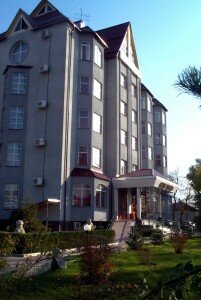
The Silk Road Lodge – our hotel in Bishkek
Technically, a tourist is someone who spends at least one night away from home.
That’s the lower limit. There is an upper limit as well, but that tends to depends on who’s definition is being used. One definition talks of someone travelling for up to a year, but more generally it seems to be up to six months.
It always used to amuse me that the definition used in Kyrgyzstan used the six month limit, but the Tourist Visa is only valid for a month … and although it was possible to extend this, there was a limit on that as well – twice. So one legal document said a tourist should be understood as a person travelling away from home for up to six months, but another said not more than three!
Incidentally, there’s another aspect about a tourist that can lead to contradictions … the purpose why they are away from home. Whereas one of the conditions of a tourist visa is that the traveler does not undertake any form of employment, there is no such distinction in the definition … Indeed Business Tourism, (when the traveler is still working and being paid, but they are doing so away from both their workplace and home), is one of the leading and most dynamically developing sectors of the industry … and it is often quoted as one of the priority areas that Kyrgyzstan wants to develop.
One of the most important decisions is where to spend that night, or those nights.
Sometimes that’s an easy decision … especially when returning somewhere. It may mean returning to a hotel where one has stayed before, so there’s a sense of familiarity and comfort.
When visiting somewhere new, however, the decision is more difficult. Fortunately we have a host of help and support available to aid us in making that decision. Almost as good as personal experience is to learn from the experience of others … to seek out and receive recommendations and reviews from others and there is now a whole industry based on just this.
A recent survey suggested that over three quarters of the respondents usually, or always, consulted the reviews on an internet site before selecting a hotel – reading between half a dozen and a dozen individual comments, and looked at photographs posed by these “citizen reviewers”.
There are, however, several problems associated with these reviews which need to be borne in mind.
At least with a personal recommendation from a relative, friend, colleague or acquaintance, the source of the information is known and it should be possible to put it into context. With reviews, it is always important to remember that they are just one more source of information, but they shouldn’t be taken as “gospel”.
One of the more publicized problems is the question of authenticity (and hence reliability) of the reviews. There have been stories of hotels “faking” the comments posted on the sites … either by writing posting the reviews themselves or by “soliciting” them by offering incentives like discounts for positive comments.
Let me be clear … I don’t think there is anything wrong with “soliciting” a positive review from a satisfied client – after all, as the old adage has it, “If satisfied – tell others … if not – tell us“, so asking clients to consider posting a positive review seems a valid thing to request … but “buying” a positive review with a discount or free meal seems a little more questionable … especially when it is part of a campaign and not simply a case of “I saw what you posted and wanted to say Thank You.”.
There have also been press reports of people posting unfair negative reviews … and even sometimes threatening to post one – as a ploy to gain an advantage – perhaps a discount.
Let me be clear: … perhaps the critical point here is “unfair negative reviews” … there’s nothing wrong with negative reviews, in themselves. Indeed they can be helpful in pointing out deficiencies and giving the establishment the opportunity to respond, make amends and to learn in order to prevent a similar situation reoccurring … it would be helpful, however, if the complaint is referred to the management first … as the old adage has it: “If satisfied – tell others … if not – tell us“.
They are a “snapshot” in time and does not necessarily tell the full story … and should be seen as such. Although it is said that every picture tells a story … the problem with a snapshot is that captures a a moment in time. As a result we know only what is in the review – and any response the management offers, if there is one.
Not every comment gets a response … the management may have responded directly to the poster … or made a positive decision not to respond. They may not even be aware of the comment – although I do check the main review sites to see what’s new, there are a whole host of others and in the past there have been several occasions when I have been surprised when someone has referred to a review somewhere that I didn’t know existed.
Then there are advertisements … websites, dedicated pages on on-line travel agencies and hotel booking sites, … and so forth. Although they are useful as “visiting cards”, platforms for telling potential guests that the hotel exists and what they have to offer … but, as advertisements, they are designed to attract attention and persuade the potential guest to choose this particular establishment emphasizing the advantages and merits which the management think will achieve that.
.
Now, every guest is different … the things they look for in a hotel will also vary.
In some cases they look for status – for some people a five star rating is important; a recognizable name, being a part of an international chain … and so forth …;
In other cases, the location is important … city center, for example; proximity to a particular locale such as a railway station or an exhibition center; or in the country;
The facilities or services on offer … breakfast included in the cost of the accommodation; free airport transfers; free wifi internet access are often cited, but there is also availability of a fitness center; a business center; … perhaps non-smoking rooms; childcare facilities; and so on …
Then, of course, there’s the price.
.
Sometimes, the attraction of a particular hotel might be some unique feature, for example it might model itself on a theme or – carved into a Swiss mountainside; or into ice in the Arctic; tree top cabins on the Savannah; straw huts on a sub-tropical beach; a salt mine; a former prison; a castle; … and so on.
.
When it came to our hotel here in Bishkek, the Silk Road Lodge, we sat down and brainstormed what people wanted in a hotel … with two of our investors were international lawyers who did a lot of travelling as part of their work, (one spending more time on the road than at home), and several visitors, (both short term and long term), to Bishkek.
Several ideas came up … in addition to things like internet and phone access to the outside world; a good breakfast with plenty of choice; variety of cuisines (including healthy options) on the menu in the restaurant; reasonable sized rooms; coffee/tea making facilities; a usable fridge that is not packed full with minibar items for sale; an iron; a hairdryer; no “fees” or surcharges … and so on.
The most important thing, however, was “I want to be comfortable – to feel at home”.
That’s part of the reason why, for several years we used the slogans “Your Home Away From Home in Bishkek” … and “Your Home on the Great Silk Road“.
They didn’t want to feel that were staying in “Just another hotel“.





 Bishkek