Konstantin Petrovich Kaufman
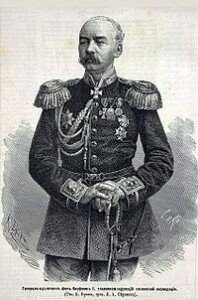
Kaufman
Konstantin Petrovich Kaufman was born on 19th February, 1818, (O.S. – that is according to the Julian Calendar … in most of the world where the Gregorian Calendar operated it was 2nd March) – although some sources suggesting it was one day later.
He was to play a vital role in the Russian expansion into Central Asia as the first Governor General of Turkestan.
His family were of Austrian origin, but had been in the service of the Tsar for over a century and had, for example, converted to Orthodoxy. It was a military family; his father was a general and his older brother was another successful military engineer.
The young Konstantin had a military education and he graduated as a military engineer, entering the army in 1838, serving in campaigns in the Caucasus – serving with distinction in various skirmishes,being wounded twice, having to undertake hard treks in the difficult mountain terrain, being promoted several times, receiving various awards and quickly rising to the rank of Colonel.
He commanded the sappers during the siege of Kars, in the Crimea, in 1855 and was delegated the task of agreeing surrender terms with the British. At the age of 38 he became the youngest General in the Russian army.
In 1861 he became the Director General of Engineers in the War Office and was heavily involved in the reorganization of the army – and the introduction of the military District system of government, being promoted once again, to the rank of Lieutenant General, in 1864 when he was nominated to the post of Governor of the North Western Territories and the commander of the Military District of Vilna. It was his administration that prohibited the use of the Latin alphabet in Lithuania.
In 1868, the explorer Fedchenko made an expedition into the Pamirs and one of the peaks in the range was named in Kaufman’s honour in 1871 – later, in 1928, the 7134 meter Kaufman Peak was renamed as Lenin Peak … then in 2006, Tajikistan renamed it as Abu Ali Ibn Sina.
Three years later, in 1867, he became the Governor General of the Military District of Turkestan … a post which he held for for 15 years – the rest of life. Arriving in Tashkent to take up his new post, he set off on a tour of the territory he was to especially to see the borders with neighbouring Bukhara.
He began with a campaign against Bukhara in 1868, first capturing Samarkand and then subjugating and annexing the whole Khanate.
In 1873 he launched a campaign against Khiva, capturing the capital and forcing the Khan to capitulate and accept Russian suzerainty, for which he awarded the Order of St George.
Then, in 1875 he turned his attention toward Kokand, defeating the Nasreddin who had usurped the Khanate, annexing the territory into the Russian empire and was transformed into the Ferghana region.
The borders of the Empire were rapidly expanding and approaching closer and closer towards Afghanistan … and towards British India. When in 1878 he sent a diplomatic Mission to the Amir of Afghanistan (uninvited and reluctantly received by the Amir), alarm bells started ringing among the British who demanded the right to send one as well. The Amir not only refused to permit one, he said they would turned back … which is exactly what happened when they approached the Khyber Pass in September. This led to the Second Afghan War when Britain sent a military force across the border early the next year.
As Governor General, he was granted considerable latitude in the policy which he could follow, including conducting negotiations with neighbouring states on his own authority, wage was and conclude peace treaties. Indeed, no other Governor General was granted so much freedom of action, and independence form central command. Perhaps that was partly due to the vast distances from the center … isolated from European Russia by the vast expanse of the Steppe … which involved a two month journey.
The population and culture also differed significantly from European center of the Empire with its well established Islamic culture.
As a result, Kaufman didn’t always get things his own way, and many in the court at St. Petersburg doubted whether Central Asia could be successfully integrated into the Empire, so they didn’t always support his plans for further expansion of the Empire. Even so he dispatched Skobolev against the Tekkes n 1880 and 1881 and was planning a campaign against Merv when he died suddenly in Tashkent in 1882, at the age of 64.
He was buried, under elm trees, rose bushes and jasmine trees, in the Town Square which later became known as Kaufman Park. When the Military Cathedral was built in the city, in 1889, his body was relocated thereon the seventh anniversary of his death.





 Bishkek