In answer to a question:
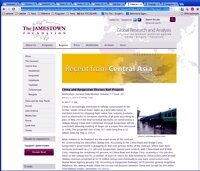
The article “China and Kyrgyzstan Discuss Rail Projects” on the Jamestown Foundation website.
A short while ago, one of my correspondents sent me a link to an article by John Daly on the Jamestown Foundation’s website, China and Kyrgyzstan Discuss Rail Projects, and asked if I could comment …
The article is about the discussions that are going on about the possibility of developing the country’s railway system … and the two different options that are being considered: the China-Kyrgyzstan-Uzbekistan option going East to West and Kazakhstan-Kyrgyzstan-Tajikistan one which goes North to South.
“I’m very surprised by this,” he said, “I thought it would definitely be East to West, and now there’s the new plan from North to South.”
I thought that other people might be interested in this so I decided to post my reply here as well … so, here it is:
It’s actually quite a good analysis and summary of the debate.
There’s been a discussion of the two railroad links for some time – practically all the time I have been here … and before.
The East-West Route was proposed back in the days of the Tsarist empire when it was known as the Trans Caspian Railway and it was even the basis for an adventure story by Jules Verne: Claudius Bombarnac. With the extension of the railway in China to Urumqi and then Kashgar, China was interested in extending it even further and talks began on the creation of a China-Kyrgyzstan-Uzbekistan link that would link China with Europe as in olden days creating a new, modern, version of the Great Silk Road for the twenty first century.
Discussion about the North South link, on the other hand, was concentrated on the possibility of linking landlocked Kyrgyzstan with its nearest seaport, Karachi, in Pakistan – although I have seen other suggestions that have taken a route through to an Iranian port … I forget which.
There has also been a lot of discussion about extending the existing limited network in the country from Balykchy (at the Western end of Lake Issyk Kul) to the Kara Keche coal fields to the North of Lake Son Kul. This coal field is the largest in the country and the line would facilitate the movement of coal and hopefully held lead the development of this relatively poor region. At one time it was also mooted that the Chinese were interested in “getting their hands” on this valuable resource and so they might be interested in helping to develop an extension of the line up there.
As the report says, finance (or lack of it) has always been a problem and so, when the Chinese looked as if they might provide this it became a real possibility rather than a pipe dream. Recently, possibly as a result of Chinese prompting, work began on actual planning (on the East West route) rather than simply discussing the possibilities.
Since then, however, we have seen two revolutions and a shift in outlook here in Bishkek. Whereas the East-West route may be useful to Kyrgyzstan, the proposed route is good for China and Uzbekistan but offers little to Kyrgyzstan … travelling through remote regions where there is little of commercial or industry development and – more importantly – little chance of any potential to be developed. Suggestions from Bishkek – and Naryn – to reroute the line through Naryn were rejected.
The thought of extending the network by creating branch lines to Naryn and Kara Keche were mentioned at one point but there was little or no interest in this from Beijing and as far as I can tell they have been dropped, (if they were ever seen as realistic or possible).
The main problem with the East-West line is that it offers Kyrgyzstan little apart from the chance to earn transit fees … and perhaps some additional employment for people at the borders and along the route. The new channel for imports and (more importantly for Kyrgyzstan) exports, goes through a relatively underdeveloped region, (even Osh, the second biggest city in the Republic – has lost virtually all its industry since Independence without central planning, investment and support from Moscow) – and it is not likely to lead to future development. There are politicians and economists who stress the risks of remaining a transit corridor for Chinese goods and ignoring the vital need to develop our own industry here in Kyrgyzstan.
Hence the declining fortunes of the East-West route. Although, it is felt, it may represent a good deal for Kyrgyzstan, the question is being asked if it is the best that can be achieved?, are there alternatives? … and that is where the fortunes of the North-South route have blossomed.
.
The people now in power, that came to authority as a result of those revolutions, would be happy to implement either project and reap the economic advantages … but they also have other problems, such as facing down ethnic pressures and the constant worry and speculation about the Republic really being two countries artificially held together.
Many years ago, for example, I saw a State Department analysis that suggested that within a short time following Independence, (if I remember correctly – ten years), there was a risk of the country dividing in half with the Northern part looking to Kazakhstan and Russia and the Southern to Uzbekistan. Fortunately that hasn’t happened … and I don’t think it will happen … but even Akaev (a Northerner) took pains to try and make sure there was a balance of power here in Bishkek and when Bakiev (a Southerner) came to power in 2005 that balance was more or less eaten away … then came the events of 2010 and after, creating more North-South tensions. It was even mooted that to even talk about a North-South split was unpatriotic … tantamount to treason. This has been simmering away over the years and emerged once more at the end of last year with the controversial sacking of Melis Myrzakmatov as the Mayor of Osh.
This is a little simplistic, but it is worth noting that the Kyrgyz have always been a tribal society with rivalries and “little love lost” between the different groups … look at the trials and tribulations faced by Manas and the various attempts, (for example by Ormon Khan and Alimbek Datka), to unite the Kyrgyz under a Great Khan. Only a few were successful and usually only to a limited degree; for a specific purpose and for a limited time. Hence the achievements of Independent Kyrgyzstan under Akaev (fifteen years) and perhaps under the present regime no matter how troubled the times we are going through, should not be underestimated.
Kyrgyzstan’s glory and the source of all its major assets, the mountains, are also the source of its biggest problems – dividing the country into quite small, distinct regions – each with its own history, character, culture etc. … It’s like a microcosm of mankind as a whole – a single unit unified by certain characteristics but rich in a variety of specifics … which can lead to tensions and even conflict.
This is probably why the North-South route is seen as so important. It will (or, at least, should) help to unite the people and bring about a form of cohesion.
.
At the moment there are only really two North-South Corridors, the main Bishklek-Osh highway, constructed in the 1960s (which can be considered as extending to Sary Tash and Irkeshtam and hence China) … and the road from Bishkek (via Issyk Kul) to Naryn and Torugat and China. The road through Chatkal is closed for most of the year. There is also really only one good East-West corridor, from Issyk through Bishkek to Chaldovar and onto Uzbekistan. There is an alternative route from Issyk Kul to through Chaek to Suusamy which then meets the Bishkek-Osh Road … with the possibility of crossing over into Talas. The road from Naryn through Kazarman and down to Djalal Abad is closed for most of the year and in the South there are the roads through to Batken (with the problems presented by the enclaves) and through the Alai valley to Tajikistan.
The recently introduced, (revised) proposals to build an alternative North South road, from Issyk Kul diagonally down to Djalal Abad, should be seen in this light – together with the extension over to Kegen in Eastern Kazakhstan. It is hoped that this will bring not only better international communications but also act as a stimulus for development and act as a cohesive force in the country as a whole.
On top of that, there is no rail link between North and South … the tiny network in the South of the country is totally cut off from the small network in the North and there would be advantages in uniting them.
Finally, there is the revitalized importance of Russia and Kazakhstan as strategic partners which has resurfaced with greater emphasis than in the past – especially with the emergence of the Customs Union. If the tariffs and other issues can be settled, then Russia and Kazakhstan could also represent lucrative markets for Chinese goods and the rail link through the North of the country might also beneficial to China.
.
One thing worries me is that, by playing “hardball” over the East-West option, I think they run the risk of closing the door and losing that option … especially when the finance for the North-South route is not in place. I think that some people might even be prepared to welcome such an outcome. We have seen the adoption of a laissez faire approach, (We’ve lived for years without this, so let’s not rush into this and sign away our heritage, the “family silver”, our birthright for “a mess of pottage” …), elsewhere – for example in the Gold mining industry.
.
To be frank, both routes face technical difficulties and will be expensive to implement … but the relative medits and drawbacks can be summarized as:
East-West: Advantages include Improved links with China (a major strategic partner) and Europe (also a major partner but more nebulous and distant); finance may be more easily arranged from China … BUT the disadvantages include A sort route through a remote and undeveloped part of the country, with limited potential for acting as a stimulus for further investment and development, Limited earnings potential;
North-South: Advantages include improved links with major strategic partners Russia and Kazakhstan (and possibly China? if a link can be negotiated) and possibly with a sea port; facilitating political, social and economic cohesion and development within the country … BUT finance will be a problem.
Perhaps the best outcome of all, would be if it were possible to develop both routes and create a junction between them at somewhere like Djalal Abad … which has been suggested as a possible strategy, but I fear is probably just another pipe dream.
.
I am sorry for going on at such length … but you did ask … and I hope it is useful.
I should finish with the usual disclaimer … these are personal thoughts, albeit based on my observations and experiences over the years. I may have missed something, misinterpreted something, or simply be wrong.





 Bishkek
Another railway project in trouble … from Tajikistan onwards …
http://eurasianet.org/node/68057