Spectacular … but scary
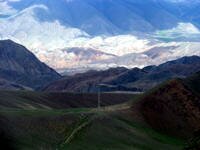
John is a consultant who has been working on a project here in Kyrgyzstan, off and on, over the past two. His contract has finally come to an end and he flew out early this morning. From the airport he sent me an SMS to tell me that he was boarding, and to say "goodbye". He finished with the phrase: "Scary Mountains!"In fact, this wasn't the phrase he's been using all week ... that was "Spectacular ... but scary."
Now, if I was looking for a slogan to advertise Kyrgyzstan, then I might well look for something to reflect the mountainous landscape … after all, it is often said that 94% of Kyrgyzstan is mountainous. This statistic sometimes surprises visitors … especially those who come looking for alpine landscapes with towering craggy peaks, snow covered or otherwise. Although we have those in abundance here, a lot of the highlands also comprise wide open valleys and flat plateaus with the peaks receding far into the distant horizon. This doesn’t always match the image of “mountainous” that people carry in their minds. The logic behind the statistic, however, is simple … anything over 1500 meters above sea level is classified as mountainous – and 94% of the country is higher than this.
Although I might like to use the word “Spectacular”, I’m not sure that I would chose the adjective “Scary”. So why did he?
Like most consultants here in Kyrgyzstan, John was kept quite busy for most of the time he was here, and he didn't really have much time to get out of Bishkek. He was able to go out for the odd excursion at weekends - to the nearby valleys of Ala Archa or Alamedin, for example. There were occasional seminars or meetings at one of the resorts up on Lake Issyk Kul ... and on a couple of occasions he did manage to take a long weekend and visit a coup0le of more distant spots.We often commented, that there were lots of interesting places in the country and he was missing out on an awful lit being trapped here in the capital for so much of his time. There are lots of places in Kyrgyzstan that I have yet to visit ... and that's after fifteen years. On the other hand, I do get out and about at least once a month, as I travel up to Naryn to visit our guesthouse there ... and for several months, John has said how he would like to tag along and see somewhere different. As this was going to be his last chance to do so, we decided that he should seize the chance and come along on what was going to be, by coincidence, his last weekend in the country.
As it happened, I was already planning to take a couple of other staff and a photographer with me on this particular trip … and so, when Steven, another consultant who has also been here for about two years, and who also complains that he hasn’t really had the chance to see much of the country, asked if he could join us … and also offered to drive one of the vehicles for us … we were more than happy to agree.
We left early on the Friday morning and the first part of the journey followed the River Chui … a wide, gently sloping valley with the mountains making a picturesque backdrop, well in the distance. The road climbs slowly through the Boom Gorge, (that’s not “Boom” as in English … it’s more like Baum Gorge – and means “Shoestring Gorge”. It is so named because it is quite narrow in places). The gentle slope means that by the time you reach Lake Issyk Kul, you have risen about 900 meters to 1900 meters above level, over the 180 kilometers … an average climb of just 1-in-200, (or 0.5% as these things are expressed here). Still, by the time you reach the lake, you are over the threshold and into the “mountains”, even though the lake itself, is in a long wide basin and the peaks are well in the distance.
Turning off towards Naryn the road climbs and falls more dramatically, and as we passed over the Dolon Pass at just over 3000 meters above Sea Level, both consultants confessed that this was probably the highest they had been in a car.
From there the road descended (with an occasional climb over a little crest) to Naryn which sits astride the Naryn River at about 2300m. Whilst those of us who had work to get on with did so, the rest went for a walk in the town, before a hearty supper and a good night’s sleep.
So far, so good. Nothing “scary” here.
The next day we took the road south, over a mountain pass and down past the town of At Bashi … As I was acting as the “unofficial English Speaking guide” I was passing on little tit-bits of information as we went … which included things like, “this road often gets blocked in bad weather by avalanches” … and over there is a roadside tombstone which marks the grave of people killed in an accident … or “this road is closed to buses and minibuses because there was accident …”, … which, looking back now, with hindsight, was perhaps not the thing to say … it was all true, and I did tell them other things as well … not just the macabre stuff … but l was laying up problems for the future … and I was going to regret passing on these three particular snippets of information.
On route we stopped off at the Koshoi Korgon ruins. Although they are not far off the main road, (in fact they are visible from the main road), I have never actually been there before and I was particularly keen to see them as I had heard there was a new museum built nearby, and I thought it would be interesting … It was interesting, but also a little disappointing as the ruins themselves were fenced off and. like the distant mountain peaks, had to be admired from afar.
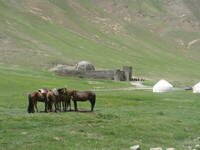
After that we continued southwards towards the Chinese border … not that we were going to cross the border – or even to it – we turned off about fifty kilometers short of the border itself, to visit one of my favourite spots in all Kyrgyzstan: the Tash Rabat Caravanserai.
To my amazement, the bridge over the river has finally been repaired … in all the thirteen years I have been going to Tash Rabat, this was the first time we didn’t have to ford the river. I was impressed, and was almost happy to pay the toll for using the road. The money raised was apparently being well used. I wasn’t so happy, however, that in all the chat they forgot to give me a receipt … and that caused problems later on. More to the point, however, and once again with hindsight, the fact that the road conditions had changed since my last visit should have reminded me that you don’t take things like this for granted. In this case the road was improved … but … well, that was all in the future.
Basically … everything was fine … everyone was happy … nothing scary here.
So the third and final day of our jaunt dawned. After a brisk breakfast we set out for Son Kul. The road followed the valley floor of the Naryn River for ninety kilometers. We turned right at the Ak Talaa checkpoint and headed north and upwards, past the mausoleum of Taaylik Baatyr, towards the Kurtka Pass … and that’s when it all started to go wrong … or should I say, scary, … or as John put it later: “Spectacular, but scary”.
I wouldn’t say that we ran out of road … but the asphalt ran out … and as we climbed higher and higher on the narrow stone road, turning hairpin bends around which it was often difficult to see if anything was coming in the opposite direction, anxieties began to creep in. A small but sudden skid brought us close to the edge. That car, coming the other way, is going too fast for these conditions … and it doesn’t matter how safe your driver is … there are always others who can easily cause him (or her) to have an accident … and … “It’s a long drop!”
In itself, this wasn’t a big problem … the anxieties were more than outweighed by the fantastic scenery and a sumptuous picnic lunch by the lake shore … but anxieties there were.
After lunch, we headed towards the ridge of mountains that ring the lake, and the plateau, and then rose to a pass at over 3300 meters, to cross down to the other side and the Kara Keche coal mine and road home. The car in front of us pulled up slowly, ground to a halt, and everyone got out to take a look – a look, not at the magnificent scenery, but at the road … or more to the point: where there should have been a road.
At some point in the not too distant past, a small section of road – maybe about eight feet, or just over two meters, had been washed away … and the land on either side of the path that had once been a road was riddled with ditches, pot holes and mud … Oh dear! Oh dear!!
As it happens, both of our vehicles got over that obstacle … just … and the next wash out … just … and the next … just … and the one after that … just … We managed to get stuck in the mud on one occasion, going neither forwards not backwards until our one free vehicle was able to tow the other one out …. We crested the pass and began to descend, though more narrow, tight, hairpin bends … with small stones scattering as our wheels ground over them … past the coal mine where two hulking great lorries were sinking slowly into a muddy pond at the foot of a cliff … just how did they get there? It didn’t matter how slowly we were going, or how careful the driver was … every twist and turn, every bump in the road, bounced and resonated in the passenger compartment … anxiety was growing …
Now, I tend to fairly blasé about this sort of thing … I have traveled this particular road several times in the past … although, to be honest, the last time was four years ago … and if a week is a long time in politics … then four years is the equivalent of an age … and things can change quickly in the mountains …
It was then that we encountered the one thing we were all dreading … especially me as a tour operator … not only was a section of the road away … a bridge was down … there was was no way forward … only back.
Kara Keche is a big, open cast coal mine. Although there are lots of deposits in Kyrgyzstan, most of them are small and in remote and hard to reach locations … Kara Keche is fairly remote but easy to reach … at least, it used to be. I had wondered why the road had been so quiet … in the past we would have passed many a huge Kamaz truck bringing the black stuff down from the mountain … but this time it had been eerily quiet. No wonder … there was no way a Kamaz truck could cross the river.
There was no way down … just back up the way we had come … adding kilometers and hours to our journey … and we had to face the possibility that we might not make it across the washouts.
Fortunately, our eagle eyed driver spotted a vehicle crossing the fields coming towards us … and so he headed for it … it hit the road and turned up towards the summit before we caught it … so we couldn’t ask … we had no choice … we turned onto the track it had left and headed out over the fields … in the hope that it would bring us back to civilization.
It did. Thank goodness!
After a long, slow, meandering drive through narrow culverts and blind turns we finally hit the main road … and stopped for a peaceful snack of Manti.
Now, in theory at least, the rest of the journey along the valley of the Kekemeren River should have been quick and easy … but an avalanche put paid to any hopes of that. We crossed it … just … but it was another heart in the mouth moment …
An encounter with a snake just before we hit the Suusamyr plain slowed us up once more. There aren’t many snakes in Kyrgyzstan, but some of them are poisonous … and this one writhed and wriggled as it made its way confusedly across the road … Now, why did the snake cross the road? I have no idea … maybe it was trying to do the same as us … get home before the sun set.
It might have made it. We didn’t.
We still had to cross one more mountain chain … more hairpin bends, and a tunnel, but the road has been reconstructed and the surface was good. I wish I could say the same about some of the driving we saw … as we passed two accidents and saw many more potential ones in the making.
I said that I tend to be fairly blasé about these things … I have traveled around Kyrgyzstan over the years and I am used to encountering all sorts of obstacles and hindrances … and so I wasn’t particularly “scared” by anything that happened to us. Worried, yes – but that was mainly concern about issues like how we would be able to overcome the obstacles and hindrances … and the effect they would have on our planned itinerary and timekeeping … and so on. I can understand, however, why John found parts of this experience, (in his words), “Spectacular … but scary.”
At least we hadn’t planned to take the Kazarman-Djalal Abad road … but that’s another story. Somehow, I don’t think John and Steven will be that keen to come with me on that one.




 Bishkek