Off the beaten track … Kol Suu
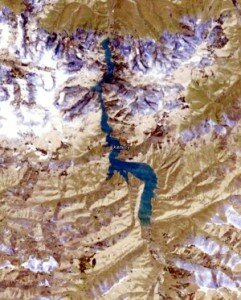
A satellite image showing Kol Suu Lake in the Naryn oblast
About a year ago I got a frantic phone call from a friend of mine … a local, – that is, although he is not Kyrgyz, he was born and grew up here … asking me if I could tell him how to get to Kol Suu, (pronounced Kol Suu, but it is sometime written as Kel Suu … Kol is Kyrgyz for Lake and Suu is Kyrgyz for Water.).
My first reaction was Kel-what?, Kel where?, and I had to admit that I didn’t have the faintest idea of what he was talking about. He sent me a link to a photograph someone had posted on Facebook and I went and had a look. My first thought on seeing the photograph was, “That’s not Kyrgyzstan, that’s Norway!” … it looked very much like a fjord with bright turquoise waters and steep sided cliffs descending down into the waters.
I was wrong … it most definitely is in Kyrgyzstan.
Kol Suu is a mountain lake in the Naryn oblast, formed as the result of an avalanche, (probably the result of an earthquake), falling across and blocking a river. It is because it is a flooded river valley, (long and narrow, meandering as the river snaked its way between the mountain slopes), that it has the look of a fjord which threw me.
It is little known and studied because of its remote location in the Ak Sai valley, (actually, it’s on the Kurumduk River, a tributary of the Kack Kiya … which flows into the Takshan River that then crosses the border into China), behind the At Bashi range of mountains.
It lies at an altitude of over 3500 meters above sea level, is about four and a half square kilometers in area and is estimated to hold almost 340 million cubic meters of water, making it the country’s fifth largest lake, (after Issyk Kul, Son Kul, Chatyr Kul and Sary Chelek).
What’s more, it is near the Chinese border, which means that special permits have to be obtained in order to visit it.
Because of the height it can be very cold, especially at night time, even during the height of summer – which is quite short, lasting just over a month from mid July until mid August … and even then, snow is not uncommon.
Apart from the spectacular scenery, it offers a wonderful opportunity to get a feel for the peace and tranquility of the mountains, with their dramatic landscapes with its snow capped peaks, as well as the difficulties faced by the people living in these remote regions … and a sense of what hardy people the original Silk Road travelers must have been.
I could well understand why my friend was interested in visiting the lake …
A few years ago, one of the great attractions of Kyrgyzstan was simply that very few people had heard of it.
You used to hear phrases like “Kyrgyzwhat?”, “Kyrgyzwhere?” or “Whereisiztan” … on my occasional visits back home, one of my former teaching colleagues would ask me “when are you going back to Uncle Stan?”. Kyrgyzstan had once been a restricted zone and, under the Soviet system, special permission was needed to visit the Republic … which was not always granted. (I am told that even Soviet mountaineers sometimes had difficulty getting the necessary paperwork that allowed them to visit.) As a result, and even after Independence, there were very few foreigners, and to those of us who did make it, it sometimes felt as if we were pioneers.
Nowadays, thanks to two Revolutions, the presence of the Manas Transit Base, the expansion of international business opportunities and donor funded projects … and not forgetting, of course, the role played by the growth of international tourism, (travels along the Great Silk Road, mountaineering expeditions, specialist horse riding tours, and so on …), there are more and more tourists who are becoming acquainted with the various attractions that the country has to offer.
The introduction of the visa free regime for citizens of 44 countries has also helped to increase the number of foreign tourists … although the numbers are still a long way short of making Kyrgyzstan a destination for mass tourism.
Having said that, for years, even in the Soviet period, there have been a lot of tourists during the high season – July and August – up at Issyk Kul … especially visitors from Kazakhstan and Russia. Some of the beaches can feel a little crowded, like those on the Riveria, with people hugging their particular space … but, fortunately, it is also possible to find less populated beaches, even if that means with less developed facilities.
Actually, there are people who prefer this … they want to “get away from it all”, the crowds, the hustle and bustle of modern life. There seems to be an inbuilt desire to seek out remote and beautiful spots in order to soak up the peace and solitude.
Kyrgyzstan is actually well endowed with such “remote and beautiful” spots … and Kol Suu is definitely one of them!.
Here is a link to a photo report on a trip to the lake including a short video, (3 minutes) … it’s in Russian, but there’s very little text and the photographs speak for themselves!
.
Although the lake and its surroundings offer great potential for a prolonged stay with a variety of activities, it is also possible to visit s part of a longer tour, for example following the Great Silk Road:
Day 1. Bishkek- Ala-Archa- Bishkek
Arrival in Bishkek, meeting with the driver and guide at the airport. Transfer to a hotel. Take a tour of the city, with lunch in a café. In the afternoon drive to Ala-Archa gorge and explore the area. In the evening return to Bishkek for dinner in a café. Overnight in the hotel.
Although Bishkek cannot claim to be one of the major cities of the world, (like London, Paris or New York), it is, however, the capital city of Kyrgyzstan and does have a number of important and interesting buildings, monuments, parks, museums, galleries, theaters and other places worth seeing or visiting.
The Ala Archa National park was created in 1976 by Government decree and occupies about 120,000 hectares. With snow-covered peaks, steep forested slopes, picturesque water meadows of the fast-flowing, noisy Ala-Archa river.
Day 2. Bishkek- Kara- Unkur gorge
After breakfast drive to the Kara-Unkur gorge, visiting the BuranaTower on the way. Lunch on the way. Dinner in a café. Overnight in a guest house/yurt.
The Burana tower is all that remains of the ancient city of Balasugan set at the foot of the Shamshy valley. Established in the 10th century on the site of an older settlement, the city was the birthplace of the poet Jusup Balasugyn (1015-?) who wrote an epic poem called Katadgu Bilim (=”The knowledge which brings happiness”), which has been translated into several languages – including a recent translation into English by Walter May.
Day 3. Kara- Unkur gorge- Kel-Suu lake. Overnight in yurts
After breakfast drive to Kol Suu lake having lunch before the Kyndy pass. Arrive to the yurt camp. Hiking to the lake’s shore (500-700 m). Dinner and overnight in yurts.
Day 4. Kel-Suu lake
Rest by the lake and explore the area with a local guide. Lunch/dinner in the yurt camp. Overnight in yurts.
Day 5. Kel- Suu – Tash- Rabat
After breakfast drive to Tash- Rabat. Lunch on the way. Explore the area. Dinner in the yurt camp. Overnight in yurts.
Tash- Rabat is a carefully restored stone building that once housed an inn on the Great Silk Road. Its date of origin is strictly unknown – but there is archaeological evidence to suggest that the site was occupied in the 10th century. Set some 15 km up a small, beautiful valley in the foothills of the Tien Shan, embedded against the hillside. There is evidence that it was a place of both rest and worship and would have served to protect caravans to and from China from both the ravages of the weather and of bandits – from before the time of either Tamerlane or Genghis Khan.
Then … either:
Day 6. Tash- Rabat- Torugart- Kashgar
After breakfast drive to the Kyrgyz- Chinese border post at “Torugart”. Go through the formalities before crossing. and traveling onto Kashgar – to continue your Silk Road tour with a Chinese operator.
… Or:
Day 6. Tash- Rabat- Son-Kul lake
After breakfast transfer to Son-Kul lake in the Central Tien Shan. Lunch on the way. Explore the area. Dinner and overnight in a yurt camp.
Son-Kul is situated on a treeless, high mountain plateau, and is surrounded by lush mountain meadows (jailoo). As such it is used by the shepherds of the Kochkor, Naryn and At Bashi regions for summer pastures for their flocks. In fact, there is evidence that it has been used for pasture from very ancient times.
Day 7. Son-Kul- Bishkek
After breakfast transfer to Bishkek. Lunch en-route. Dinner in a café. Overnight in a hotel.
Day 8. Airport transfer
… and departure




 Bishkek