Artnapped
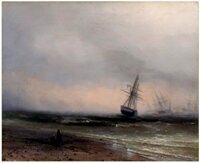
STOLEN: Crimea Seascape by Ivan Aivazovsky, 1866
Over the New Year we got a piece of surprising news …
Some enterprising thieves decided to help themselves to a painting hanging in the Museum of Fine Arts. It seems that a corporate event was being held in the Museum and, once it was over, the curators noticed that a painting, (Crimean Seascape painted by Ivan Aivazovsky in 1866), was missing off the walls of the second floor Russian Gallery.
.
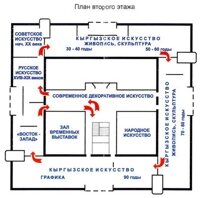
Floor plan of the museum
The galleries in the Museum of Fine Arts are located on the first and second floors. The first floor galleries are used for temporary exhibitions, but the main exhibits from the museum’s collection are housed in six galleries on the second floor. There are two more galleries on the floor – flanking the central staircase, which rises from immediately opposite the main entrance on the ground floor through the center of the building – one is used to host temporary exhibitions and the other is dedicated to historical examples of Kyrgyz traditional Applied Arts, (feltwork: ala kiyiz and shyrdaks; kurak; chiy; wordwork; leatherwork; jewelry and the like) – whilst the area at the top of the stairs is usually used for the display of modern examples of decorative.applied arts.
The floor plan of the building is basically a square with the central staircase emerging in the center. The recommended route – basically, there is only one possible route – takes the in clockwise circular path through the galleries in turn: Upon climbing the stairs turn left and then right entering the room dedicated to Russian painting from the eighteenth and nineteenth centuries although, actually, the earliest of which, Vernicle, dates back to XVII century. The collection consists of 24 works, , by famous Russian artists such as Borovikovskiy, Falk, Ge, Ivanov, Kiprenskiy, Konchalovsky, Korovin, Kustodiev, Kuznetsov Levitsky, Repin, Savrasov, Surikov and, of course it housed the Aivazovsky.
Passing through this room the visitor enters a gallery dedicated to works of Soviet artists from the twentieth century; then one a series of galleries dedicate to artists from Kyrgyzstan arranged in chronological order from the 1930s through to the end of the century … followed by a display of graphic work and a gallery called East-West.
.
The stolen painting was not exactly a small one, at 47 by 54 cms. Mind you, it seems that it was just a case of the thieves taking it off the wall, tucking it under their arms and walking away with it, they “brutally” cut the canvas out of the frame.
Although Artnapping is supposed to be quite good business … apparently there are a lot more thefts from gallery’s than is commonly recognized … usually it is only the really spectacular cases that get into the press.
This particular theft caused quite a storm … what happened to the security? … why did it take three days for the theft to be announced? … exactly how was it done? … and so on … and, of course, there’s the question, why this particular painting?
.As it happens, there
Aivazovsky is a famous painter who, as far as I can tell, although he did travel to Turkey and through Western Europe, (France, Germany, Holland, and Spain), and later on assignment with the Russian fleet, (to America, Egypt, Greece and Turkey), he never visited Central Asia, yet alone Kyrgyzstan.
He was born into an Armenian family living in the town of Theodosia on the Crimea peninsular, on 29th July 1817. They had moved there from Galicia in Poland (although it is now part of the Ukraine) some five years earlier. The family weren’t rich and he spent his early years in relative poverty, but he was taken on as an apprentice by a local architect and then gained a scholarship to a Gymnasium and then to the St. Petersburg Academy of Arts, where he excelled as a student … and was to return to, later, as a Professor – at the ripe old age of 30!.
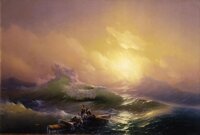
Aivazotsky’s The Ninth Wave
His early works won a number of awards and in later life he was to become famous for his seascapes such as the painting stolen from Bishkek, which basically comprise of more than half his total output … which was pretty considerable – he was one of the most prolific artists of the time … with over 6000 recorded pictures – the most famous of which is called The Ninth Wave. His paintings are to be found in a number of Galleries in Turkey, Russia, throughout the former Soviet Union … and especially in the Ukraine and Armenia. With such a large output, however, widely spread, it is said that one has to be careful when viewing his work as, it is said, he is one of the most forged of all Russian painters.
The constant changing nature of his favoured subject matters, (such as water and seascape and events in battle), his preparatory work tended to be limited to quick pencil sketches – and he had to work primarily from memory. It seems he preferred to work outdoors, returning to the studio only to add the finishing touches to his work.
To an Englishman, like me, his work is reminiscent of the works of Turner – who apparently dedicated a poem to him.
He died on 5th May, 1900, at the age of 82.
.
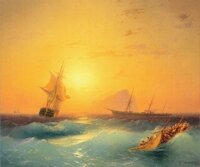
American Shipping off the Rock Gibraltar – $4.4
The painting, Crimea Seascape, was given to the Bishkek Museum back in 1955 when its value was estimated at 10000 rubles – at the time which, according to the official exchange rate, that was about USD1900 at the time … but it’s the equivalent of about USD15000 today taking inflation into account. That might not seem like a huge haul perhaps, but it’s not clear what it might be worth in today’s market.
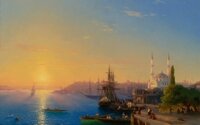
View of Constantinople and the Bospherous
Up until 2006, for example, paintings by Aivazovsky had realized over three million dollars when they were sold in auction … then in 2007, his painting American Shipping off the Rock of Gibraltar more than doubled that when it went for 2.7 million pounds … and then in 2012. his View of Constantinople and the Bospherous was sold at Sotheby’s in London for 3.2 million pounds, (that’s over five million dollars).






 Bishkek
I happy to say that is currently being reported that the painting has been returned …
It seems that the police had identified a couple of suspects that committed the theft and actually had one in custody when the painting was “thrown” into the museum … although I am not quite sure what is meant by that phrase.