Elebaev – Founder of Kyrgyz Literature
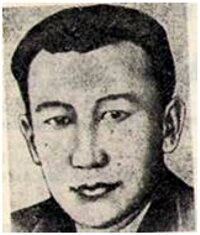
Mukai Elebaev – the Founder of Kyrgyz Literature
Although one source says that the poet and novelist Mukai Elebaev was born in 1905, but other sources suggest that it was on 15th January, 1906 that he first saw the light of day.
When I saw the discrepancy, my first thought was that it was simply down, (once again), to the difference resulting from the change over, in 1918, from the Julian to the Gregorian Calendar … but, unfortunately, it is not that simple … according to the Gregorian Calendar, 15th January, 1906 would be 2nd January, 1906, according to the Julian one … both dates being in 1906.
Elebaev was born into a poor peasant family in Chon Tash ayl in the Tyup district of Issyk Kul. An ayl is a small settlement – like a village of hamlet in English but back then, before the policies of collectivization and enforced settlement) the term was used to describe a sort of nomadic or semi-nomadic settlement – basically, a collection of yurts.
Life was far from easy … not just because his family were poor … at the age of nine, both of his parents were dead and the young Mukai found himself an orphan … he survived by working for the local bais - local landowner or sheepmaster… basically for just for his food and keep.
Then, like so many of his generation, he got caught up in the events of 1916, (when brutal hostilities broke out between the Kyrgyz natives and the Russian settlers and authorities), and the Urkun – the flight into China. He was stay in China until 1919 before crossing the border once more and was able to return to his homeland.
On his return, things started to look up for the young teenager – he started to get an education, first of all thans to a campaign against illiteracy and then was enrolled at a boarding school in Prezhervaslk, (Karakol), and as he entered his twenties he studied at the Tyup Vetinary College … before studying at the Technical College, (Pedtechnikum) in Frunze – nowadays called Bishkek, graduating in 1930.
He is best known, however, as one of the founder of Kyrgyz literature – playing a mahor role in shaping the development of Kyrgyz poetry in particular.
He started young … in 1924, when he just 18, one of his poems, (Zaygam – straitened), was published in the pages of the newly established newspaper Erkin Too. In it he drew on his personal experience and addressed the issue of overcoming illiteracy – and the desirew of the Kyrgyz youth to gain knowledge.
In another example, in his poem Our Youth, published in 1928, he expresses how glad he is that the children of simple nomads, shepherds and labourers have grasped the new opportunities that have opened up for them and begun to study in places like Moscow, Tashkent and Almaty.
In 1931, after he had finally graduated, his first collection of poems, Yrlar zhyynagy, was published, followed by another, The Battle, in 1933 which was groundbreaking in that in introduced themes taken from modern daily life and introduced new poetic forms.
But he wasn’t just a poet … his novel Usak Jol, (Long Walk – or Long Journey), drawn on personal experience is a fictional “documentary” based on the Kyrgyz refugees seeking asylum in a foreign land after the 1916 uprising. was the first example of autobiographical prose written in Kyrgyzstan. It was followed in 1938 by a sequel, Kyyyn Kezeng, (Hard Crossing), and then other stories such as Zarlyk and In Burana’s Day.
He also got involved in translation – one of the first Kyrgyz writers to do so, translating works by the people like Gogol, Tolstor, Pushkin and Furmanov … as well as a variety of fairy tales into Kyrgyz.
Unfortunately for him … war broke out in 1941 when the Germans invaded the Soviet Union … and like many of his generation, (once again), he enrolled and went off to the front to defend his Motherland. He didn’t stop writing, however, and some of his poems describing life at the front were published.
However, he fell as one of the casualties of war in the Pskov region of Russia … and died in 15th May, 1955.
.
He became a member of the Writer’s Union in 1934 … and as well as achieving success at home, his works were also translated in Russian and Latvian … and, for all I know several other languages as well but, as far as I can ascertain – not English.





 Bishkek