Could this be Kyrgyzstan’s Year – The year of the Horse?
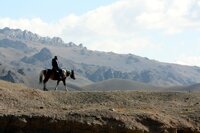
Photo: Lisa Vitaris
Last year was supposed to be my year – the Year of the Snake. I was born in 1953 and in the Chinese Calendar, that was the Year of snake … and according to the Chinese Zodiac, every year has an animal associated with it – there are twelve of them in a cycle, (Rat, Ox, Tiger, Rabbit, Dragon, Snake, Horse, Sheep, Monkey, Rooster, Dog and the Pig), and so the cycle repeats itself every 12 years. Hence, last year was also the Year of the Snake.
Today is New Years’ Day according to the Chinese Lunar Calendar – and we are entering the Year of the Horse - and given the Kyrgyz affinity with horses, I suppose that this could be Kyrgyzstan’s Year.
For the record: According to Chinese Astrology, people bear the characters of the animal in the year in which they were born, as adjusted by the five elemental signs – Fire, Earth, Metal, Water and Wood. This year, for example, is the year of the Wooden Horse … so, in fact, there are 60 years in the full cycle.
.
According to one legend, (there are others), a Great Race was held by the Jade Emperor so as to determine the order in which the animals would appear in the cycle. The race was involved running a great distance and then swimming across a great river to the finishing line on the other side.
The rat and the ox crossed easily enough (the rat hitchhiking on the ox’s back before jumping off the back of of the ox to grab first place).
The tiger was a powerful swimmer and had no problems whilst the dragon was able to fly across the river but was delayed by performing magic to bring rain to a relieve a village which was suffering a drought.
The rabbit, crossed the river by hopping from stone to stone and grabbing hold of a floating log (and also got a little help from the dragon).
The horse, whilst being an excellent runner, was not such a good swimmer, and would have been next but, the snake crossed the river by stowing away on horse’s hoof, doing a sudden dismount in order to cross the finishing line in front of his ride.
Then came the Goat, the Monkey and the Rooster who had helped each other in freeing a raft on which they could float across the river.
The Dog came next, surprising low down in the order as he is supposed to have been a good swimmer – but he got distracted en route, playing in the water … taking a bath, he said!
Last of all came the pig … who stopped off for snack on the way and after having eaten his fill fell asleep.
Apparently, the cat was also a competitor … but cats are not good swimmers and it drowned, which is why it’s not in the zodiac … and that’s why they always chase rats – jealous of the fact that they came in first place and for “stealing” their place in the zodiac.
.
In Chinese mythology the horse is:
- seen as symbols of travel and reaching a reaching a (success);
- competitive and hot blooded, and likes to show off;
- intelligent, but in need of training because as a wild animal it will just wander aimlessly and so needs a guiding hand to give it one;
- sociable and affectionate;
- noble: they weren’t put to farm work, for example, (that was left to the ox), and only those of noble birth would ride a horse, (so is concerned about their image – their appearance and speech);
Horses are often portrayed as a protagonist for action, providing the driving force behind a venture.
Wood on the other hand is associated with both strength and flexibility, warmth, generosity and idealism, patience and altruism but also with anger.
So, those people who were born in the year of the horse are considered to be
- popular;
- cheerful, perceptive, talented and down to earth;
- clever and kind;
- likely to join in collective efforts;
- communicative … although they may have a tendency to talk too much and to want to be the center of attention – to be in the limelight;
- persistent and do not give up easily;
- but their interest can be superficial – easily distracted as they do not pay attention to detail, hence …
- they may not be good with financial matters;
- they can also be
- stubborn and independent, not listening to advice and …
- impatient, not taking kindly to being restrained and …
- this can lead to outbursts of a bad temper and …
- pessimism setting in when they do meet failure and have to give in.
.
Horses are quick-footed, hoofed quadrupeds and there are many different breeds which can be used for transportation, (especially for military purposes), either being ridden, used as a “pack horse”, or for the providing the locomotive power pulling a chariot or wagon … as well as being loved or cherished in their own right as pets or companions … or even as inspirations for works of art and literature … oh, and yes, …for food.
The Kyrgyz people, as as nomads have roamed Central Asia over the centuries. The nomadic tradition is so strong that some say that it is only in death, when he is buried, that a Kyrgyz stop wandering.
For centuries, and even today, the backbone of the economy has been animal husbandry – sheep, yak and horse breeding for wool, meat, milk and fat. Horses and sheep were the main currency of exchange to buy goods … or even a wife.
Horses play an important role in the life of nomadic peoples, and Kyrgyz ponies were famous and a prized possession because they were strong and sturdy, bred to travel great distances with flocks and herds of animals. Even today, herds of horses can be seen wandering mountain pastures,
Children would be placed in a saddle and learn to ride a horse almost as soon as they learn to walk.
In the countryside, nothing is respected more highly than skill with horses. Horse races that test both speed and skill can stretch over 30 kilometers and games played on horseback form the center of festivals such as the Chanach. One such “game” involves two competitors on horseback whose bodies are covered with sheep fat, who try to wrestle each other to the floor. Another, Kok Buro, involves two teams trying to score “goals” by carrying or throwing a weighted carcass of a goat across the opposing team’s goal line. Perhaps more “romantic” is Kyz Kumai where a man chases a woman, both on horseback, attempting to kiss her whilst she does her utmost to avoid him. According to tradition, if he fails then she whips him – but if he is successful, then she is bound to fall in love with him as he has proved himself to be a truly skillful horseman.
Another activity in which horsemanship plays a major role is hunting, especially with eagles, which is still practiced in certain regions of Kyrgyzstan and Kazakhstan.
Horsemeat is also a highly revered food – horses are specially bred, and never ridden to ensure the tenderest meat. For a major celebration or a funeral then horse is the staple meat that is served. A horse is, in fact, a major investment for a Kyrgyz.
.


 Bishkek