The Kyrgyz Khanate
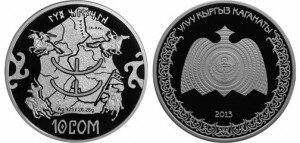
The newly minted 10 som commemorative coin
At the end of last year it was announced that a new 10 som coin was to be issued on 24th December … although it is technically legal tender, it’s really meant as a collectors item … for numismatics.
There will only be 2000 copies minted and they will be made from silver. It’s the first of ten coins that are planned in a series dedicated to the “Age of the Kyrgyz Kaganat“.
Depicted on the face of the coin is a tamga - a symbol of the Kyrgyz people, placed over a stylized map of the territory in which they lived before the Kaganate was established. Four horsemen are pictured, galloping over the borders, expanding the boundaries of the state. In the upper part there is an inscription, made of Orhon- Yenisei Runic writing, which translates as “Kyrgyz State”, whilst in the lower part are an indication of the fineness and weight of metal (Ag 925/28.28 g) and the denomination (face value) of the coin (10 Som).
On the Obverse side, the main element is the gerp or state seal – a national emblem – placed in the center of the image of a stylized eagle. At the top there is the name of the coin “Great Kyrgyz Kaganat” in Kyrgyz, and around the rest of the rim there is inscribed a traditional pattern. At the bottom, beneath the stylized eagle and inside the circle is the year of issue, (2013).
The coin is 38.60 mm in diameter and sold in “mint condition” in special protective packaging and a numbered certificate of authenticity. Although the face value is just 10 som, the asking price at the National Bank, where they are on sale, is 2200 som each – that.s about forty four dollars.
Thanks to the ancient Chinese Chronicles, we can obtain a picture of the Kyrgyz nomadic state of the sixth to tenth centuries in the upper reaches of the Yenesi river.
The “nobles” of the Kyrgyz state were called “bek” – or “beg” – and “Bars Bek” (which basically translates as “Bek, the snow leopard”) was an honourific title which seems to have been applied to the leaders of the nation. One leader in particular was called Barsbek and is thought to have been part of the inspiration behind the epic hero Manas.
Some of the names of the individual leaders of the Kyrgyz at this time have come down to us in the Chinese Chronicles, and also from tomb inscriptions. (Although the Kyrgyz had no written language until the twentieth century – in keeping with most of their neighbours they used runic characters for such inscriptions.)
They were rich and powerful characters … with herds of cattle, horses and sheep; often having many wives, concubines, slaves and bondsmen; they had squads of warriors (often comprising of their many sons). They were involved in trade with their neighbours, selling not only meat, wool and skins – but also fine handicrafts and jewellery.
It seems as if they were held in high esteem by their neighbours. Apparently, other Turkic khans considered it a high honour for their daughters to marry one of the Kyrgyz begs.
However, there was also tension … and their neighbours tried to subjugate them on numerous occasions. There were repeated raids and invasions of their territory – driving off the livestock and enslaving the people. The most severe attacks occurred in the 8th century, at the hands of the Uighur Khanate, taking advantage of the weakened state of the Kyrgyz following a century of wars, raids and internal strife which had left the Kyrgyz disunited, hostile to one another and generally on the point of social and political disintegration.
Then, there arose amongst the Kyrgyz a new leader … who managed to unite the people and lead them to victory over the Uighurs and the seizure of vast tracts of land … from the slopes of the Tien Shan as far as Mongolia. The name of this leader is not known … in the Chinese Chronicles he is referred to by the Chinese name Tsitse Ghunghe Ghing. Some scholars, however, identify him with Yaglakar Khan … whose tomb was discovered in 1909 near the village of Suja on the banks of the Selegna River in Mongolia. The Chinese Chronicles tell us that his mother belonged to the Karluk tribe that lived in the Altai, and which had seized the Semireche (Seven Rivers) district that included the Chu Valley in 766AD, and his wife came from the Turghesh tribe which had lived in the Chu valley from before that time.
The Uighur state occupied a vast area including the region of Eastern Turkestan and Mongolia and they sought to extend their empire to the lands of the Yenesei River occupied by the Kyrgyz. There were several incursions into the Kyrgyz territory – which were met by fierce resistance. Eventually in 839, an 80000 strong army with the aid of a Uighur rebel, Guilu Baga, who showed them the way, attached and sacked Uighur capital. Taken unawares, Chzhan Sin was killed in the battle, his sons fled and his wife, a Chinese princess, captured. In order to maintain good relations with the Chinese, she was sent back to her father with an armed escort – but the caravan was attacked en-route and it was only after three years and many adventures that she finally reached home.
Defeated, the Uighurs scattered and although fighting continued until 846, it was effectively the end of the Uighur empire. During those six years, the Kyrgyz took other cities in the empire one by one, burning them to the groundThe mysterious leader of the Kyrgyz died the following year. The Kyrgyz and Chinese courts exchanged ambassadors and for a while relationships between the two were good. Chinese foreign policy, under the emporer U-Tsun had long aimed to cement a positive relationship with the distant Kyrgyz tribes whom they had seen as a check and balance against the Uighurs. In 846, however, U-Tsun died and his son, Suan-Tsun, adopted a new policy in the face of the new political and strategic reality. Now that the threat posed by the Uighur empire had disappeared – and the Kyrgyz had now become their new, powerful, neighbour … the relationship between the two cooled …
Some scholars now identify this mysterious, unnamed, leader of the Kyrgyz with the original Manas, (the legendary hero of the Kyrgyz), and his victorious campaign over the Uighurs with the central episode of the epic – The Great March.





 Bishkek