Signs of progress …
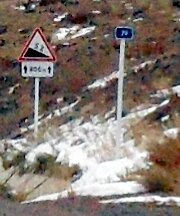
A new generation of road signs
On my recent trip up to Naryn I got a bit of a surprise … a pleasant surprise, I might add. Normally, I don’t like surprises … but it was nice to see how things have improved.
The road forms part of the main highway from Bishkek to Torugart – and as such is one of the most important roads in the country, carrying traffic to and from China – so it plays a particularly important role in the economic life of the country. For some time now it has been under reconstruction – not only getting resurfaced but also being widened in places, being re-routed in a few places and, apparently, being fitted out with new road signs.
The new surface, where it has already been laid, is a delight to drive – smooth and, (so far), no potholes, ruts in the surface and uneven patches … so there’s no bouncing around inside the vehicle as it comes across a patch of warped asphalt. I suppose that it is only a matter of time before such blemishes in the road surface re-emerge … either as a result of coping with the extreme weather conditions or, (as many locals like to contend), overweight Chinese trucks, (heavier than the roads were originally designed to cater for … and so, technically banned from entering Kyrgyzstan), carrying goods to Kyrgyzstan’s markets – or beyond.
As we reached 272 kilometers into the 360 kilometer journey, just before the Dolon Pass, we reached the end of renovated highway … and turned off the CD player – just in case – so as to avoid damaging the disc as we bounced back and forward, lurching this way and that.
In places, what was a simple two lane carriageway …
although, to be fair, much of the road is still a simple two lane highway about seven and a half meters wide … but with the improved surface
… has been transformed into a four lane, dual carriageway – complete with central partition. I am amazed at how this has been achieved in several places – especially through the narrow Boomskoye usheli, (Boom Gorge as it is known, or Shoestring Gorge). Where it seemed that the previous generation of engineers had managed to miraculously find a path for the road to take, (nestled at the foot of a steep cliff, right next to the rushing river, … or between two perilously perched rows of buildings on either side of a road through a tiny village – a road that was obviously built for smaller, slower, more sedate forms of transport), the current generation have managed to find ways of building an embankment on which to perch the road, or to carve away tons of rubble pushing the cliff face back into the hillside and thus provide the required extra meters to allow for the additional lanes.
Not only will these enable a greater flow of traffic, it should also make things safer as it will be easier and less perilous to risk overtaking other vehicles – especially those large, slow moving, heavy Chinese trucks that always seem to travel in convoys.
In a few places the road has been re-routed to by-pass some community or potential hazard. Whilst in some places this has entailed carving out a new stretch of highway, in others it has simply meant taking a slight diversion, utilising and upgrading an already existing alternative road.
At long last, for example, the 26 kilometer stretch from Kok Moinok (in Boom Gorge) to the Orto Tokoi reservoir, (just before Kochkor, has finally been approved, adopted and the restrictions that used to prohibit certain traffic from using it have been lifted. This saves those vehicles over 80 kilometers and almost an hour on the journey between Bishkek and Naryn as it is no longer necessary to travel all the way to Balykchy on the Western tip of Lake Issyk Kul.
I have noticed all of that on previous trips up to Naryn … and although the read works have entailed many delays there has always been the expectation of the benefits that these improvements will bring … which, indeed, are already evident, even though there is still a lot to be done.
.
What surprised me on this trip however, was the new signposting – especially two particular innovations.
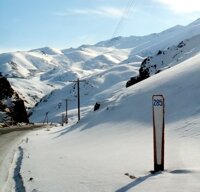
The old style distance marker
The first hit me almost as soon as we left the city limits … the old style of “milepost”, or distance marker, inherited from the days of the Soviet Union, have been replaced – at least along this road.
They used to be a triangular post standing at the side of the road, the edges painted orange to help it stand out and each of the angled sides being visible from traffic approaching it, with numbers painted in large figures indicating how many kilometers it is from the start of the road. Personally I liked these – even when the paint had faded … they seemed a comforting sign that although the kilometers were passing they gave an indication that civilization was never that far away.
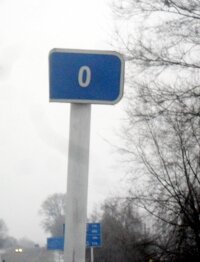
The new style of distance marker.
They have been replaced by new signs, blue rectangles placed on plastic poles – the plaques themselves about the same size as the figures on the older posts. The numbers, in white, are thus smaller and harder to read at a distance – even if they are “modern” and reflective.
The second surprise came as we turned and I looked up from the book I was reading, (yes, because it was a smoother ride and I wasn’t shaking from side to side or bumping up and down as we traversed the carriageway, I could read without difficulty), and my eye caught a gradient marker … indicating the slope of the approaching section of the road.
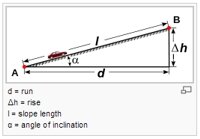
The Mathematics of measuring a gradient
The question of gradient has always confused me a little … being used in the UK to gradients being expressed in terms of 1-in-x … a rise of one meter in a run of x meters … a tangent to the mathematicians. Here, however, they are expressed as percentages … 100 times the measured rise in a given run.
The odd thing about this system, it seems to me, is that – technically – you can a slope of more than 100% – although it would be very, very, steep. A slope of 100% – a rise of 1 meter in a run of 1 meter – subtends an angle of 45º … I think it would be challenge to drive, cycle or walk such a hill – either up or down*. Any slope with an angle of over 45%, however, ends up with a slope of more than 100% … with a sheer, vertical, technically having a gradient of ∞% (!).
In the past these signs all seemed to indicate a slope of 12% – about 1 in 8 – although, over the years, I have seen a few indicating different figures. Because they all seemed to say the same regardless of the actual slope of the road, I thought that either someone had bought a “job lot” – or that the signs were simply put up to indicate a steep stretch of road … and no-one took any notice of the actual figures. The new ones on this renovated road, however, indicated slopes of differing gradients, from 4% to 6% – that is, from about 1 in 25 to 1 in 16 … not too steep. I presume that they related to actual gradients measured by surveyors, although one or two seemed to be a little “out” – or at least, that’s how it seemed to me at the time.
.
I suppose that we should see these new road signs as “signs of progress” … although I can’t help feeling a sense of regret at the loss of an “old familiar friend” …
.
* Incidentally, although I have done something similar, (for example, in a Niva … as a passenger … Thank you for the experience Tom), but it’s not something I am eager to repeat and I wouldn’t recommend this to anyone:
.
.





 Bishkek