Compote
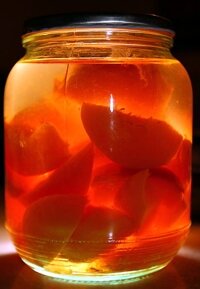
A jar of Compote
The other day my neighbour brought a in jug and poured out its contents into several glasses which she then distributed around the office.
The jug contained Compote – a traditional fruit drink – which she had just finished making and wanted to show off. It was still warm. When we had dutifully drunk our glasses and praised it, she kindly offered to make me some more if I bought her the ingredients.
She pointed out that it was not only tasty but also very healthy – much better than the vast array of soft drinks on sale … and I have to admit that the kids like it immensely. It’s fairly easy to make at home but it is also produced commercially and the supermarket chains here sell 5 liter jars of it. Recently, although consumption has apparently been declining as a result of the introduction of those same soft drinks and mineral waters, some “up market” versions have appeared with some of the fruit in it – imported from Azerbaijan.
The name, “Compote”, comes from the French for “mixture” which gives away its origins … 17th Century France and a drink prepared from a mixture of fruit, (typically apples, pears, plums or berries. I understand that compote can also be mode out of rhubarb and even shallots … an onion!), cooked in a sweet syrup, (containing sugar and spices) – although it may be based on an earlier dessert from Byzantium. Itn France, it was originally served chilled as a dessert.
It was also used in Northern Europe as a way of preserving fruit for the winter.
Also, a fruit Punch was a common refreshment in India and brought to Britain by sailors returning from establishing the Raj.
.
It can be made using either the whole fruit, parts of the fruit, pureed fruit or even dried fruit, (although dried fruit needs to be soaked before use). It is best to use good quality fruit, that its without any bruising.
Here’s a simple recipe:
For one cup of sliced fruit, you’ll need three quarters of a cup of water, half a cup of sugar and a couple of teaspoons full of lemon juice.
Add the sugar and lemon juice to the water, and bring the solution to the boil then adding the fruit. Cook it over a low heat until the fruit is soft and beginning to break down. Take it off the heat and set it aside to cool.
Other spices or flavourings can be added, such as vanilla, cinnamon or cloves, ground almonds, grated coconut or raisins. Sometimes compote is laced with alcohol; brandy, rum, or liqueur.
As well as being a refreshing drink, it can be used as a source for other dishes and the “stewed fruit” can be used as an ingredient for other dishes.
The Russians also have a similar “fruit soup” called Kissel, which you sometimes find here. In fact the supermarkets sell it packet form – an “instant kissel”. Thick variations are used as sauces for other dishes, such as semolina, pancakes, syrniki and ice cream.
The name comes from kissly, the Russian word for “sour”.
There is an interesting legend of how Kissel was instrumental in saving a city from nomadic hordes which were besieging it. As the supply of food in the city was running out, a wise man advised the city elders to gather what grain and mead they could find and fill two barrels, one with a form of kissel and the other with the mead. These were then buried in the ground and disguised to appear as wells. When the nomadic emissaries came to seek the surrender of the city they were treated to as display of the people drawing food and drink from these wells … and thus were persuaded that the city was fed by the earth itself, decided to lift the siege.
Although fruit is abundant here in Kyrgyzstan, and Compote seems to universally popular, it doesn’t seem to be a feature of traditional Kyrgyz cuisine … at least it doesn’t appear in any of the Kyrgyz cookbook that I have seen.








 Bishkek