The four stages of a tour
I had a visit the other from yet another journalist who wanted to take an interview about the state of tourism in the country.
This time it’s for an article to appear in a new journal which is being planned to be published here in Bishkek by a European publishing house. It will be in Russian, so it is for the local population which means that the articles will need to be analytical rather than marketing. It’s surprising how many local people don’t understand that point. Even journalists!
Anyway, I have gotten used to this sort of scenario … and they look for a good topic to serve as a theme for the first issue. Something that is attractive with the possibility for many different stories on different aspects, and lots of good photo opportunities. Tourism in the republic is a good choice because it’s meant to be a priority are of government strategy, with great potential for growth and improving the earning potential amongst all sections of the population, including the poorest. there are many different stories to be told, lots of people willing and eager to have their say and provide a good quote. There are many, many photo opportunities.
Anyway, yes, of course I agreed to give an interview.
We began with some background about the planned publication, circulation, no of pages, planned targeted readership, etc. Then we launched into the questions … she told me that she had three questions and it would take about half an hour … Not bad, I thought to myself.
As usual, however, Robert Burns got it right when he commented about how “the best laid plans of mice and men … ” often go awry.
You see, she asked her first and ninety minutes later I said, “What about your second question?” … well, we decided to give that a miss … I think her Dictaphone had run out of storage space, or battery, or something … or maybe she was just tired … I know that I was.
We took it for granted that the development of tourism in the republic was a good thing, that it would bring benefits and that we should pursue it.
The trouble was that her first question was basically about what needs to be done to develop tourism … and then she went on: “I suppose something needs to be done about the level of service …”.
Well, talk about a leading question … Sorry, but I don’t agree … let’s start at the beginning … don’t worry, we’ll get to the question of service, but it’s not necessarily where we need to start.
I explained that, as I saw it, there were four main areas that we had to concentrate on:
The first was … Before the potential client decided where to go on holiday – it’s a question of marketing.
We have to tell them about Kyrgyzstan and persuade them that it is really is a place they ought to visit. If we didn’t do that, then everything else was irrelevant. Sorry but just building a hotel doesn’t mean that guests “will come”, (as in “Field of Dreams”), they won’t automatically beat a path to the door and start banging on the door demanding to let them in. Without clients … there’s no business.
Once again, I am often amazed how many people don’t seem to understand this basic point.
In fact, it shouldn’t be too difficult … if we can get over the “whereizstan”? syndrome … then it should be possible to explain that Kyrgyzstan basically has something for everyone … well, except, perhaps a volcano, (but then if someone is specifically looking for a volcano, then there’s probably nothing we can say to persuade them …).
One of the most influential forms of advertising is personal recommendations, accounts, comments and photographs of those who have already been to and enjoyed their visit to Kyrgyzstan. Every satisfied client will recount their experiences and impressions to members of their family, their friends, their colleagues at work and their acquaintances, and some will be intrigued and may “catch the bug” and have their interest in the country aroused. Unfortunately, if they have they have a bad experience they will tell all of their family, friends, colleagues and acquaintances … and the “dirt will stick”. Bad news travels fast and it is very difficult to combat is, so our reputation is very important.
One issue that may attract people, or put them off, is the question of price. In recent times there has been a lot of discussion about pricing policies. In some respects, Kyrgyzstan is a cheap destination, but in others it is expensive, especially when compared to other destinations … and when comparisons are made about the level of facilities and service which the tourist receives. Those of us in the industry have come under pressure to reduce prices. I understand that everyone wants to pay as little as possible to obtain goods and services, to save money … no-one wants to feel that they have been “fleeced” … and that prices should be commensurate with the goods and services the client receives. However, there is also an obligation on those setting the prices to cover their costs, pay their taxes – and make a profit. It does nobody any good if the company goes bankrupt because they have reduced their prices so much that they cannot cover their costs, or they don’t make enough profit to enable future development, renovation, etc. It’s a balancing act.
The second is … When they have decided to come here, then we have to do everything to make it easy for them to actually do so.
Unfortunately, it’s not all that easy to get here … some of the difficulties are grounded in the fact that we so distant from our markets – whether it be from places like Europe, America and Australasia, or even from the population centers of Kazakhstan and Russian, which provide the vast majority of tourists to visit the country,
It’s not just the distance, though … the connections, (where by road, rail or air), are so limited. There are only something like eight border crossing points that are open to foreigners. There are basically two train lines into the country, and only one of those actually goes any real distance inside the country … up to Issyk Kul … and the journey from Moscow, for example, can take several days. Likewise a bus journey from the population centers in Siberia. Try getting to and from Australia … there are no direct flights and with at least one change over, sometimes a lay over, and often two … and the journey can take take twenty six hours or several days … if there are seats. Most of the planes on the popular route, through Tashkent, are flight shares and fully booked well in advance … or they use small planes and can carry a limited number of passengers. One client from Australia actually found it easier to book a seat via London, than fly via Tashkent … three quarters of the way round the world!
Then we come to the thorny questions of Visas …
Let’s be frank about this …. visas are important. They are an important tool in the fight against crime and terrorism. However, although people do understand this and are prepared to obtain visas where necessary, this requirement does present a barrier to the visitor. The requirement to obtain a visa says to the visitor, we don’t trust you – we need to check you before we will let you into our country. That’s hardly a welcoming message to send, especially for those for whom there is no real or perceived threat to Kyrgyzstan.
Now, to be fair, Kyrgyzstan has a fairly liberal visa regime in many respects. It is one of the most liberal in the whole of the region, in the whole of the former Soviet Union, but it could, of course, be made easier. There are some countries whose citizens enjoy a visa free regime … they can simply visit the country without needing to obtain permission from the authorities. Others need to obtain a visa, but can obtain one by simply applying for one at a Kyrgyz consular office … If they can find one, that is … there aren’t that many of them around the world. It’s possible to apply for a visa at a Kazakh embassy in countries where there is no official Kyrgyz diplomatic representation, (for example in France, Italy or Spain), but this involves additional formalities, time and expense. It is also possible for them to obtain a visa on arrival at Manas Airport in Bishkek, but not everyone uses Manas as a gateway to the country. Everyone else who wishes to visit Kyrgyzstan has to be invited, and have that invitation approved by the authorities, which involves additional cost and time, (in the worst case of which I am aware, it took seventy days to obtain approval), and the tourist cannot be sure that approval will be given. They wait for seventy days, planning a trip, and all their plans, hopes and expectations can be overturned because authorization is refused. That’s hardly an encouraging or welcoming message to send.
What’s more, for the visitor to obtain a visa costs them time and money. If a family is travelling then the time taken to obtain a visa is probably the same as if just one person was travelling, but the cost in terms of visa fees, the cost increases proportionally. If the tourist is planning to visit several countries – then they need several visas – involving additional expense, additional time. It would help if there was only one visa necessary to visit several countries, like the Schengen visa in Europe, or as in Southern Africa. That would require international agreements which will take time to conclude, and our experience with the Republic of Kazakhstan on the limited, mutual recognotion of tourist visas, does not set a very good precedent, as it basically doesn’t work.
It would be good if we could simplify the visa system … just the announcement that we were doing so would send a positive message around the world.
That brought us to the third … Once the visitor has finally arrived, we need to do everything that we can to ensure that they have a good time and a memorable experience … with good memories that is. At long last we have arrived at the question of “Service” … where she wanted to start the interview …
There’s a lot said about the quality of service … and it is an important issue. We are a “service industry” … and we have to provide value for money
When they do eventually manage to arrive, what do visitors face … a smiling face with a cheerful “how are you?”, no chance … passport control and immigration with unsmiling, unwelcoming officers sitting in booths, often not looking at even them apart from a suspicious scowl as they slowly and deliberately compare the photograph with the original standing before them. Not all of the cabins are occupied … not all are working, so it can take well over an hour to clear the last passenger off the plane.
Off-hand Customs officials who, even if they don’t ask any questions, can “make even a sainted grandmother feel uneasy and guilty” (… that’s actually a quote from a former client). When they arrive at the airport, every bag has to go through scrutiny … as if they hadn’t been checked before allowed onto the plane in the first place. That’s every bag … not just a spot check, or suspicious baggage, every bag!
Finally, they emerge from the customs hall into a noisy melee of expectant taxi drivers who seem to take it as a matter of professional pride to make sure there is never more than a meter of free space outside the door. It’s probably in the early hours of the morning after a long night time flight when it has been barely possible to catch some sleep, so they are likely to be tired and irritable after their long journey. They often find the airport cool, (if not cold) and poorly lit … now, most Soviet buildings are really quite spacious and well lit, so why is it that the airport isn’t?
If the clients have read the travel warnings issued by foreign governments, then they know to be wary of taxi drivers. Most of them are actually quite reasonable, helpful and don’t overcharge as a matter of course … but, unfortunately there is always the exception. It’s bad enough, stressful enough being in a strange country, in a poorly lit airport hallway without having to cope with the language problem … although those who have booked a tour are likely, at least, to be met by a guide who will speak their language … but even they have to “run the taxi gauntlet” in order to find them.
However, it’s not all bad news. Things are improving. They have improved a lot since I first came here for a short visit in 1994. People who work in the industry do now think about this and in most places it is no longer a case of “take it or leave it.”
There have been initiatives to improve the quality of service in the industry … work has gone on to define standards for professional qualifications, specialist training courses have been started which employers and training institutions cooperating together. Most employers undertake special training for their staff … and, most importantly, many of the staff working in the industry do understand the importance of the quality of service.
In many respects, the question of service is a question of psychology: empathy with the client and motivation. When it comes to it … the question of the quality of service really boils down to the person “on the front line” … the receptionist, the waiter, the cleaner … they have to understand what’s involved and why it is important. All the official standards, training and procedures will have little effect if they don’t understand.
For example, one problem which has hindered the achievement of improvements in the quality of service is that so few of the local population who work in the industry have ever been “clients” themselves. A waiter, who has never eaten a meal in a restaurant, may well have studied hard and have a certificate to show that he has successfully completed a training course, but if he also has experience of having been a diner then he will have a better idea of what the client is looking for when it comes to service.
One exception to this, however, concerns mealtimes. Often the meals provided are “Table d’hôte”, a set menu at a set time … and there is no choice offered about what to eat, or when to eat. I understand that running a resort on Lake Issyk Kul is a difficult task … the logistics and economics of feeding hundreds of people are complex enough, and the constraints that impose means that offering choices will only make the whole issue more difficult. We faced similar problems in our hotels … I think we have solved the issue in Bishkek, although we still have problems in guesthouse in Naryn where we still operate a set menu, but with flexible times. The guests are paying and deserve the effort that is required to try and overcome these logistical problems.
But it’s simply a question of service. For tourists to enjoy a pleasant and memorable visit to Kyrgyzstan, it also requires developing the infrastructure.
As it happens, there has been good news here as well. On Lake Issyk Kul, for example, there has been a lot of new development and renovation to bring hotels and resorts up to modern standards which tourists have become used to enjoying around the world. It’s true that not every establishment, everywhere, has undergone such renovation, but it’s a “work in progress”.
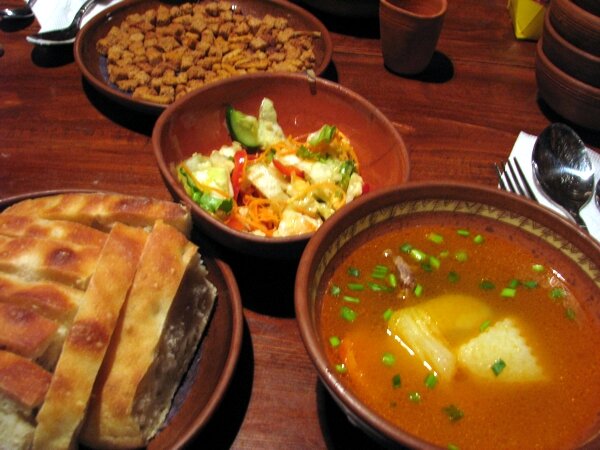
The number, variety and quality of places to eat has grown tremendously in recent years – to the benefit of everyone, not just the visitor.
Other examples of infrastructure development important to tourists are also showing signs of improvement – telephone services, internet access, banking services, for example. Some of the roads still need improvement, particularly bridges on some of the minor roads, and this should benefit the local population as much as the tourist. Generally, however, although it is always possible to do better, the main roads are not too bad …
We probably need to improve things like the provision of medical services but, once again, that is something that should benefit the population as a whole and not just the tourist.
Another thing we should pay attention to is signage. Information boards, preferably in different languages, would be a boon to the visitor, who may or may not understand Russian, but who probably won’t understand Kyrgyz. In some places around the country, road signs and place names are displayed in both Cyrillic and Latin scripts and it would be good if this could be extended … informative signs, (giving a few basic facts about things like historical events, geographical features, wildlife), and not just “Rules and Regulations” would be helpful. Museums, could have signs about their exhibits in different languages … it helps the guest feel welcome and creates a positive impression.
Perhaps the biggest improvement we could make to the infrastructure, however … the one that would have the best effect … would be to improve the state of toilet facilities throughout the country. Roadside toilets always present a problem, as the provision of water supply and sewerage facilities can be costly and impractical, where ever possible, however, clean and presentable toilet facilities will make a big difference to peoples impressions and memories about Kyrgyzstan.
… and Finally … When the tour is over and the tourist leaves Kyrgyzstan, we shouldn’t just waive goodbye, turn around and forget about them.
We should show that we value them by, at least, asking them for feedback about their experiences … what went well?, what did they particularly enjoy?, what could we do better?, how can we improve?. This information will help us to improve our services in the future.
Hopefully their memories and souvenirs are good … and will encourage them to speak positively about Kyrgyzstan, to recommend us as a holiday destination to their family, friends, colleagues and acquaintances. We should do all we can to help encourage them … where possible we should to keep in touch with them and give them news, … and listen to theirs.
It often surprises me how many people forget the importance of of “aftercare”.
Of course, the development of tourism so that it achieves its full potential, but not at the cost of the natural environment or social wellbeing and cultural heritage that help to make Kyrgyzstan what it is, is actually quite a complex task.
These four stages are sequential in terms of what the tourist experiences, but we can’t treat them sequentially … it would be a total waste of time to concentrate on marketing the country if the rest of the package is not ready. Just as it would be wrong to concentrate on “service”, alone. In the words of the old song, “you can’t have one without the other”.
Now, the old song coupled together “love and marriage” and “horse and carriage” and it’s not necessarily true, however, that you can’t have one without the other. Although they compliment and enhance each other, they can exist separately, whether we like it or not. I think a better coupling, on the other hand, would be “mountains and valleys”, as the relationship is stronger … although you can have valleys without mountains, (they could separate hills, or hillocks), the existence of a mountain necessitates the existence of valleys.
Basically, however, all this boils down to two things … to develop tourism in the republic, we need to work on, at least, two fronts simultaneously … with clients and with the front line staff who deliver the services to them. It’s two ends of the same pole, two sides of a coin.
Of course, here I’ve condensed ninety minutes of conversation, (and it was a conversation, not a monologue, – although I may have done most of the talking), into a small space to fit onto a webpage. I peppered the points I was making with examples, quotes from clients, and so forth. She came back with questions, anecdotes and comments of her own. That’s probably why it took so long. I know that not everything we discussed will get into the final article … but I hope it gave her food for thought … and, maybe, some ideas for some follow up material.





 Bishkek