The things you see
My father used to have a phrase he would use to say whenever he was astounded by something: “Well, I’ve got a bloody hell …!”.
A friend of mine, Paul, had another phrase which he would use in similar circumstances: “The things you see when you haven’t a gun!”
I think I prefer Paul’s version, and although I don’t say it very say it very often, I have been known to use it here in Kyrgyzstan, which usually leads to trying to explain what it means. I might, however, change it to, “The things you see when you haven’t a camera!”
Things like:
The “cowboy” on horseback, rounding up a stray steer:
This is one of my first memories of Central Asia. It was back in 1994 when I first came here, on a holiday. My friend, Tony, had been back and forth to Kyrgyzstan on various donor projects following the dissolution of the Soviet Union and had bored all of us back in London, regaling us with enthusiastic accounts of the “paradise” that he had discovered, and had persuaded me that it was worth the effort to come and have a look. We had spent a few days in Moscow, before catching the connecting flight … to Almaty. (In those days there were no direct flights from London to Bishkek.)
We arrived in the early hours of the morning and staggered out from the airport to be met by the taxi that his friends in Bishkek had arranged for us, a luxurious “Moskvitch” that looked as if it would fall apart as soon as it hit a pothole, and we sat back, exhausted, for the three hour drive to Bishkek. I watched as we drove round the outskirts of Almaty and headed West through rolling countryside … which soon emerged into long straight stretches with the mountains rising to our left, and the vast vast Kazakh steppe stretching out to our right. At the side of the road was, what seemed to be, a never ending line of trees separating the asphalt road from the cultivated grassland. It was just like the scenes you see in photos and films of the American Midwest, I thought to myself, just before I fell asleep.
I woke about two hours later, startled at the sight of a youth on horseback, frantically whipping the flanks of the animal with a horsewhip as he urged it through the trees and onto the road after a cow, or calf, which had wandered off where it had no business to go. Perhaps I really had ended up in America, in the Wild West, I thought to myself as I came to my senses and gathered my thoughts.
Oh, how I wish I had had my camera to hand.
The night sky on the road from Bishkek to Almaty, or above Lake Son Kul, and Over a meteorite shower in the night sky over Ala Archa:
Another occasion on that first trip that sticks in mind wouldn’t have made a very good photograph, because it was a view of the the night sky, and the little pinpricks of light would not have shown up on the image without a special camera, lens and film. It was whilst we were the return trip to Almaty to catch the flight home.
During the Soviet period, the border was basically just an administrative one. On one side was the Kazakh SSR and the other the Kyrgyz SSR – both of which were constituent republics of the same country – the Union of Soviet Socialist Republics, or USSR. Although in 1994 it had become an International border with border crossing points, passport control and Customs procedures, the crossing was very simple, virtually free of any formality. We just drove up to the border and they waved us through. That doesn’t mean, however, that our passports weren’t checked … on the contrary. There were several points on the journey where the vehicle was stopped by the GAI – the State Auto Inspection, or Traffic Police – who asked for our passports and looked us over. Coming from Britain, this struck me as quite odd, and to be honest, unnerved me a little.
After crossing the border, which is only about 30 kilometers from the Bishkek city center, the road wound its way as it climbed to the Kordai Pass, 1233 meters above sea level. The meandering road was clear as it was summer, but I was told that in winter, when it is covered in snow and ice, it can be quite dangerous. The derelict ruins of cars and buses at the roadside gave ample evidence of this.
After crossing the pass we descended to one of the GAI check posts and what seemed to be an endless straight road running along the foot of the mountain range … mountains to the right of us and endless steppe to the left. Not that we could really see much as it was pitch black dark … no lights on the road, only distant lights to indicate some village or settlement either on the slopes to our left or way out on the steppe to our left.
Our driver, Sergei, was a former helicopter pilot. After a couple of hours, Sergei stopped the car and asked for a “smoking break”. It seems as if everyone here smokes, although that’s not true, but certainly a lot of people do. The thought of a four hour car journey without a “puff” can be quite a strain for some people. At least he did the professional thing and stopped rather than smoking at the wheel. It was probably time for a break anyway and a rest would help his concentration, so we were more than willing. We had a flask of hot coffee with us and drank a cup … and then stood and took in the scene: the darkness, the silence and the night sky.
I don’t think I had ever seen anything quite like it before. It was a cloudless night and there seemed to so many stars … much more than I had seen at home, and they seemed closer, and brighter. Of course, there was “light pollution” – no streetlights or neon signs to interfere with the view. It was almost a mystical experience. I stood there and counted off the constellations that I could recognize.
I have the same feeling twice since then – once in Ala Archa, in the mountains outside Bishkek one August night when I watched the Perseid meteor shower up by Ala Archa and another summer night up at Lake Son Kul.
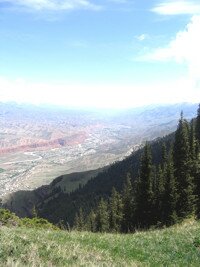
Kyrgyzstan, being a land of mountains, (over 90% of the country is considered mountainous), there are plenty of viewpoints which offer spectacular Mountain Landscapes:
|
One of my favourite memories is of an excursion, a day out, which we took from Naryn a few years ago. We decided to take a trip to the television transmission tower, about 20 kilometers to the West of the town, high up on the ridge above the town. The tower is visible from the town, but is actually quite difficult to reach, but it was worth it as we were provided with fantastic views over the town.
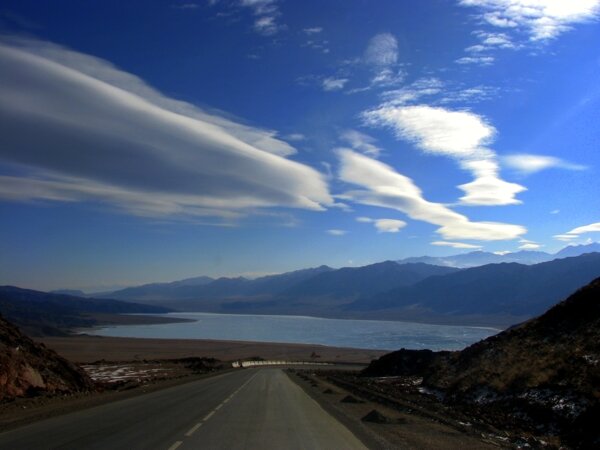
Also near to to Naryn, a few hours away, it can make for a pleasant day trip, or be visited en route to or from Bishkek, is Lake Son Kul. The lake lies in hollow in a treeless, high mountain plateau ringed by mountains which rise above it like a crown. There are four roads to the lake from the surrounding valleys, like the four corners of a square: one to the North East passing the Kara Keche coal mine; another to the North West down to Sary Bulak and Kochkor; a third, to the South East, towards Naryn, is called thirty three popugai, after the twists and turns of the serpentine road that approaches the plateau and the last crosses the Kurtka pass to the South West, and down to Baetova and Kazarman. On one occasion we drove over the pass to descend to the Naryn River below and a storm broke out which sent us scurrying to the vehicles in order to keep dry … but which also uprooted trees, one of which narrowly missed us when it fell across the road just after we had passed it as we drove down the narrow valley.
Another landscape I recall was taking the road from Kazarman to Djalal Abad. The road passes over two high passes and is quite wild in places … narrow and “unmade” – no asphalt. As we hit the pass, Andrei, the driver brought the vehicle to a halt … we had a flat tyre. As he set about to change the wheel, the rest of us set out to explore. I had my camera with me, but it wasn’t much use as we were high in the clouds … the mist enveloping all around us. Mike, one of our guests, went up to and over the crest and I set off to follow. When I got to the summit, I took a deep breath when I saw that he had descended twenty or thirty meters down what must have been a seventy or eight slope over a deep, deep drop.
It was here that we also saw a silhouette in the distance which looked like the “Hound of the Baskervilles”, lying calmly on the slopes, looking down the valley. As we came closer in order to investigate, it looked first this way, then that, but didn’t stir from its spot. It looked like a wolf, but was probably just a shepherd’s dog, and as the mist swirled around us we decided that caution was the better part of valour and to beat a hasty retreat … just in case … anyway, Andrei had probably repaired the vehicle and it was time to move on .
Although animals provide numerous opportunities for photography, even if you do have a camera to hand, usually the photographs are not that successful. Unlike this particular hound, instead of sitting quietly, posing whilst you get into position for the perfect shot, they tend to move suddenly … to run away, or look the other way.
For example, once again without a camera, I witnessed a pair of wolves running along the side of a river: On another journey out from Bishkek, we drove towards Lake Issuk Kul. The road passes through a gorge, Boom Gorge, ( it’s pronounce Bo-om, not boom, and said quickly so that the two syllables merge together, and means “Shoestring Gorge”, in English). at one pointy the road runs parallel to the river and the driver slowed to a halt pointing down to the river bed, where the two animals were prancing along the riverbank.
There are wolves in Kyrgyzstan, and they often get blamed for taking sheep in the high mountain meadows, or jailoo. To see them this low and close to human habitation, is very rare and I felt very privileged to have witnessed their playful antics.
Another experience involving the rich and diverse wildlife of Kyrgyzstan which I will long remember … and always regret the fact that my camera was not to hand … involved an eagle riding the airstreams:
On one occasion I was driving back to Bishkek from one of my monthly visits up to the guesthouse in Naryn. We had some guests with us so we decided to make a detour to one of the local beauty spots, Lake Son Kul. Having had a picnic lunch by the side of lake, we climbed back into the minibus and headed off to the pass, to descend back down to the main road and head off home. As we crested the pass, the drive hit the brakes and stopped the vehicle., pointing to the right, down into the narrow valley that rose up to the pass.
There we could see a magnificent eagle, still with white feathers, which suggests winter plumage, or that it was a young fledgling. It’s wings didn’t move … not a flap … as it glided on the thermals, rising gently and steadily towards the pass. Seemingly totally unaware of us observers sitting dumfounded and gaping through the open car windows as it passed within about thirty meters of us, up and over the pass.
I have seen several eagles here in Kyrgyzstan. One May I say hundreds one day, flying high over Issyk Kul, but I never seen any in the wild as close as this. Even holding an eagle during a demonstration of traditional Eagle hunting by a local Berkutchi was little in comparison to the astonishment and emotions that I experienced on this occasion.
The natural environment provided another memorable moment, when I was once visiting a cafe in the foothills overlooking the city, and witnessed a Lightning storm over Bishkek: The climate in Kyrgyzstan is “continental” which can mean very hot summers and very cold winters. Each valley creates its own microclimate which varies according to altitude and can mean that it is possible to experience all four seasons in the space of a single day. Sometimes in summer, it can be very hot and sultry and we can get quite dramatic thunderstorms. On one occasion I went with some friends to the Panorama Cafe in the foothills overlooking the southern suburbs of the city, which obviously gets its name from the panoramic view over the city that it offers.
As the evening wore on, we sat eating our shashlik and drinking vodka, (the others were drinking vodka, I don’t really like it and only drink it when I “have” to, for example at a wedding or birthday party, when there isn’t any alternative), it started to get dark, but not as a result of night drawing in, … rather as a result of gathering black, threatening, cumulo nimbus storm clouds.
Suddenly there was a tremendous crash like a cannon going off about 10 meters away and the sky became unbearably bright. A thunderstorm. We sat there for about an hour watching as the sky lit up with bolt after dolt of lightning, silhouetting the cityscape beneath us. Eventually, the thunderclaps grew further and further apart, and the storm was over.
Not all the surprising sights are drawn from the natural world … I remember, for example, when I saw what must be one of the world’s largest flags flying above the Ala Too Square in Bishkek for the first time: The main square in Bishkek, (Ala Too Square) is home to a number of landmarks. The square is bisected by one the city’s main streets, Chui Avenue, along which parades are sometimes held, overseen by dignitaries who stand on a podium at the foot of the Erkindik monument … the Kyrgyz “Statue of Liberty” – Erkindik in Kyrgyz means “Freedom”. The huge marble cube behind this, in the northern half of the square, is the State Historical Museum. To the West of the podium is the state flagpole with an honour guard standing to attention beneath it during the daytime and which sports a huge Kyrgyz flag. When there is no wind, the flag hangs limply, but when there is a breeze then it wafts to and fro.
In June, 2009, I happened to go to a meeting on the other side of town and as I walked back to my office after the meeting was over, I could clearly see the flag. I noticed, however, that the flag was very bright and colourful, at that point it was brand new, … it also seemed to be quite large. At first I thought this was because it was much nearer than it really was … perhaps it was on the Ministry of Culture building … at that point in time I hadn’t really noticed the new State flagpole which had only recently replaced a much more modest one and I didn’t know anything about a new flag. As I drew closer and closer, I kept expecting to draw level with the flag but, just as the summit always seems to retreat into the distance as crest yet another ridge, I didn’t seem to get any closer. Finally, I entered the square and took a deep breath as I took in the scene.
The flagpole measures some 45 meters high and the flag itself has an area of 150 square meters. It needed 22 soldiers to unfold it and carry it to the flagpole when it is raised.
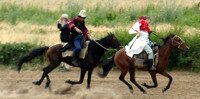
Perhaps one of the funniest sights I saw was the film cameraman running from the horses, (and it almost tragic sight as well – humour is like that, isn’t it? … one person’s amusement comes at the expense of another’s discomfort):
This was on an occasion when a German film crew had asked if we could arrange some traditional Horse Games in a village on their route. Everything was going and they were, so they said, getting some fantastic footage, as the cameraman wandered fearlessly around the participants wrestling over a sheep’s carcass in a demonstration of Kok Buro. Everything was going well until we came to an example of Kyz Kumai, or “Chase the Girl”. In olden days, this would form part of the wedding ritual. According to the rules the “bride” was entitled to a head start on her horse and then the “bridegroom” set out in pursuit. The idea was to catch up with her, and steal a kiss, thus proving his love and right to marry her. Being at a disadvantage, with the slower horse because she has been give the best “racer”, he sometimes failed to catch up with his fiancée, and so she would set about him with her kamchi – horsewhip.
Well, true to his style, the cameraman stood in the meadow as the two riders galloped their horses to him … In theory, they should have passed to one side of him, but the lead horse had other ideas … and headed straight for him … causing him to jump about two feet in the air and three feet to the side before turning and running off.
Undaunted, he said, “Let’s try again ,,, but this time, make sure the horses pass to the side of me …”. OK, no problem the locals assured us … but the horses had different ideas and I think that the cameraman jumped even higher and further than on the previous run.
Undaunted, he was about to say “Let’s try again …”, when the Director butted in and said … “I think that will do … it’s an expensive camera – and we don’t have a spare.”
As it happens, the footage was spectacular and has, I believe, been used several times in different programmes.
I wish, however, that I had been able to get the action shot from the sidelines.
Then, there was the occasion when I saw a row of boys, sunbathing in the middle of the road: It was in the afternoon of a hot summers’ day … We were making my way back to Bishkek when the driver started to apply brakes. Like most good drivers, he was keeping his eyes open and, thinking 10, 20 or 30 seconds ahead, looking for potential hazards ahead. He had seen something in the road, and as we approached he slowed down. It was just as well, because lying across the carriageway was a row of six or eight young boys, soaking up the sun. As we got closer, he sounded the horn, and you could see heads pop up and look around … realizing that there was a vehicle coming they got up, one by one and ran to the side of the road … it was then that we noticed that they were “starkers”, naked, without a stitch on.
I am not sure what was the most surprising thing … the fact that they were there at all, lying in the middle of the road … a fairly busy major road … or the fact that they had no clothes on, not even pants or swimming trunks. There is a very strong tradition here against any form of nudity … so even if they had swimming in the nearby stream, I would have expected them to have at least been wearing shorts, or underpants.
My favourite “I’ve got a bloody hell” moment, however, must been the time I saw a London Routemaster Bus, a bright red double decker, driving along the street in Bishkek: I had been to a meeting and was walking back to my office and came to a set crossroads with a set of traffic lights. As I waited for the lights to change, so that I could cross to the other side of the street, I looked around and saw this bright red London Routemaster bus with the destination board displaying “Westminster”. I wanted to flag it down and point out that it was heading in the wrong direction – East rather than West.
|
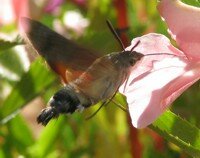
One occasion when I did have my camera with me … well, almost … was the sighting of the Hummingbird Hawkmoth. I had gone up to Issyk Kul for a weekend conference and because I was coming from Naryn, and not Bishkek, I arrived to the resort where it was being held earlier than everyone else. I checked in, unpacked and decided to kill some time whilst I was waiting by going for a walk in the grounds. It was a bright spring day and I walked along the side of the flower beds taking in the colours and smells, and watching the bees and butterflies flitter from flower to flower, bloom to bloom. Suddenly, I stopped short … I couldn’t believe my eyes. Normally the butterflies landed on a flower and opened their wings and seemed to bask in the sunshine, the bees landed on the blooms, hustling and bustling, this way and that, collecting pollen for their hives, with never a still moment.
There in front of me, however, was a tiny insect, (well, not that tiny, about two or three centimeters long), but it wasn’t its size that attracted my attention – it was what it was doing. It didn’t land on the plants, but hovered in front of them, and projected a proboscis into first one bloom and then another. It looked like the action of a humming bird. Now I know that some humming birds are very small … but this seemed to be far too small – so I took another, closer, look and confirmed that it really was an insect.
I had never seen anything like this before, although I have subsequently learned it is not exactly a rare species. As I said, I did have my camera with me … but not in my hands, so I ran back to my room to get it … when I returned, the insect was no longer to be seen … I hunted up and down the flower bed … and then, yes, there it was … I raise the camera and took a photo … or tried to … whhrrr, whhrrr … was all I could hear, there was no click of the shutter. The batteries were dead. Yes, I did have a spare set … back in the room. I ran back and got them. Once again the pesky insect had flown on to another sport and I was left to search up and down the flowerbeds once more … Yes, there it was. I snapped a picture … it was out of focus. I took another … got it .. but it was too blurred … the wings were moving too fast, Eventually, several shots later I got a clear copy … and then some more.
When I got back to Bishkek I searched the internet and found similar photos … and a description. As I said, its not a particularly rare species, but I felt really pleased that I had seen it … an insect that acted like a bird.
“Well,” I thought to myself, “I’ve got a bloody hell! … The things you see when you haven’t a gun!”




 Bishkek